
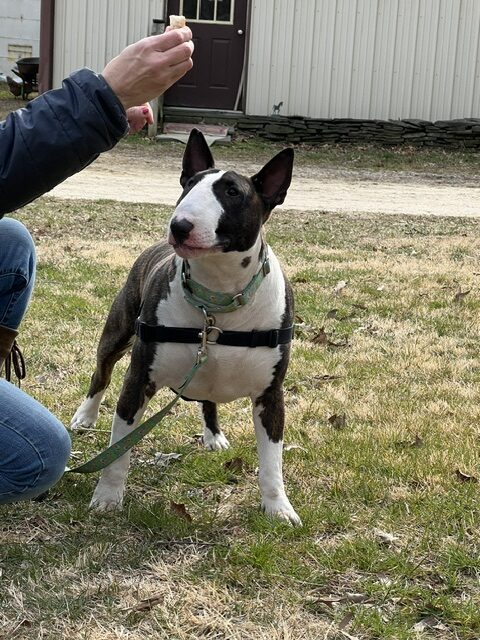
When teaching a dog or puppy to walk nicely, many believe that purchasing a harness will give them either more control or will stop the pulling altogether. However, neither thought is exactly true.
It’s important to know that there is only one type of harness that is truly a no-pull harness, and that any other harness is designed to alleviate any pressure the puppy or dog might be putting on their necks. The latter harness will still allow your dog to pull and will require the same training effort as a collar does. This type of harness is the one designed so that a dog steps into the leg holes with the fabric, then goes in between the front legs and then under the belly. The top will go over the head, and it is then fastened by being clipped in between the shoulder blades, with the leash being clipped onto the back. These harnesses do not stop pulling by design, nor do they give you more control. This harness is the type of harness used on sled dogs so that the power from the chest and shoulder movement is not restricted. Many owners of toy breeds opt to use this style of harness because they worry about hurting their dogs’ necks using a collar, but still report that the dog pulls.
The only harness that actually stops pulling is a no-pull harness that is designed so the fabric or front strap of the harness drops over the head and lies horizontally across the chest and shoulders. It has one strap that lies over the back, and one that goes under the belly, where it is secured, and the leash is connected to a ring in the center of the chest. This style of harness doesn’t actually stop pulling, only training does that, but what it does do is prevent the dog from fully striding out and using its full chest/shoulder power. When the dog is trying to pull, their motion is actually restricted, giving you the impression that they aren’t pulling. When using this harness, I also connect the leash to both the collar and the harness.
The decision to outfit a dog with a harness here at Four on the Floor is based on the dog and the owner’s skills, physical strength and coordination. I prefer to train every dog I work with on a martingale collar before adding a harness. Sometimes a big, strong dog that is very aware of their strength, or a small toy breed who simply isn’t getting it, needs the harness as a training aid to prevent injury to the owners who can get pulled over by a big dog or to prevent injury to a toy breed who has a delicate neck. In either situation, the goal is to train away from the harness and simply use a collar.
Whichever harness you personally opt for, it is important that the dog, and especially a puppy, not wear the harness 24 hours a day, as doing so can cause your puppy’s ligaments and bones to grow at incorrect angles. Any harness is not meant to be substituted as a collar and worn all day. They are only to be used when walking and should be fitted so that they are snug but not rubbing against the dog’s skin.
I personally try to avoid using harnesses if possible and focus on addressing the root of the problem when teaching leash walking. However, if you feel a harness helps you walk your dog better, I am all for it. Just make sure you have it fit correctly and ensure that you take it off when not walking them.
Heidi Clayton started Four On the Floor Dog Training to provide positive, reward-based dog training in South Jersey. She breeds, trains and shows bull terriers under the SoraBully’s Bull Terriers kennel name. Email questions to heidi@fouronthefloordogtraining.net or learn more at https://fouronthefloordogtraining.net