Life is What Happens
Last Thursday I found myself sitting in a chair that read, “Humans Sit Here,” in an exam room at Ventnor Veterinary Office.
But there was no dog with me.
“Am I your first human patient?” I asked Dr. Jessica Grant.
“Not at all,” she said gently. “You’d be surprised.”
Dr. Grant squeezed me in between a terrier and a border collie, listening patiently as I replayed Eddie’s last days and calmly helped me understand what my heart still resisted: that after 18 years, 3 months and 8 days, Eddie’s time had come.
By the end, our little Maltese was blind, nearly deaf, wore double diapers and needed round-the-clock care. Still, like so many families with senior dogs, we kept moving the line further.
One more week. One more good day. One more walk tucked into my backpack to the middle of the Dorset Avenue Bridge where pedestrians heading toward Ventnor Heights stopped to greet Eddie along the way.
Four days earlier, on Mother’s Day, my family and I decided to put Eddie down – not at our regular vet, but at an animal hospital open on weekends, in what was, thankfully, a comfortable room with a small couch meant to keep families and their dog close at such a moment.
Our family had been grappling with the decision. For years I would call our vet, identifying myself simply as “Eddie’s Mom.” On Mother’s Day, I needed to be his mom one last time, in the hardest way imaginable.
It was a beautiful spring day at the shore. Dogs and their families were at the beach, on the boardwalk – anywhere but here. The animal hospital in Northfield was empty; no one wanted to be in a vet hospital on Mother’s Day, but our “fourth child” needed us.
We were never supposed to become dog people. I grew up in a hamster, canary, boxer-turtle, one-cat-as-a-teenager kind of family. Even in the early years of my adult family and pre-Eddie, a pet fish salesman informed us he didn’t think we could “handle saltwater fish.” All my kids wanted was Nemo the clownfish.
To achieve her dream of having a dog, our daughter, Talia, wore us down slowly when she was a pre-teen. The final push came when Aunt Sherry and Uncle Jeff bought her a mechanical dog that “breathed” with an unmistakable battery sound. It was close to the real thing – but not close enough.
As Talia later wrote, “First I asked for a dog, then I begged for one, and then I just couldn’t take ‘no’ for an answer.”
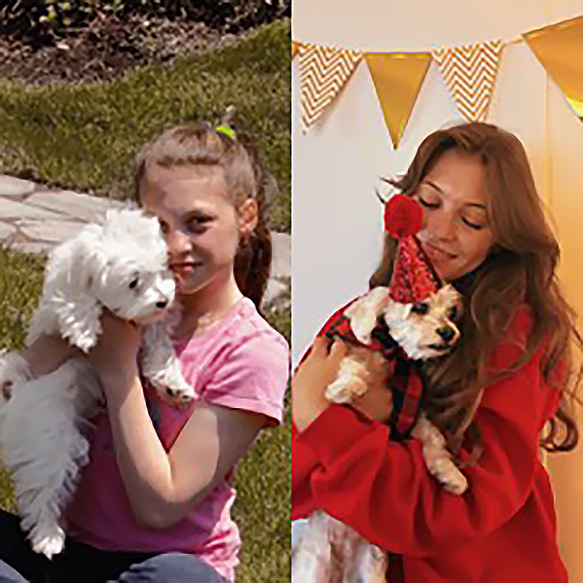
Finally, in 2008, Eddie the pup came home with us on Talia’s 12th birthday – she married last month at 29.
We were told he was the runt of the litter, which became a family joke when Eddie outlived every sibling and neighborhood dog, quietly beating the odds his entire life.
From week one, pet insurance denied coverage for Eddie’s floating testicle, calling it a preexisting condition. Years later, when he developed congestive heart failure, they refused again – hereditary, they said.

“I knew his parents,” I told them. “Roxy and Mojo were the pictures of health.”
By then, Eddie had become woven into the fabric of our family history. In our annual holiday letters, we wrote about him almost like another child in the house. And honestly, he was.
Over time, Eddie stopped being the children’s dog and became everybody’s dog. He comforted us at the foot of our beds when we were sick – or sick of life’s challenges – survived road trips, college visits, first apartments, random hotel rooms and countless mouthfuls of Jersey Shore sand – and even had a “bark mitzvah,” complete with a video and greetings from his canine friends.
Part of Eddie’s longevity, I’m convinced, was that he was never in a kennel. Instead, he had loving “godparents” – Deb, Nicea, Amy and Anne and their partners – who watched him when we traveled.
My son Brett, who originally declared he would “not be taking care of the dog,” developed strict rules about coexisting with Eddie. He had us buy him a high bed so Eddie couldn’t jump on or off it. After Eddie died, Brett admitted that whenever we weren’t home, Eddie would scratch at his bedroom door until Brett would relent, break his own rule and let him in anyway. Life’s compromises.
Toward the end, our home became part preschool, part nursing home. After presenting us with a human-sized bill, Eddie’s cardiologist smiled and said, “Email me anytime.”
At nearly 18, Eddie rejected kibble and canned food in favor of homemade chicken and rice over pumpkin puree with a dusting of ginger. He took heart medication twice a day – one prescription delivered monthly to our door – and beat the cough that comes with congestive heart failure. He didn’t sleep through the night anymore, so my husband and I took shifts, the way exhausted parents care for a newborn.
This past February, in a letter I wrote for his 18th birthday, I thanked Eddie for introducing me to a world I might have never known – the love of a dog. I also thanked him for teaching me how to find the most comfortable spot in any room, be it a couch, a pillow, or the last pile of clothes on moving day. He taught me how to “chillax,” an area in which I don’t exactly excel. Turns out, I needed that.
By the time Eddie died, my kids were grown men and women. Our youngest, Alana, was only 8 when we got Eddie and barely remembers life without him. They had a kiss-and-lick routine reserved just for her.
Eddie lived long enough to know one husband, one fiancé and one almost-the-one.
Talia was on her honeymoon safari in South Africa during Eddie’s last days, texting us photos of gorillas, elephants, giraffes and lions, while we were texting her updates on her dog.
“As I meet new animals along the way, I’ll see Eddie in all of them now,” she wrote.
We had lived longer with Eddie than with any of our three children. That realization undid me.
The first day we held Eddie, my kids were little. The last day we held him, they weren’t. Maybe that’s why losing him feels less like losing a pet and more like saying goodbye to multiple chapters of family life.
Eddie’s bed still sits by the fireplace, a Mother’s Day balloon floating above it. My husband always called it Eddie’s “comfy couch.” I can’t bring myself to move it – the alternative is a stark, cold tile floor.
For 18 years Eddie threaded himself through every version of our family – which is probably why I found myself weeping in a veterinarian’s office in a chair reserved for humans, feeling guilty for grieving him so deeply.
“It’s a relationship,” Dr. Grant said. “Your heart doesn’t differentiate between species.”
I reminded myself that only 8% of dogs ever make it past 15. Eddie made it to 18 – 95 in human years. We didn’t just have a dog; we had two dog lives in one.
Having a senior dog is like having a child who never leaves home.
Dr. Grant nodded. “One hundred percent,” she said. “Your kids grew up and out. Eddie stayed dependent and close – from the time he was 9 weeks old until the day he was 95.”
Walking out of the Ventnor Veterinary Office, I noticed a small, white dog in the passenger window of a car stopped at a red light. He looked just like Eddie. I motioned for the older couple to roll down the window.
I told them my story, and they told me their dog was supposed to be 4, but they think he’s 2, and he’s a handful.
The light changed. I smiled.
I knew that story – the all-consuming beginning of caring for and loving a dog. As memories of Eddie settle into our past, somewhere in Ventnor, another family’s story is just beginning.
Lisa is an advertising copywriter (think ‘Madmen’ without the men), journalist and columnist. Claim to fame: Lou’s waitress for four teenage summers. For column comments, story ideas, or to get on her “quote” list for future columns: redshoeslzs@gmail.com