
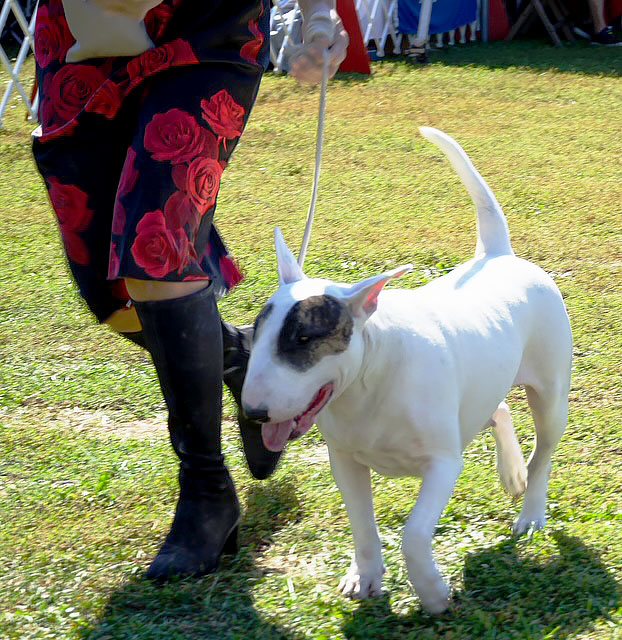
Starting leash-walking training with your puppy early will help you manage one of the biggest complaints I receive about walking: pulling. Training a puppy to walk nicely on a leash is like a puzzle where you can only add one piece at a time, so breaking down the process into steps will help both you and your puppy.
The first piece to the puzzle you have hopefully worked on is cementing the automatic check-in from your puppy when on leash out in the world. From there, I graduate my puppy to their placement in regards to where I want them when with me on leash, and I begin to add movement.
Being tethered to a human is not exactly natural to a dog. Normally, we walk much slower than the average dog, which is why pulling starts. When owners take tiny puppies on walks, they usually allow the puppy to be at the very end of the leash out in front of them. The puppy may be strutting along nicely enough, but is usually paying zero attention to the owner behind them. When they are tiny puppies, they are fairly easy to keep pace with. Pulling starts when they have a growth spurt, and when they have a little muscle and weight behind them. After that, they are able to pull you when they get to the end of the leash. Since you have let them always walk out in front of you and have ignored it, they have now put you on the “pay no mind” list. Your struggle to get them not to pull increases, because now you are also struggling for their attention.
The first rule of stopping pulling is to never get frustrated and start to pull back, yelling, “no pulling!” When you are yelling, “no pulling,” and the puppy is in fact still pulling, you have given the opposite meaning to the command of “no pulling.” To make “no pulling” mean what it actually means, you must first show the puppy what the command is by rewarding them when they are not pulling you with praise, by saying “good no pulling!” I like to put my puppies on leashes and walk back and forth across the yard, both praising them and giving them a treat when they are not pulling me. When they do start to pull me, I will either change directions or stop moving. I also keep the leash short and reward them when they are next to my leg, not out ahead of me. Don’t worry, they will later be allowed to do that as they mature, but not when they are baby puppies.
Another rule is to keep your arm and hand loose, kind of dangling at your side. I have noticed that when a puppy starts to pull, the human responds by holding the leash tighter and tighter and also raising their arms higher and higher, essentially playing a game of tug of war with the puppy. Since they have a lower center of gravity, you will lose. This is a game you’re going to lose, so it is best not to play it at all. When a puppy throws what I can only call a hissy fit and wants to pull you, remember to stay relaxed. Either stop moving, or change directions. However, if it is a prolonged hissy fit, lower the bar entirely: Wait for them to settle, and look for that automatic check-in look, even if that look is a dirty look. When they have settled and checked in, try to begin walking again, remembering to reward them heavily for getting it right.
Pulling is going to happen, but if you are consistent with your rewards and praise, and remember to stay very connected with your puppy out in the world, the pieces of the puzzle will come together in no time.
If you have any questions, please feel free to email: heidi@fouronthefloordogtraining.net.
Heidi Clayton started Four On the Floor Dog Training to provide positive, reward-based dog training in South Jersey. She breeds, trains and shows bull terriers under the SoraBully’s Bull Terriers kennel name. Email questions to heidi@fouronthefloordogtraining.net or learn more at https://fouronthefloordogtraining.net