After years of planning and securing funding, construction is underway on the Ocean City Housing Authority’s (OCHA) Pecks Beach Village Affordable Housing Project. Aimed at expanding and modernizing affordable housing, the project will replace deteriorating units while adding new homes for local families.
The effort traces back in part to the impact of Hurricane Sandy, which flooded older garden-style apartments at the north end of the property. That damage accelerated long-term plans to reinvest in the site.
Ron Miller, OCHA executive director, said that led the housing authority to develop Speitel Commons, which opened in 2021, allowing officials to relocate residents and free up land for the next phase of redevelopment without forcing families off the island.
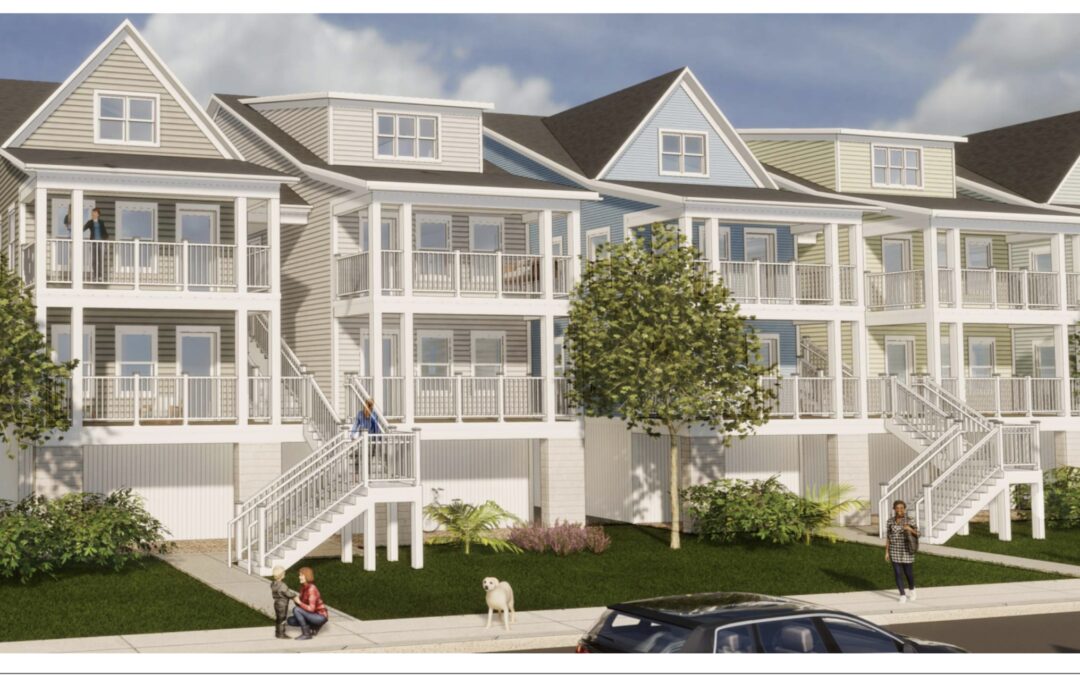
The current project will replace 40 existing units while adding 20 more, bringing the total to 60 apartments. The new buildings will be elevated to address past flooding concerns and designed to blend seamlessly into the surrounding neighborhood.
“They’re essentially like quadplexes, but they’re going to resemble a duplex. They’ll blend right into the neighborhood,” said Miller.
Funding for the project is coming from a combination of tax credits, state support through the New Jersey Housing and Mortgage Finance Agency, contributions from the city and private banking partners.
Miller said it took seven years to secure funding, after which the OCHA awarded a $23 million contract to Gary F. Gardner Inc.
Construction is expected to take about 18 months, with occupancy projected for 2027 or early 2028.
The need for affordable housing in Ocean City remains significant, as rising home prices continue to limit options for low- and moderate-income families. Eligibility for the new units will be capped at households earning below 60% of the area median income.
Beyond local demand, the project also helps Ocean City meet its state-mandated affordable housing obligations under the Mount Laurel doctrine, which requires municipalities to provide a fair share of affordable housing.
While Hurricane Sandy played a role in accelerating the timeline, Miller said redevelopment was inevitable due to the age of the buildings, which date back to the 1960s and have become increasingly difficult to maintain.
“The mission of the housing authority is to provide safe, suitable, sanitary housing to its tenants,” he said. “We would have pursued this regardless of Hurricane Sandy, because [the complex] also stands out in the neighborhood as a public housing site — and that’s not what we’re about. We’re about integrating into the community and becoming part of the community. Just because you have to live in affordable housing doesn’t mean that you have to live in a different style of housing than anybody else.”
The housing authority hopes for a second phase of development, which is under discussion with the city, though that will depend on future funding.
Ultimately, Miller said the project is about improving quality of life for residents and the surrounding neighborhood.
“We’re looking forward to the property opening. I think it’s going to be great for the community and the tenants,” he said.