
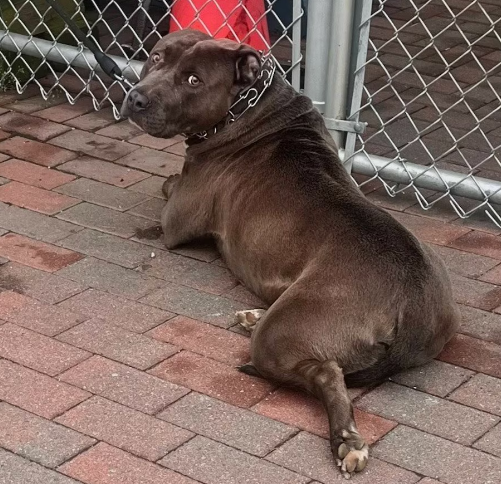
When Humane Society of Atlantic County staff arrived at work on May 26, they found a pit bull tied to a fence outside the shelter.
The dog, later identified as Blue, had reportedly been left there around 10:15 p.m. the night before and remained outside until employees arrived around 8 a.m., according to Executive Director Steven Dash.
Surveillance footage showed the dog’s owner parked at a local gas station along Absecon Boulevard before walking the animal to the shelter and tying him to a fence. The woman then fled the scene.
“When we came in, the dog was scared and was trying to bite,” Dash said. “We got the dog calmed down and inside the fence, and then we saw that the dog was having a difficult time urinating.”
Because the shelter’s veterinarian was not on site that day, staff contacted Atlantic City police and animal control. Blue was transported to the Atlantic County Animal Shelter, where he received medical treatment.
The Atlantic City Police Department reported that the unnamed woman was charged with animal abandonment, cruelty to animals, failure to provide necessary care for an animal, and theft of services because the animal rescue center charges $150 to drop off dogs.
On June 3, the woman was allowed to reclaim Blue, despite the criminal charges against her.
Blue was not the only abandoned animal the Humane Society encountered that week. According to Dash, three other animals — a cat, a ferret and a kitten — were also abandoned at the shelter in separate incidents.
One person left a cat outside before the shelter opened. Another dropped off a boxed ferret while the shelter was open and drove away. In another case, someone allegedly parked nearby and tossed a kitten over the fence.
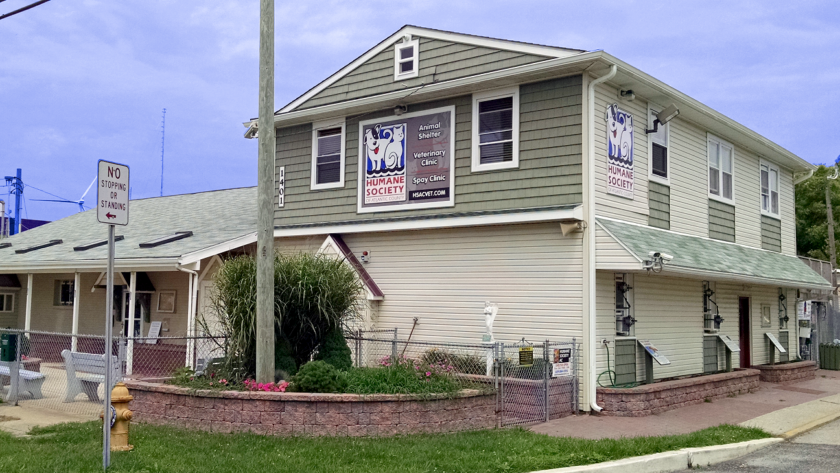
Ferrets are a rare site at animal rescues, but were popular in the 1980s and 1990s. Since the Humane Society of Atlantic County is not equipped to house ferrets, the animal was transferred to a specialized animal welfare organization.
The incidents highlight a growing challenge facing animal shelters throughout South Jersey and across the country. Shelters are struggling to keep pace with the number of pets needing homes while dealing with limited kennel space, rising veterinary costs and a seasonal influx of kittens.
“We’re getting 10 or more calls a day to take dogs and cats in,” Dash said. “Now it’s kitten season, so we’re getting all the kitten calls. The county shelter is the same. The rescue groups are the same.”
Many owners seeking to surrender pets cite housing changes, financial hardship or veterinary expenses as reasons they can no longer keep their animals.
“A lot of what we’re seeing is, ‘I have to leave my apartment tomorrow and I can’t take this animal with me,” he said. “People always know they need to move for quite a while in advance. People have to put the work into finding a place for those animals.”
How to properly rehome a pet
Dash said abandoning an animal outside a shelter is never the answer.
Besides being illegal, abandonment can place animals at risk from weather, injury, stress and untreated medical conditions. In Blue’s case, staff quickly realized the dog required veterinary attention, but veterinary staff were not on site at that time.
At the Humane Society of Atlantic County, owners are asked to complete a surrender application through the shelter’s website. Staff review each application and contact owners when space becomes available.
“It’s a process,” Dash said. “If people are willing to work with the process, we’re happy to work with people.”
That process may take time. Dash recently worked with a family that submitted an application and waited several weeks until kennel space became available. The dog was eventually accepted into the shelter, spayed and prepared for adoption.
The challenge, Dash said, is that shelters often remain full.
The Humane Society’s 14 kennel runs are typically occupied, making it impossible to accommodate every surrender request immediately. Meanwhile, veterinary costs have climbed significantly since the pandemic, increasing financial pressures for both pet owners and shelters.
When animals arrive without any information, the burden becomes even greater.
“When we get these animals abandoned, we don’t know their name, their age, their medical history,” Dash said. “We have to start from fresh, and that is never easy.”
How the public can help
While surrender requests continue to rise, adoptions have not kept pace.
Dash said many prospective pet owners are obtaining animals through breeders rather than adopting from shelters, leaving many adoptable dogs and cats waiting longer for homes.
Dash pointed to the sharp increase in hybrid breeds, like doodles or long-haired French bulldogs. These kinds of animals cannot exist without a human orchestrating the breeding process.
“The only way shelters are going to catch up is if more people go to shelters to adopt,” he said.
For residents who are unable to adopt, donations remain critical. Dash said surrender fees cover only a fraction of the shelter’s operating expenses, leaving organizations heavily dependent on community support.
In needy cases, the humane society waives the surrender fee, and in all cases, necessary veterinary care costs are covered solely by the rescue organization.
Dash emphasized the importance of surrendering an animal the right way. He noted that the Humane Society of Atlantic County is equipped with high-level security equipment, so dumping a pet will almost always lead to charges.
For shelter workers, the goal is not to shame owners facing difficult circumstances. Rather, it’s to encourage people to seek help before a situation becomes desperate.
“There are times when people genuinely have nowhere to turn,” Dash said. “We’ll do what we can. But leaving an animal in the middle of the night is not the way to do it.”
As shelters continue to navigate overcrowding and limited resources, animal welfare advocates hope cases like Blue’s will serve as a reminder that help is available — but owners must be willing to ask for it.
For more information on Humane Society of Atlantic County, including rehoming forms and donation requests, visit https://humanesocietyac.org/.