A building that once helped produce one of Atlantic City’s most famous souvenirs could soon become a new hub for artists, residents and visitors on the Boardwalk.
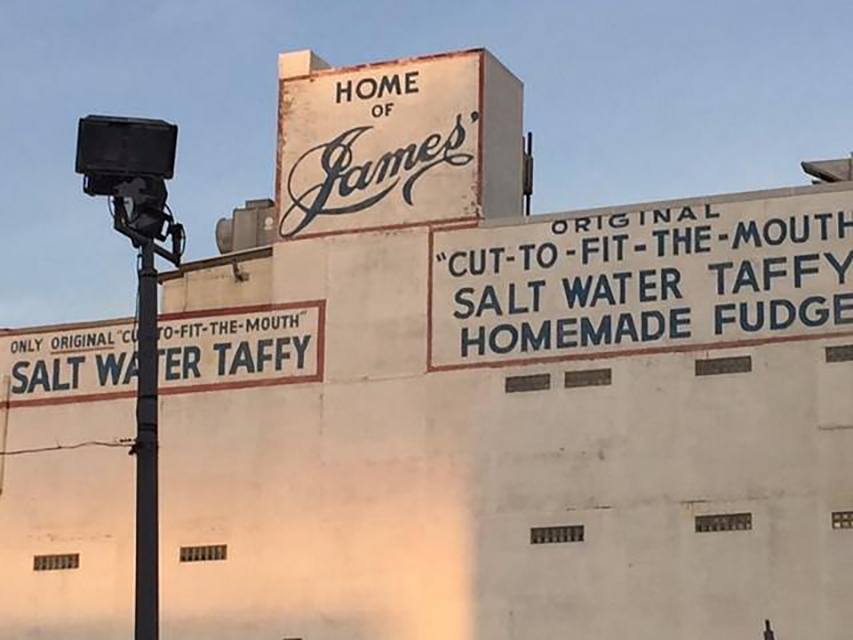
The former James Candy Company property at 1519 Boardwalk is slated for an approximately $20 million redevelopment into Taffy Lofts, a mixed-use project envisioned as a place where artists can live, work and display their creations.
Plans for the historic property include artist studios, gallery space, a coffee shop and live-work loft apartments, giving new purpose to a building deeply connected to Atlantic City’s salt water taffy tradition.
Developer Pat Fasano is behind the project, which would preserve the historic structure while adapting it for a new generation of uses.
The proposal continues a wave of investment around Atlantic City’s Orange Loop and Boardwalk area, where vacant and underused properties have increasingly been targeted for restaurants, arts spaces, entertainment and residential development.
The building was once home to the James Candy Company, one of the businesses that turned salt water taffy from a local Boardwalk treat into an enduring symbol of Atlantic City.
Official site plans filed with the Casino Reinvestment Development Authority identify the project as “Taffy Lofts” and call for the adaptive reuse of the former James Candy property. Earlier plans for the site contemplated hospitality, restaurant and other mixed-use components, showing that redevelopment of the property has been in the works for several years.
Arts foundation already helped reimagine the space
The transformation from candy factory to creative hub has, in some ways, already begun.
In 2023, the Atlantic City Arts Foundation selected the former James Candy building for the 10th installment of ARTeriors, its signature program in which artists temporarily transform vacant or transitional properties into immersive art installations.
More than 25 artists took over the former candy company building for ARTeriors at The James, creating installations inspired by the structure, its history and one another. The foundation described the exhibition as an opportunity to showcase both Atlantic City’s artistic community and the possibilities for buildings awaiting redevelopment.
The monthlong project attracted hundreds of visitors to receptions, exhibits and other activities, according to the Arts Foundation.
Many of the installations deliberately played with the building’s sugary past, bearing names including “The Candy Parlor,” “Garden of Sugary Delights,” “Sweet Mementos” and “No Bitter Without The Sweet; No Sweet Without The Bitter.”
When the exhibition opened in November 2023, then-Executive Director Kate O’Malley described its return to the Orange Loop as significant because of the neighborhood’s growing identity as an arts and cultural district.
That temporary experiment now feels particularly relevant to the Taffy Lofts concept.
ARTeriors is specifically designed around buildings that are “in transition,” allowing artists to demonstrate how otherwise dormant properties can be activated through creative uses. The James exhibition effectively gave visitors an early glimpse of how the former factory could function as an arts destination before permanent redevelopment began.
The Arts Foundation had used a similar model elsewhere in the Orange Loop. Its first ARTeriors exhibition was held in 2015 at 121 S. Tennessee Ave., when that portion of Atlantic City was only beginning its redevelopment. The building later became MADE Atlantic City Chocolate and subsequently Bar 32.
An investment in an Atlantic City landmark
The Taffy Lofts project is expected to represent an investment of approximately $20 million, with plans centered on creating a multi-use artistic community rather than simply renovating the former factory for a single commercial tenant.
Artist studios and gallery areas would make parts of the property accessible to the creative community and the public, while live-work residences would give artists the ability to both create and reside in the same complex. A coffee shop would add another public-facing component to the development.
The concept also fits into a broader effort to establish more year-round activity beyond Atlantic City’s casinos and major tourism attractions.
An exact opening date remains dependent on construction and redevelopment progress. Earlier planning documents demonstrate that proposals for the site have evolved over time, making projected completion dates subject to change as the final version of the redevelopment advances.
More than a century of taffy history
Although Taffy Lofts is focused on what comes next, the project’s identity remains closely tied to what came before it.
Salt water taffy became associated with Atlantic City during the late 19th century, when the young resort was drawing growing numbers of visitors to its Boardwalk.
The Atlantic City Arts Foundation traces the James Candy site’s candy-making history to 1880, describing the former company as a landmark in the development of the confection.
One of the best-known stories surrounding salt water taffy involves an Atlantic City candy merchant whose stock was supposedly soaked by ocean water during a storm. When a customer later asked about the candy, the shopkeeper reportedly joked that he had “salt water taffy.” The precise origins of the term have become part of Boardwalk folklore, but Atlantic City became firmly associated with the chewy confection by the late 1800s.
Candy makers including Joseph Fralinger and Enoch James helped turn taffy into a tourism industry. Fralinger famously packaged pieces into boxes that travelers could bring home as souvenirs, while James developed his own taffy recipes and production techniques.
The candy even attracted celebrity customers. According to a history of the company, Frank Sinatra once placed an order for hundreds of pounds of taffy while performing in Atlantic City during the casino era.
From old to new
For generations, colorful boxes of taffy became almost as synonymous with an Atlantic City vacation as the Boardwalk itself.
The former James property therefore offers something increasingly rare in a city that has repeatedly reinvented itself: a physical connection between Atlantic City’s earliest tourism era and its next one.
If the Taffy Lofts project comes to fruition, the machines that once pulled strands of candy may be gone, but creativity would again be produced inside the walls of the old James building.
Only this time, instead of boxes of salt water taffy leaving the Boardwalk, the finished products may be paintings, sculptures and other works from Atlantic City artists.