
Drink Up!
By David Setley
It probably won’t shock you that California is the number one wine-producing state in the US, with current statistics reporting that the Golden State produces as much as 84% of our nation’s wine. The number two state is New York, with approximately a 4% stake. That leaves the states of the Pacific Northwest coming in at third and fourth, with Washington state (number 3), producing about 50% more wine than Oregon (number 4).
My wife and I visited a wine bar at Pike Place in Seattle last year, during which the waiter was quick to exclaim that Washington produces more wine than Oregon. It is clearly a state point of pride! Yet, Oregon tends to be more recognized, likely because of its Pinot Noir. While Washington’s most produced wines are Cabernet and Chardonnay, those two varietals are more famous from California, especially after the 1976 Judgement of Paris in which California outscored France in a blind tasting on those wines. Though California also produces Pinot Noir, the Oregon wines have characteristics more similar to wines from Burgundy, France, where Pinot Noir originated. California’s climate is significantly warmer, resulting in a riper, fuller-bodied, more fruit-forward version. Let’s take a deeper look at wines from Washington and Oregon.
Evidence shows that vines were first planted in Washington by members of the Hudson Bay Trading Company in 1825. These vines were likely Vitis labrusca, a native North American vine, rather than Vitis vinifera, the European grape vine that almost all wine is made from today. Vitis vinifera arrived in the 1870s when Italian and German immigrants planted vines in the Yakima Valley and Walla Walla areas of the state. However, commercial production of wine didn’t begin until after Prohibition was repealed in 1933.
Chateau St. Michelle has become Washington’s leader in Riesling. The Chateau St. Michelle Columbia Valley Harvest Select Sweet Riesling is an elegant wine for those who enjoy something a little sweeter. Columbia Crest Grand Estates Cabernet Sauvignon is a good example of a Washington state Cab; rich, full-bodied, with dark fruit flavors complemented by notes of chocolate and vanilla. Of course, one of the most widely known wineries in Washington is 14 Hands, easily recognized by the horse on the label. You can find 14 Hands Wine in Cabernet Sauvignon, Chardonnay, Merlot and my favorite, the Hot to Trot Red Blend. The winery blends 40% Cabernet Sauvignon, 37% Merlot, 19% Syrah, 2% Cabernet Franc & 2% Petit Verdot to create this fruit-forward, smooth, flavorful wine.
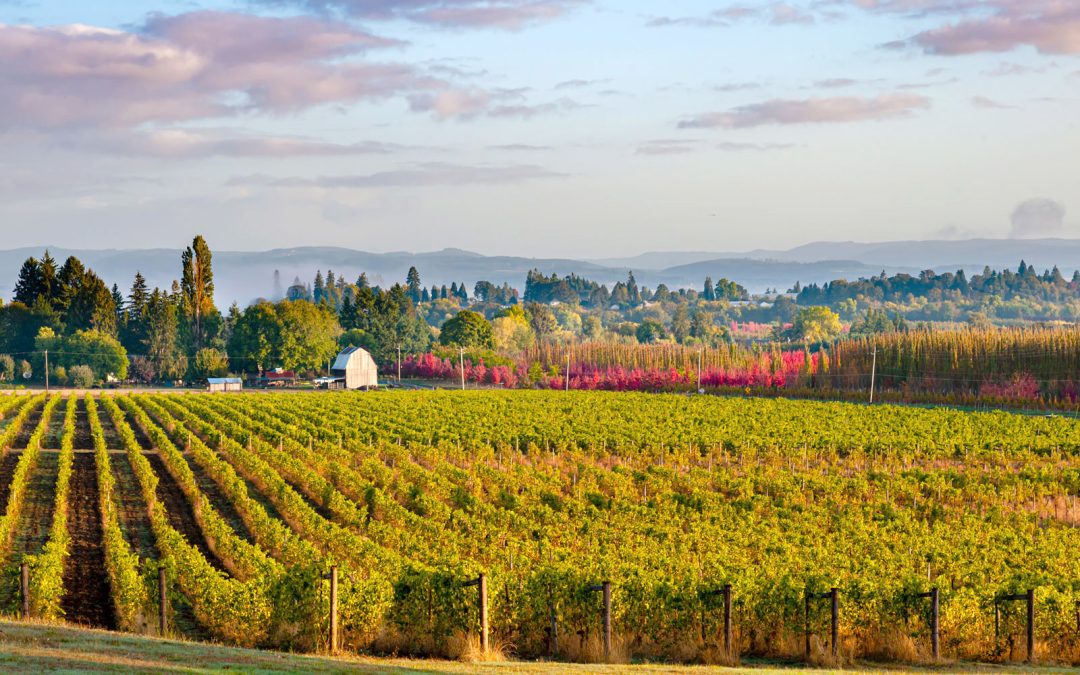
Like Washington, Oregon started making wine in the 1840s when pioneers on the Oregon Trail brought clippings of indigenous North American varietals to the state. Commercial vineyards were established in the Willamette Valley in the 1850s. Pinot Noir wasn’t planted until the 1960s, well after Prohibition. Richard Sommer is credited as the Father of Oregon Pinot Noir.
Pinot Noir from Oregon entered the world stage in 1979 at a blind tasting hosted in Paris by Gault-Millau. A Willamette Valley Pinot Noir, produced by David Lett at Eyrie Vineyards, finished in the top 10 against top-tier Burgundy Pinot Noirs. Due to the impact of his wine at the tasting, David Lett is known as Papa Pinot. Success breeds success! The 1980s were a period of investment and expansion in Oregon, especially the Willamette Valley.
There are countless fabulous Pinot Noirs from Oregon to choose from. The varietal is a translucent pale ruby red color with fruit notes of cranberry, fresh red cherry, raspberry, and strawberry with hints of baking spice, cinnamon, and vanilla. The earthy notes can best be described as forest floor, damp earth, or mushroom, with subtle floral or herbal hints. While very similar to Burgundian Pinot Noir, the Oregon wines tend to be slightly more fruit-forward and slightly less earthy and acidic.
For a Pinot that is true to its name, try L’Umami Pinot Noir. The umami (forest floor and mushroom) aromas of the wine are dominant. Or, a go-to Pinot Noir for many is from A to Z Wineworks, established in 2002. A to Z was the first Oregon Winery to join the International Wineries for Climate Change (IWCA), committing to strict greenhouse gas reductions. Their wine is well-balanced and very food-friendly.
Montinore Estate is one of the largest producers of certified estate wines made from biodynamic grapes in the United States. I covered the biodynamic concept in an article last month, but suffice it to say that these wines are made with strict organic standards. Borealis Pinot Noir is a very reasonably priced example of Montinore’s quality. Or, the Montinore “Red Cap” Pinot Noir is classic with wonderful bright red fruit flavors balanced with forest floor and a light minerality.
Brianne Day is a leader in the next generation of Oregon winemakers. The Day Winery in Willamette Valley has gained the attention of the wine world through its minimal intervention approach to winemaking using organic grapes, wild native yeast, whole-cluster fermentation, and minimal sulfites. Bellande Pinot Noir is one of Brianne’s projects. Minimal intervention allows the grapes to tell the unadulterated story of this wine. My top Oregon Pinot Noir recommendation is the Day Johan Vineyard Pinot Noir. This is Brianne’s outstanding example of the elegance and purity of Oregon Pinot Noir. She includes a dedication on the label, saying “This wine was created naturally with consideration and respect for the planet, for people who love and tended to it and for those who will enjoy drinking it.” Cheers!
I urge you to try some of these Pacific Northwest wines. As always, if you have questions or comments, stop in the Somers Point store or contact me at dsetley@passionvines.com. Until next time, happy fall, y’all, and happy wining!
David Setley is enjoying his retirement from higher education as a wine educator and certified sommelier at Passion Vines in Somers Point, New Jersey.