For generations, amusement parks have been woven into the identity of South Jersey.
They are where teenagers get their first summer jobs, including where my sister and I entered the job market. At sixteen years old, we donned our bow ties, watching over children under the giant Wonderland Castle marquee.
It’s where parents take children on the same rides they remember from childhood and where the glow of a Ferris wheel becomes as recognizable as the skyline itself. It shapes the Jersey Shore experience, becoming as iconic as the sandy beaches themselves.
Around here, amusement parks have never just been tourist attractions. They are landmarks.
That makes the past few years difficult to ignore.
Gillian’s Wonderland Pier ended nearly 60 years of amusements on the Ocean City Boardwalk in 2024 after operator Jay Gillian said the business was no longer financially viable. Now, even the park’s iconic 144-foot Ferris wheel is slated for demolition.
Property owner Eustace Mita said deteriorating conditions beneath the former amusement area have become a safety concern, eliminating earlier hopes that the wheel could remain as part of a future redevelopment.
Clementon Park & Splash World, which dates to 1907, has closed again after five seasons under its latest ownership and will be offered for sale. The Camden County park had previously shut down in 2019 before being purchased at auction for $2.3 million and reopening in 2021. Its current owners say they hope to find a buyer who will continue the park’s legacy.
And now Steel Pier — perhaps the most storied amusement property in South Jersey — is on the market for $85 million.
Steel Pier is not just another collection of rides. The Atlantic City landmark opened June 18, 1898, stretching roughly 1,000 feet over the ocean.
Over the decades, the pier became known as “The Showplace of the Nation” and hosted an extraordinary roster of performers, including Frank Sinatra, Louis Armstrong, Ella Fitzgerald, Bob Hope, The Rolling Stones and The Beach Boys.
Moreover, the legendary diving horses will always live on in history and memories.
Under owners Frank Gravatt and later George Hamid, Steel Pier became far more than an amusement park. Visitors could see concerts, movies, children’s shows, diving exhibitions, circus acts and technological displays. At one point, the pier promoted the idea that one admission price could provide an entire day of entertainment.
Today’s Steel Pier is a different operation, but the location remains synonymous with Atlantic City entertainment. That is what makes its listing so striking.
Wonderland. Clementon. Steel Pier. Three very different parks. Three reminders that an amusement park can feel permanent right up until it isn’t.
And what is happening in South Jersey is part of a much larger challenge facing regional amusement parks across the country. The question remains – are amusement parks dying? Or does South Jersey reject roller coasters?
The difficult economics of fun
Amusement parks are extraordinarily expensive businesses.
They require acres of land, complicated mechanical rides, insurance, utilities, maintenance crews and large seasonal workforces. Attractions must be continually repaired and eventually replaced. New rides can cost millions of dollars.
Unlike a restaurant or retail business that can operate every day of the year, many Northeastern amusement parks have only a few months to generate much of their annual revenue.
In a national analysis of the regional amusement industry, estimates show that developing a regional amusement park can cost roughly $400 million to $800 million.
Even keeping an existing park competitive requires enormous reinvestment. Its analysis found Six Flags historically spent more than $100 million annually on capital expenditures, representing roughly 30% to 50% of operating income in some years.
That means a park cannot simply build a roller coaster and collect ticket revenue indefinitely.
The rides themselves depreciate. Machinery wears out. Guests eventually want something new. Operators must constantly spend money simply to convince customers to come back.
There is another problem: the definition of an amusement park has changed. For much of the industry’s history, parks competed largely on rides. Who had the tallest roller coaster? Who had the newest thrill?
Modern MBA argues that Disney and Universal fundamentally changed that competition by shifting the emphasis toward intellectual property and immersive experiences. Guests no longer simply visit to ride a coaster. They enter Harry Potter’s world, walk through Star Wars settings or interact with Nintendo characters they already know.
Regional parks generally remain significantly cheaper and closer to home, yet millions of consumers are still willing to spend considerably more to travel to major destination parks.
That presents an uncomfortable question for a regional operator: How many expensive new roller coasters can you build before another slightly faster or taller ride stops being enough?
Six Flags offers a warning
Six Flags provides perhaps the clearest national example of how difficult the regional park business has become.
The company expanded aggressively in the late 1990s, taking on more than $2 billion in debt. It eventually entered bankruptcy in 2009 before emerging through a restructuring the following year.
Its attendance also declined dramatically. According to Six Flags annual reports, attendance fell from approximately 47 million guests in 2001 to 21 million by 2010, though some of that decline occurred as the company sold parks from its portfolio.
Six Flags eventually found a way to bring people back: cheap season passes. Attendance climbed from about 21 million in 2010 to 33 million by 2019. Season-pass and membership holders eventually represented roughly 50% to 60% of attendance.
There was only one problem. Those guests weren’t necessarily spending much more money.
Between 2010 and 2019, average admission revenue per guest rose from roughly $21 to $25, while average spending on food and merchandise increased from around $16 to $18.
Six Flags Great Adventure in Jackson recently advertised an online single-day ticket for $45, half of its listed $90 gate price. An $89 promotional Gold Pass included access for the remainder of 2026 and all of 2027, free general parking and admission to East Coast parks including Dorney Park.
Dorney Park — an easy day trip from much of South Jersey — advertises the same East Coast access through its passes.
Those two parks are now part of the same company. Six Flags and Cedar Fair merged in 2024, bringing parks including Great Adventure, Dorney Park, Cedar Point and Kings Island under one corporate umbrella.
There are obvious advantages to that scale: shared marketing, purchasing power, broader season-pass networks and the ability to spread costs across many properties.
But the merger itself also speaks to how the regional amusement industry is changing.
Modern MBA’s analysis found that by 2022, Disney Parks, Universal and Cedar Fair had surpassed their 2019 theme-park earnings, while the former Six Flags operation remained below its pre-pandemic level.
The problem was never simply whether Americans still enjoyed roller coasters. The problem was finding a sustainable way to make money from them.
When the land becomes more valuable than the rides
That challenge becomes even sharper for independent amusement parks sitting on valuable property.
Steel Pier is not simply an amusement park. It is oceanfront Atlantic City real estate.
Wonderland Pier occupied prime Ocean City Boardwalk property.
Clementon Park occupies approximately 52 acres in Camden County.
Eventually, amusement owners and developers confront an uncomfortable calculation: Is the park worth more operating as a park, or is the property worth more used for something else?
A Tilt-A-Whirl depreciates in value. Land can become more valuable simply because of where it sits. That is a difficult competition for nostalgia to win.
It may also explain why communities have such emotional reactions when these properties change hands. To an investor, an amusement park can be acreage, zoning and redevelopment potential.
To the people who grew up around it, it is where their father took them after dinner, where they spent their first paycheck or where their own children rode their first roller coaster.
Both things can be true at once.
A hopeful counterpoint
There are also reasons to believe the local amusement park still has a future.
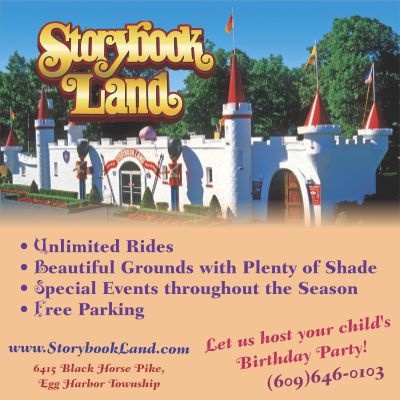
Playland’s Castaway Cove in Ocean City and Storybook Land in Egg Harbor Township remain strong examples of parks that continue to draw families by leaning into what makes them distinctive rather than trying to compete directly with massive destination resorts.
Castaway Cove, which has operated on the Ocean City Boardwalk for 65 years, has emerged as an especially important example following the closure of Wonderland Pier. The family-owned park continues to offer more than 30 rides, including the GaleForce roller coaster, along with go-karts and miniature golf.
Despite a devastating 2021 electrical fire that destroyed its arcade and iconic pirate ship, the park rebuilt and continued operating. In 2025, The Philadelphia Inquirer reported that Castaway Cove was consistently drawing crowds even as Wonderland struggled in its final years.
Its model also remains refreshingly traditional. Admission to the midway is free, families buy tickets for the rides they actually want to enjoy, and those tickets never expire. That makes it possible to stop by for a few rides after dinner without committing to an expensive full-day theme park experience.
Storybook Land offers a different lesson in longevity.
The Fricano family has owned and operated the Egg Harbor Township children’s park since 1955, and the park marked its 70th anniversary in 2025. Rather than chasing the biggest roller coasters, Storybook Land has stayed focused on young children and families, with 19 rides and dozens of attractions built around nursery rhymes and classic stories. It has also continued investing in the property, including the addition of the Cinderoller Coaster in 2025.
Storybook Land has also found ways to extend its season well beyond the traditional summer amusement calendar. The park operates from spring through December and builds major events around Easter, Halloween and its popular Christmas Fantasy with Lights. Season passes include admission to special-ticketed events, helping turn what could be a once-a-summer visit into a yearlong relationship with local families.
Neither Castaway Cove nor Storybook Land is trying to be Disney World. That may be part of their strength.
They offer something much simpler: a place close to home where children can ride their first coaster, parents can revisit traditions from their own childhoods and a family can spend a few hours together without planning an entire vacation around it.
Their continued success suggests that the future of the amusement park may not belong only to giant corporations and billion-dollar resorts. There may still be room for the smaller, deeply local park — provided it understands its audience, reinvests when necessary and gives families a reason to keep coming back.
In an industry filled with closures and uncertainty, Castaway Cove and Storybook Land are reminders that the midway is not dead.
So, do regional amusement parks have a future?
I think they do. But perhaps not in exactly the form we remember. The parks that survive may have to become more flexible.
Some will evolve toward destination resorts, incorporating hotels, water parks, restaurants, concerts and year-round events.
Others will rely heavily on Halloween, Christmas and other seasonal programming to stretch what was once a Memorial Day-to-Labor Day business into more months of the year.
Some smaller parks may survive precisely because they remain small. They may not need to compete with Disney or Universal if they can offer something different: affordability, convenience, history and the experience of a summer night spent riding a Ferris wheel near home.
Mixed-use development could also become part of the equation.
A hotel does not necessarily have to mean eliminating every amusement ride. Restaurants and entertainment venues could coexist with historic attractions. A smaller amusement footprint could potentially anchor a larger entertainment district.
In fact, the history of Steel Pier itself suggests that amusement parks have always had to evolve.
The original Steel Pier was never just rides. It offered music, theater, circus acts, movies, exhibitions and spectacles designed to keep guests entertained for hours.
George Hamid reportedly acknowledged years ago that operating Steel Pier exactly as it existed during its heyday would be cost-prohibitive today.
Perhaps that is the lesson: Preserving an amusement park may not mean freezing it in time.
It may mean finding a new business model that allows the carousel to keep turning.
What we lose when the lights go out
There is a reason the loss of Wonderland hurts differently than the closing of an ordinary business.
Generations of families crossed into Ocean City, saw that enormous Ferris wheel rising above the Boardwalk and knew they had arrived.
For me, I lost my first roller coaster, the ferris wheel where my date and I shared chocolate pretzels, and the monorail blue train where I welcomed families at my summer job.
Steel Pier carries that same kind of emotional weight in Atlantic City. These places function as communal memory.
And yet memory alone cannot pay employees, repair roller coasters, insure rides or finance multimillion-dollar investments.
That is the contradiction facing the amusement park industry.
We want these places to remain the same because their sameness is exactly what makes them comforting. But economically, remaining the same may be the fastest way for them to disappear.
For more than a century, amusement parks sold us a wonderful illusion: that some things never had to change.
The carousel would keep spinning. The coaster would climb the same hill. The Ferris wheel would illuminate the night every summer.
None of that necessarily means the midway is doomed. But its next generation may look different from the one we remember.
If communities, operators and developers can find ways to modernize these properties without stripping away everything that gave them their identity, regional amusement parks may still have a future.
Because when an amusement park disappears, we do not simply lose a collection of rides.
We lose a place where generations learned what summer felt like.