
There are many terms floated around in the dog training and behavior world that center around when a dog displays less-than-favorable behavior towards other dogs on a leash. Whether you label it as leash aggression, reactivity, or leash frustration is irrelevant, since how you fix or manage it will be just about the same.
Reasons dogs may act out on leashes include telling approaching dogs to stay away and reacting out of fear, wanting to meet other dogs and needing that instant gratification, and being over-aroused or over-stimulated. Regardless of the behavior’s cause, owners still have to learn how to manage and train their dog. Unless an owner can point to a specific incident in which their dog was attacked on a leash, you may never know why a dog becomes leash-reactive. So, as a dog trainer, I spend less time trying to find out what the behavior is stemming from and spend more time trying to manage it, including by helping dog owners learn to recognize the signs that their dog is about to react.
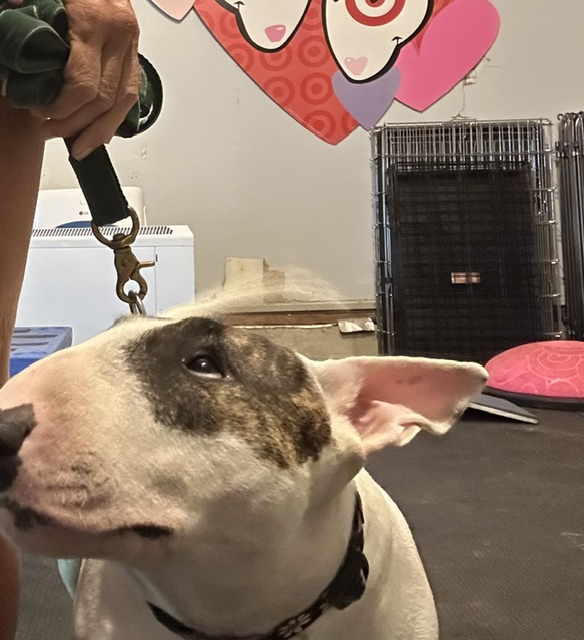
Let’s start with simple dog etiquette and basic rules that have served me well over the years. One basic rule is that you shouldn’t allow your dogs to think they are going to get to meet every single dog that they see. This was helpful at the Egg Harbor Township Nature Reserve recently when another dog there lunged at my dog, Kabuki. I was already telling Kabuki “leave it,” so she was not expecting to meet the other dog. Since she was a baby, I have rewarded her for paying attention to me in the presence of distractions. She is also used to me walking her on a short leash, where she is practically glued to my side. As a result, she does not pull against it whenever I shorten the leash. So whenever another dog approaches us, she is just hard-wired to look at me, and she is comfortable being pulled in to me.
Many owners of reactive dogs admit to feeling embarrassed or getting frustrated by their dogs’ over-the-top behavior. When you’re handling a reactive dog, you can not feel either of those emotions, since, when you do, the dog will also feel them. My advice to clients is not to walk their dog places where they will be forced to come into contact with other dogs on tight trails or paths if there is any chance you will tense up. Leash-handling skills when managing and training a reactive dog are a huge piece of the puzzle, so start with going back to the basics of teaching your dog to automatically check in with you without you asking them to. While staying silent, simply stand with your leashed dog where there are a few distractions. Then, reward them with a fantastic treat like chicken or steak whenever they lock eyes with you. Try to avoid exposing them to other dogs for the time being while you’re still working with them on mastering this skill.
While doing this, learn how to hold the leash correctly. The loop of the leash goes over your thumb. Also, instead of wrapping the leash around your hand or wrist, wrap it up inside your hand. It doesn’t matter which hand you use, but start practicing keeping your dog on a dedicated side and carrying the leash in that hand. It’s helpful to practice this at home. Gather the leash in your hand and start becoming aware of how tightly you’re gripping the leash. Notice whether you’re pulling on it or feeling tense.
Training a reactive dog is like building a foundation for a house. You need a strong foundation of automatic check-ins to reinforce that you’re a team. This foundation also includes holding the leash correctly, making sure your dog isn’t going rogue on you. When you 100% have those down, you can move on to the next step.
If you have any questions, please feel free to email me at heidi@fouronthefloordogtraining.net.
Heidi Clayton started Four On the Floor Dog Training to provide positive, reward-based dog training in South Jersey. She breeds, trains and shows bull terriers under the SoraBully’s Bull Terriers kennel name. Email questions to heidi@fouronthefloordogtraining.net or learn more at https://fouronthefloordogtraining.net