
By Sarah Fertsch
A different kind of beachgoer begins arriving along the coastline when the weather gets cold. With round, expressive eyes, whiskered faces and plump bodies perfectly suited for cold waters, seals are making their annual return to New Jersey.
The colder months bring opportunities to spot harbor seals, gray seals and even the occasional harp seal resting along beaches, rocky jetties and back bays.
Their arrival is a welcome reminder that New Jersey’s coastline is more than a summer playground. It is also an important seasonal habitat for marine wildlife.
But these charming winter visitors face dangers from human activity, particularly when well-meaning beachgoers approach too closely.
That’s where Brigantine’s Marine Mammal Stranding Center (MMSC) comes in. Since 1978, the nonprofit organization has worked to rescue, rehabilitate and release sick and injured marine mammals and sea turtles throughout New Jersey. As the state’s only federally authorized marine mammal stranding response and rehabilitation facility, its team covers approximately 1,800 miles of tidal coastline.
A tail-wagging tradition for a good cause
On Oct. 10, the Marine Mammal Stranding Center brought its sixth annual Pup Strut to Brigantine’s 16th Street beach, combining a celebration of dogs with an important lesson about protecting their ocean-dwelling counterparts.
The dog-friendly fundraiser invited families and their four-legged companions to participate in a beach walk supporting the center’s rescue and rehabilitation efforts.
The event featured music, pet-friendly vendors, educational exhibitors and opportunities to learn how dogs and their owners can safely share the shoreline with seals.
Registered pups were treated to goodie bags featuring bright green bandanas celebrating Cupid the Seal, along with MMSC dog tag necklaces. The center’s costumed mascot, Luseal, was also part of the festivities, offering photo opportunities for attendees.
Beyond the costumes and wagging tails, the Pup Strut’s message was particularly important as seal season approaches: Dogs and seals might both be adorable, but they should never meet nose-to-nose.
The gathering encouraged responsible pet ownership and reminded participants that keeping dogs leashed and away from resting seals can prevent dangerous encounters for both animals.
Embracing the arrival of seals
New Jersey’s seal season generally stretches from late fall into early spring, when the state’s colder, nutrient-rich waters provide feeding opportunities for marine mammals traveling along the Atlantic Coast.
Five seal species have been documented in New Jersey, although harbor, gray and harp seals are the most commonly encountered.
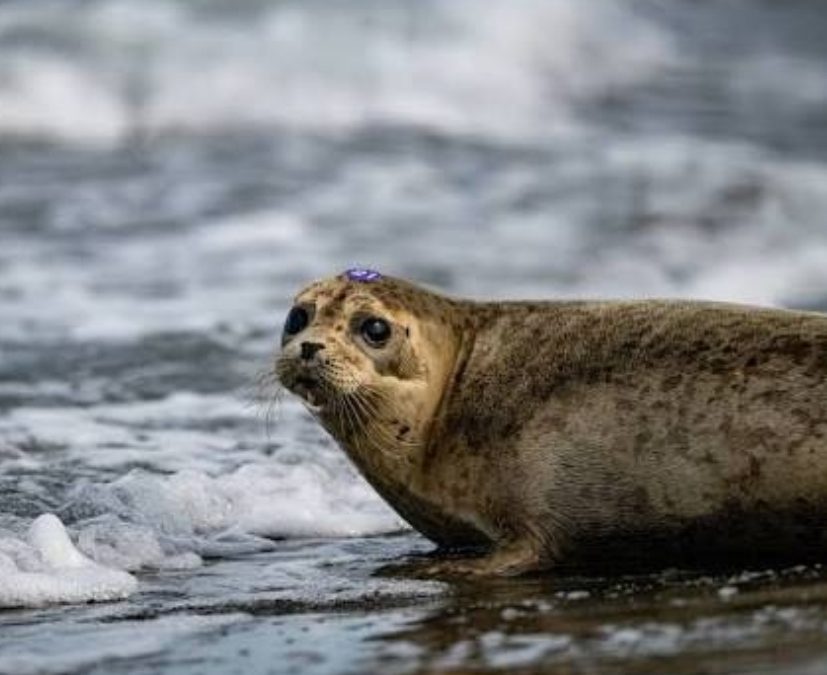
Harbor seals are especially recognizable for their rounded heads, spotted coats and large, dark eyes. Adults can grow to approximately six feet long and weigh more than 200 pounds. They feast on fish, shellfish and crustaceans and spend much of their lives swimming and hunting underwater.
Unlike dolphins, which must remain in the water, seals regularly come ashore. This behavior, known as hauling out, allows them to rest, regulate their body temperature and conserve energy.
A seal stretched across the sand might appear stranded or helpless. In reality, it could simply be taking a well-deserved nap.
Their presence provides scientists with valuable opportunities to understand the movements of marine mammals throughout the Mid-Atlantic.
Following seals through science
Researchers at Stockton University have also been working to uncover the mysteries of New Jersey’s seasonal seal visitors.
In 2023, the university received a three-year, $682,890 grant from the New Jersey Department of Environmental Protection to study harbor seal movement patterns using satellite tracking technology.
The research was designed to explore where seals travel, how they use offshore habitats and whether areas associated with offshore wind development are important feeding grounds.
Satellite tags allow scientists to follow the animals as they travel between New Jersey and other parts of the East Coast, gathering information about migration, diving and habitat use.
The research has practical implications for protecting marine mammals as coastal waters experience increasing human activity.
The technology has also played a role in rehabilitation. In June 2026, the Marine Mammal Stranding Center released a harbor seal rescued from Beach Haven Gardens after months of treatment for pneumonia and a severe respiratory infection. Equipped with satellite and acoustic tags, the recovered animal could provide researchers with valuable information about its movements following release.
Such work reminds us that every successfully rehabilitated seal contributes to a larger understanding of the wildlife sharing our waterways.
How to keep seals safe this winter
Spotting a seal resting on a South Jersey beach can be an unforgettable experience. However, wildlife experts emphasize that the best way to appreciate these animals is from a distance.
The National Oceanic and Atmospheric Administration recommends remaining at least 150 feet, or 50 yards, away from seals, whether they are on shore or in the water.
Approaching too closely can frighten a seal, interrupt its rest or cause it to retreat into the ocean before it has recovered its energy.
Dogs should always be leashed and kept away from seals. Even a friendly, curious dog can cause an animal significant stress. Seals also have powerful jaws and sharp teeth, making close encounters potentially dangerous.
Beachgoers should never attempt to pet, feed, move or pour water onto a seal. Although seals may look uncomfortable resting on dry sand, they are well adapted to spending time out of the water.
Taking photographs from a distance is perfectly fine, but approaching for a selfie is not.
If a seal appears injured, entangled, unusually weak or otherwise in distress, visitors should contact the Marine Mammal Stranding Center rather than attempting a rescue themselves.
The center operates a 24-hour stranding hotline at 609-266-0538. Trained responders can determine whether an animal requires medical attention or should simply be left undisturbed.
All seals are protected under the federal Marine Mammal Protection Act, which prohibits harassment and other harmful human interactions.
How the public can make a difference
For those inspired by the Pup Strut, the Marine Mammal Stranding Center offers several ways to get involved throughout the year.
Animal lovers can make financial donations, symbolically adopt a rescued animal, become supporting members or contribute supplies to the center’s wish list. These contributions help provide food, medical treatment and specialized care for recovering wildlife.
Residents interested in a more hands-on role can explore volunteer opportunities. The center relies on trained volunteers to assist with stranding responses, public education, museum tours and community outreach.
College students and recent graduates interested in marine science can also apply for the center’s spring 2027 Stranding Technician Assistant Internship. Applications are due Nov. 15, 2026.
Families looking for an educational outing can visit the Sea Life Museum at 3625 Atlantic Brigantine Boulevard. The museum features marine mammal displays, wildlife artifacts and educational exhibits highlighting the dangers of marine pollution. Admission is free, although a $5 donation per visitor is suggested.
Although the rehabilitation hospital is closed to visitors, museum guests may have opportunities to observe recovering seals through a remote camera system.
The public can find information about upcoming fundraisers, volunteer opportunities and other ways to help at mmsc.org.
Sarah Fertsch of Egg Harbor Township holds a Bachelors of Arts in Public Relations. She is a locally renowned poet, storyteller, and dog lover.