New family members means new dishes to embrace and enjoy
By Lisa Zaslow Segelman
In this column I usually feature the recipes and recollections that have been handed down by our mothers and grandmothers, great-aunts and uncles. These are the dishes that anchor us – traditions and mainstays that mark the rhythm of our culinary year and grace the tables of our most cherished holidays.
But family tables evolve. As new people enter our lives – through the marriages and relationships of our children, friendships with neighbors from other cultures, or our own travels – what my son calls “the same old” is often refreshed by something new.
Over time, these dishes weave themselves into our stories, becoming traditions and adding fresh meaning and memories to the table.
New faces, new flavors
At this year’s break-the-fast for Yom Kippur, the Jewish Day of Atonement, the menu was as predictable as ever: gentle dairy staples after 24 hours without food – lox, whitefish, tuna salad, egg salad and noodle kugel.
Then a ripple went through the buffet line: “Kristen made pierogies.”
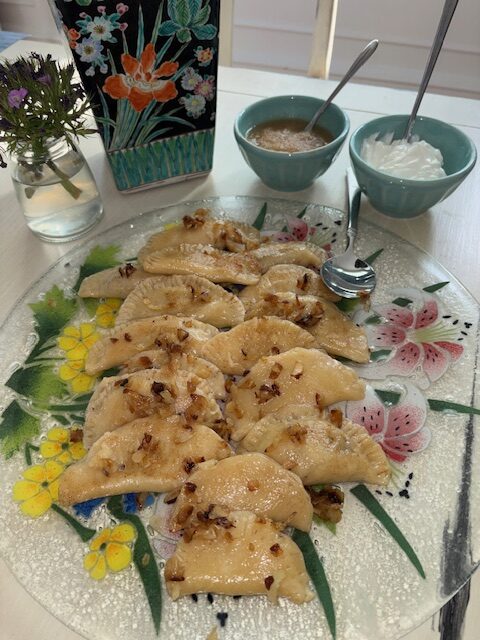
Kristen, my daughter’s sister-in-law, comes from a Polish family on her dad’s side. Although pierogies aren’t traditional fare for a break-the-fast meal, they were homemade, tender, hard to resist and clearly shaped by a steady hand “how Grandma used to make them.”
“My dad’s family is 100% Polish and for holidays, we would make a bunch of different Polish foods, like nalesniki, borscht and pierogi,” Kristen Adamkowski Hechler told me at the holiday meal. “This recipe is my (Polish for grandmom), and I used it to learn how to make this family favorite dish,” added Kristen. “I’ve modified the recipe over the years, but I still reference the piece of stained paper from my Babci’s (grandmom’s) cookbook to get the dough just right.”
Pierogies, piroshki, kreplach:
Same region of the world, different divisions.
When my niece told me about her new Ukrainian-Jewish boyfriend Yan – who emigrated via Israel to the U.S. in the 1990s – she mentioned right away that he loves anything potato. His family favorite is piroshki, a cousin of pierogi, made from his Babushka’s recipe and now cooked with his mom.
This got me thinking. Why did his Jewish family who stayed in Ukraine until 1993 make them, and our Jewish-American families, including mine who arrived in the early 1900s, did not? How could this be with so many of our grandparents and great-grandparents emigrating from Russia, Poland and the like?
Simple dish, not a simple history
When many Ashkenazi Jews were living in shtetls (little towns) in Eastern Europe in the early 1900s foods weren’t labeled like they are today. Pierogies were usually fried in oil and kosher laws required that all the ingredients be kosher.
To guard against questionable oil, they made their own version of pierogies – “kreplach” – that were meat-filled dough pouches boiled and mostly eaten in chicken soup. They’re more time-consuming and challenging than making matzo balls – thus matzo balls became one of those ethnic dishes that made it into the mainstream of American culture.
Yan and his family, however, who stayed in Ukraine until the early 1990s, became more a part of Russian society than their ancestors in the shtetls of Eastern Europe, thus piroshki became a part of their everyday fare.
The difference in the recipes below is the filling and the method: sour cream in the dough for the pierogies and farmer’s cheese for the piroshki.
For the filling, the pierogies have the caramelized onions on top. For the piroshki they’re part of the filling. The method varies also; the pierogies are boiled and finished in the pan, the piroshki are just fried.
Pierogies are often served with sour cream or applesauce; piroshki are a plain or often with a mustard dipping sauce.
Piroshki and pierogies are enjoyed year-round, but pierogies take center stage at Easter. For the holiday as a special treat they’re traditionally filled with sweetened farmer cheese or ricotta, flavored with vanilla, lemon zest, or egg yolk – rich, creamy and perfect for the dairy-focused spring celebration.
Kristin’s family: Babci’s pierogies
Serves 12-16
Dough
- 2 c sifted flour
- 1 egg
- ½ tsp salt
- ¼ c unsalted butter
- ⅛ c sour cream
Mix all ingredients together and knead in a bowl. Mold it into a ball. Wrap in plastic wrap and refrigerate for 30 minutes. Cut the ball in quarters.
Using flour to prevent stickiness, roll out the dough into ⅛ inch thickness. Use a 3-4 inch diameter round cookie cutter to make circles.
Potato filling
- 3 lbs russet potatoes
- 4 tbsp unsalted butter
- ¼ c warm milk
- (optional) ½ c cheddar cheese
- (optional) ¼ c sour cream
- Salt and pepper to taste
Peel and cut potatoes, boil for 15 minutes or until tender. Drain water from the pot and mash the potatoes in the pot. Add all other ingredients and stir until everything is combined.
Take small spoonfuls of filling into each of the pre-cut circles of dough, fold the dough over and tap the edges of the dough lightly with water before sealing. Press to seal either with fingers or a fork, being careful not to puncture the filling pocket. If there are any openings in the dough outside of the filling pocket, the filling will explode when you boil.
Boil and finish
- 2 large onions, diced
- 2-3 tbsp butter
Fill a large pot about halfway with water and a large pinch of salt. Heat water to boil. While waiting for the water to boil, sauté the diced onions in butter until brown or caramelized. Remove onions from the pan when completed, leaving the butter.
Drop several filled pierogies into the boiling water. Let boil for 60-90 seconds. Remove them from the boiling water with a skimmer and drop straight into the buttered pan to brown both sides.
To serve, scoop the caramelized onions onto the pierogies and serve with sour cream and/or applesauce.
Holiday filling:
Ingredients (for about 12-16 pierogies)
- 8 oz (225 g) farmer cheese or ricotta
- 2-3 tbsp sugar (adjust to taste)
- 1 tsp vanilla extract
- 1 egg yolk
- Optional: 1-2 tsp lemon zest or a pinch of cinnamon
- Optional: raisins, chopped finely
Yan’s family: Potato piroshki
Makes 12-16
Filling
- 3 lb russet potatoes
- 4 tbsp oil for frying
- 4 onions, chopped fine
- Salt and pepper to taste
Dough
- 2 cups farmer’s cheese
- 3 eggs
- 2½ cups all-purpose flour
- Salt, to taste
- ½ tsp baking soda
- 2 tsp vinegar
Method
1. Make the filling. Boil the potatoes until very soft. While the potatoes cook, finely chop the onions and fry them in oil until deeply golden and soft. Mash the boiled potatoes until smooth. Add the fried onions (including some of the oil), salt and black pepper. Mix well and set aside to cool slightly.
2. Make the dough. In a large bowl, combine the farmer’s cheese, eggs and a pinch of salt. In a separate small cup, add the baking soda and pour a little vinegar over it so it fizzes. Add the flour to the dough mixture, then immediately add the baking soda–vinegar mixture into the flour. Mix everything together until you get a soft, smooth dough. Form the dough into a round ball. It should be soft but not too sticky – add a little flour if needed.
3. Shape the piroshki. Lightly flour your work surface. Take a piece of dough, flatten it into a small circle in your hand. Place a spoonful of potato filling in the center. Fold the dough over the filling and pinch the edges closed well, shaping into an oval or half-moon.
4. Fry. Heat plenty of oil in a deep pan over medium heat. Fry the piroshki in batches, turning them until golden brown on all sides. Remove and place on paper towels to absorb excess oil.
Lisa is an advertising copywriter (think ‘Madmen’ without the men), journalist and columnist. Claim to fame: Lou’s waitress for four teenage summers. For column comments, story ideas, or to get on her “quote” list for future columns: redshoeslzs@gmail.com