
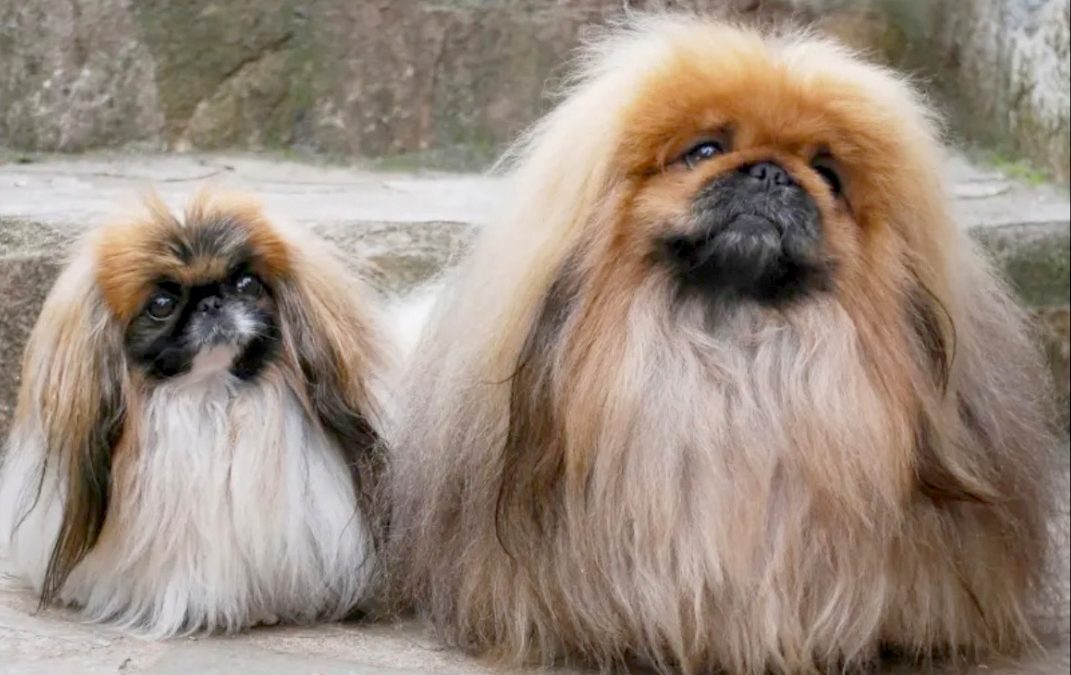
The toy group consists of 24 dogs that were, for the most part, bred to be companion animals. Some were bred to keep royalty company, while others were bred to be miniature versions of ratters and keep millworkers company. Regardless of each breed’s origin, these little dogs often pack large personalities in their small bodies and can have possessive or watchful temperaments.
Many of the toy breeds were created by royal families or nobility and were not just companions but status symbols. One of the oldest toy breeds is the Maltese, which can be traced as far back as 500 B.C. Roman nobility viewed these little dogs as a status symbol. They were known as the “Roman ladies’ dog” until the fall of the Roman Empire, when the breed was saved from extinction by Chinese nobility. Both the Pekingese and the pug are ancient Chinese breeds dating back over 2,000 years to the Han Dynasty. Legend has it that the Pekingese was created by the Buddha, who shrank a lion to be used to protect the Chinese Imperial family. Further legend is that when the British invaded Peking during the opium wars, the Chinese Imperial family killed their Pekingese rather than end up in enemy hands. Five dogs were allegedly found still alive and were brought back to Queen Victoria as a gift, where the “Peke” instantly became a Victorian status symbol.
Other toy breeds like the Affenpinscher, Miniature Pinscher, Toy Fox Terrier and the Toy Manchester Terrier are miniature versions of ratters that were deliberately bred down in size so they could come into the house and be loyal companions while keeping the house vermin-free. The Affenpinscher started as a larger breed used by Germans in the 1600s to exterminate rats and mice inside stables, but was bred down in size and moved into the kitchen to catch mice, where they became ratters by day and warm bed companions by night. The Chinese Crested goes so far back in time that there are only general assumptions about where and when they were created. What is certain is that while they most likely started on the continent of Africa, they ended up in China via trading vessels, where they were used as ratters. Once in the hands of the Chinese, they were made smaller and were called Chinese ship dogs. Their travels took them to every corner of the globe, including the United States in roughly 1880.
The Chihuahua is also an ancient breed dating back to the times of the Aztecs, who viewed them as sacred and believed they possessed supernatural powers. In roughly 1519, Spanish Conquistadors dismantled the Aztec way of life, resulting in the breed fleeing into the mountain region of Chihuahua, Mexico. They survived by living as feral animals and developed such traits as shivering to generate heat and became hyper-alert to the environment, which aided in self-defense. In roughly 1850, they were discovered by American tourists and began to be imported throughout the world.
Due to their small size, toy dog owners tend to forget that they are dogs. However, you mustn’t, or they will assume the role of household leader. Toy breeds can be notoriously needy and attention-seeking, as so many were bred to simply be companions. The former ratting breeds that were bred to be companions will need training, as they still possess independent spirits. All of the toy breeds, however, are known to be loyal and devoted pint-sized companions.
The dogs of the toy group are the Affenpinscher, Biewer Terrier, Brussels Griffon, Cavalier King Charles Spaniel, Chihuahua, Chinese Crested, English Toy Spaniel, Havenese, Italian Greyhound, Japanese Chin, Maltese, Toy Manchester Terrier, Miniature Pinscher, Papillon, Pekinese, Pomeranian, Toy Poodle, Russian Toy, Russian Tsvetnaya Bolonka, Shih Tzu, Silky Terrier, Toy Fox Terrier, and the Yorkshire Terrier.
If you have any questions, please email fouronthefloorschool@gmail.com.
Heidi Clayton started Four On the Floor Dog Training to provide positive, reward-based dog training in South Jersey. She breeds, trains and shows bull terriers under the SoraBully’s Bull Terriers kennel name. Email questions to heidi@fouronthefloordogtraining.net or learn more at https://fouronthefloordogtraining.net