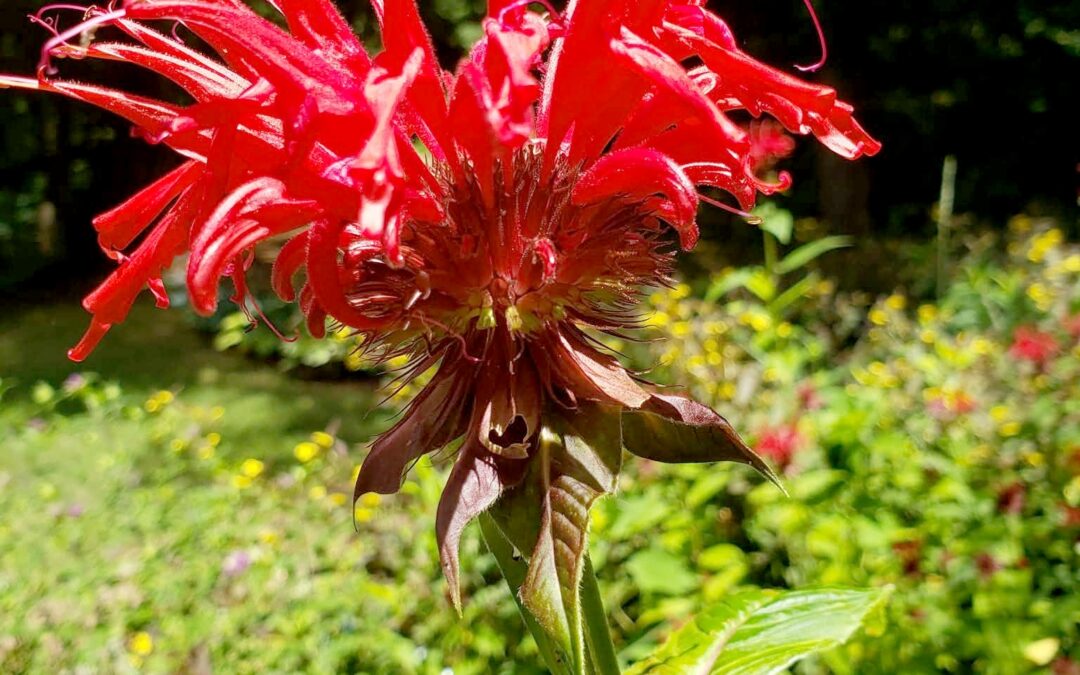
Like a friend that comes back to visit every summer, the flowers of Bee Balm (Monarda) show up in my garden late in June, hang around until the first frost, then fade away until the following season. Bee Balm has an unusual look that reminds me of fireworks, which is very fitting, since it is always bursting with blooms by the Fourth of July. Often, I make an Independence Day bouquet filled with these firecracker red flowers, adding white and blue flowers to complete the theme.
A member of the mint family, bee balm has a tendency to spread like wildfire, but it is easy to pull out or transplant. It spreads by underground stolons and, therefore, stays mostly in the section of the garden in which it was planted. This perennial will die back in the winter, but baby plants innocently poke out of the ground in spring. During this time, it’s easy to move the little plants to another section of the garden or share them with a friend. But by summer, they are tall, and the garden is on fire with their vibrant, red tubular flowers. Just when you think this “friend” is becoming overbearing, hummingbirds and butterflies show up and you realize how much you love this plant in your garden. Once the flowers are at their peak, it is rare to look out of my window and not see a hummingbird hovering over the flowers and enjoying their nectar.
One of the great thrills while working in the garden near the bee balm has been my close encounters with hummingbirds. While we are both distracted by our work and unaware of the other’s presence, I will hear the almost spooky buzzing hum of their rapidly beating wings near my ear. As I look up, we are both startled to see each other, and the hummingbird stares at me for a split second before it zips away. Those are treasured moments in the garden.
In addition to the vibrant red flowers of this sun-loving plant, bee balm also comes in purple, pink, and white. I have had the purple and pink varieties in my garden, but the plants in these colors were smaller and did not seem to be as hardy in my garden. However, the cooler colors were a nice change and very pretty, in my opinion.
Just like zucchini, phlox, and lilacs, bee balms are susceptible to powdery mildew, a fungus that gives the leaves a chalky-white appearance. Though it is unsightly, powdery mildew rarely kills the entire plant. Powdery mildew thrives in humid conditions, so plant bee balm in full sun and thin out the plants to increase air circulation. I prune the infected plants by cutting them in half, which will promote new healthy blooms. Various fungicides are on the market to combat powdery mildew, or you can try one of the endless home remedies found online using combinations of baking soda, apple cider vinegar, or even milk. Usually, it’s late in the season when powdery mildew really affects my bee balm, so I remove the worst looking plants and call it a day.
Bee balm is a must have in the pollinator garden. Be sure to plan a dedicated area where the bee balm can freely spread. Otherwise, as it grows taller, it will surpass and engulf the plants around it. Masses of color will create the best visual effect, and bees, butterflies, and hummingbirds will be attracted to the profusion of flowers.
Shore Local would love to hear about your favorite plant in the garden. Send your questions, comments,and pictures to shorelocalgardener@gmail.com.
Tammy Thornton lives with her husband, children, and crazy pets while enjoying a life of gardening, cooking, and going to the beach.