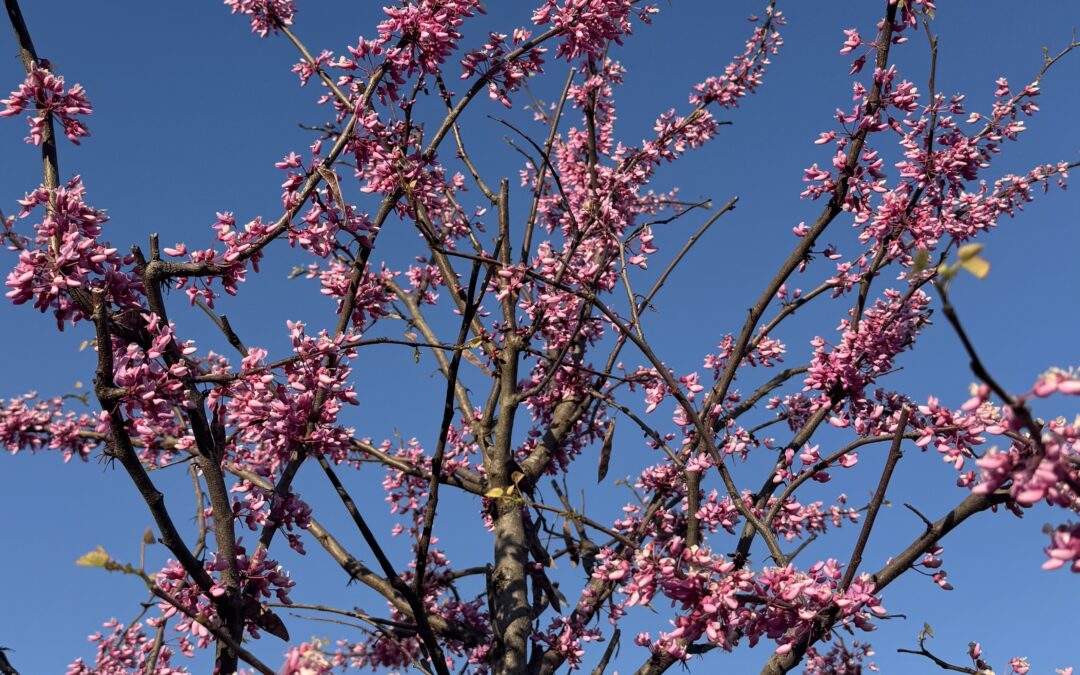
Flowering trees are one of the joys of spring. Eastern redbuds are among these early bloomers and are widely used by homeowners as ornamental landscape trees for their many interesting attributes. This native tree produces lavender-pink flowers that bloom in early spring, providing a source of nectar and pollen for early pollinators such as bees, hummingbirds, and early butterflies like the silvery blue butterfly. Redbud flowers have a unique characteristic called cauliflory, which means that the flowers bloom directly on the bare, older branches and trunk of the tree, instead of on new growth.
If you look closely at the blooming flowers, you will notice that they resemble the flowers of pea plants. This is no coincidence since it’s a family affair — redbuds and peas are both in the Fabaceae family. After flowering, redbuds produce flat bean pods (legumes) that certain songbirds find tasty, including our New Jersey state bird, the eastern goldfinch. In fact, these pea-like flowers are edible and can be used in salads. They are said to have a citrusy flavor. Even though they are pretty and tasty, you may not want to start eating your landscaping.
Eastern redbud trees are also unique in that the leaves do not emerge until the tree has finished flowering. The leaves themselves provide interest, beginning as green, glossy, heart-shaped leaves that cover the tree. In the fall, they will turn shades of yellow, copper, or red. In late autumn and winter, the leaves will fall, revealing the slender, zigzagging branches. These native trees can grow 20 to 30 feet tall at maturity. However, dwarf, weeping redbud trees are smaller and only grow 5 to 8 feet tall. In my garden, we have the Lavender Twist ® Redbud. This weeping dwarf cultivar has twisty branches that hang down. Though redbuds are among the early spring bloomers, the first year after we planted the tree, I thought it had died. While other trees were in bud, I saw no sign of life on my tree. When I had almost given up hope, the tiny purplish flower buds appeared directly on the branches. Now I know to be patient as I wait for my little tree to bloom. The flowers last about two to three weeks before being followed by the heart-shaped leaves.
You will want to plant your eastern redbud in full sun, though they can take some dappled shade. But they will bloom best with more sun. Make sure the soil is well-draining. When first planting your tree, dig a hole twice the size (width-wise and depth-wise) as the root ball. Then backfill with suitable soil, and plant the crown above the soil line. Keep well-watered until the roots are established.
This native, flowering tree will provide year-round interest. In addition to the nectar and pollen as a source for pollinators, the eastern redbud is a host plant for the caterpillars of the Henry’s elfin butterfly. Consider adding the eastern redbud to your landscape with all of its unique characteristics.
We would love to hear from our readers. Send your comments and questions to shorelocalgardener@gmail.com.
Tammy Thornton lives with her husband, children, and crazy pets while enjoying a life of gardening, cooking, and going to the beach.