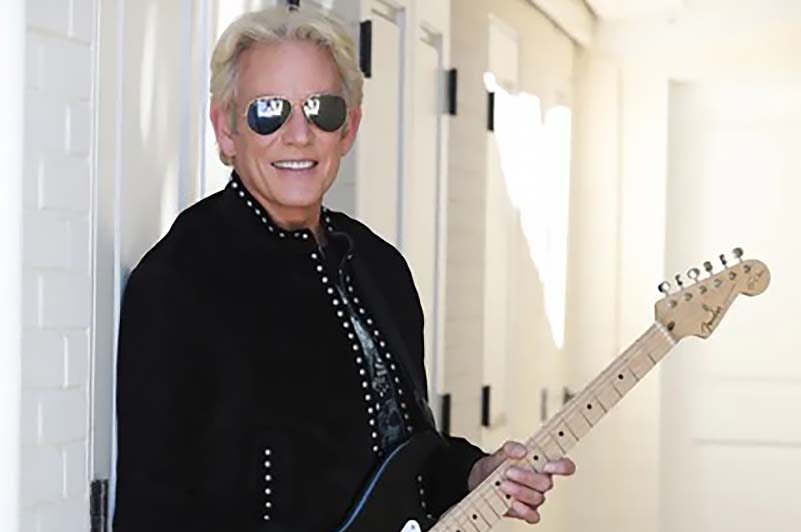
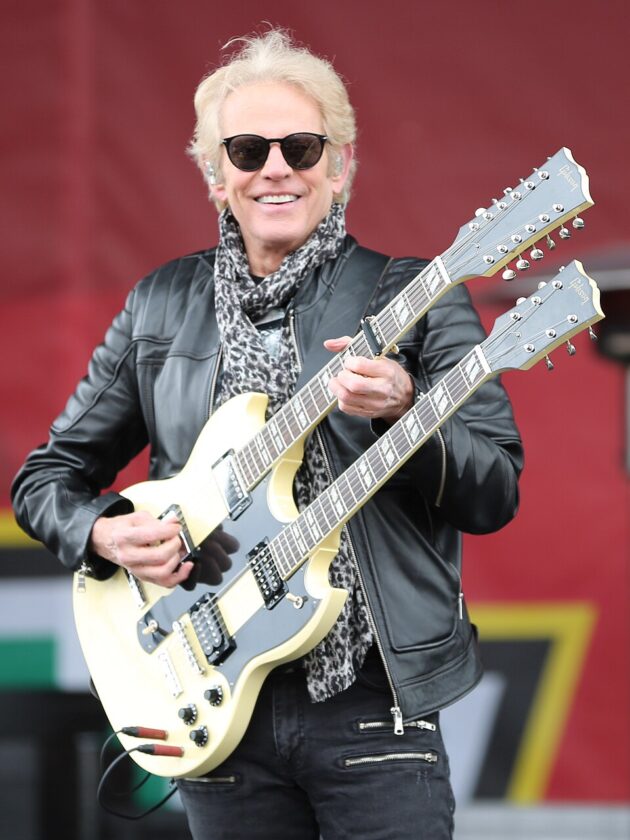
In the history of rock ‘n’ roll, there are few iconic images — and moments — more powerful than Don Felder, double-necked 1977 Gibson EDS-1275 in hand, standing on stage side-by-side with Joe Walsh ripping dueling solos on “Hotel California,” one of the greatest rock songs of all time co-authored by Felder with his former Eagles bandmates Glenn Frey and Don Henley.
It has been more than 25 years since Hell Froze Over and Felder departed the Eagles for the second time, and Felder is undoubtedly a happier man for it.
Still armed with that 18-string Gibson, the 78-year-old Felder looks ridiculously young and vibrant, and by recent reviews of his current tour, he sounds equally so.
Atlantic City will get to judge for themselves when Felder arrives at the Hard Rock Hotel & Casino with fellow classic rock legends The Guess Who featuring Burton Cummings and Randy Bachman on Saturday, July 11, for what Felder calls a three-hour magical experience of classic rock proportions.
As always, my interview with the New York Times best-selling author for his incredible memoir “Heaven and Hell: My Life in the Eagles” was insightful, candid and amazingly gracious as the Rock and Roll Hall of Famer discussed everything from giving fellow Gainesville rocker Tom Petty music lessons to his charitable endeavors to his time with the Eagles to what audiences will hear Saturday night, from Eagles classics to gems on his latest release, “The Vault — Fifty Years of Music.”
Get ready for a fantastic trip down rock ‘n’ roll memory lane with the one and only, Don Felder.
Scott Cronick: You look fantastic, dude. Life on the road is good, huh?
Don Felder: Yeah, you know, I have to say, I’ve toured with a lot of different acts. I’ve toured with the Doobie Brothers, I’ve toured with Styx and Foreigner and REO and on and on and on.
But this group right here, I’ve never met a Canadian that I didn’t like. Everybody in this band, the main primaries of people that are in the bands and the crews and the production crew, everybody is just almost too nice, to be honest with you. There’s no hissy fits, there’s no drama, there’s just a bunch of guys wanting to play a lot of good fun rock ’n’ roll for a lot of fun people and have a great time.
That’s what we’re doing.
SC: You’ve been here a lot over the years. Anything that stands out to you about your time here?
DF: I just love playing in Atlantic City. There’s usually a great crowd there on the weekends that are down from New York or wherever they’re coming from to get down there, party, see a show, gamble, have fun, go out by the pool and enjoy all of it.
And so I have to tell you though, this show for me is probably one of the best shows you can get. It’s like getting three shows in one. You get me, I come out and do a bunch of my Eagles hits that I co-wrote and recorded with the band.
I do a couple of singles here and there like “Heavy Metal” and maybe one of the new songs from my album, “The Vault.” Then The Guess Who comes out and they do two hours of just hit after hit after hit after hit. And then you get Bachman Turner Overdrive, too, a bunch of Randy’s Bachman Turner Overdrive songs.
So, you really get three hours of just solid rock ’n’ roll that’s not to be missed. Honestly, it’s really one of the most fun shows I’ve done in a long time.
SC: When you think about rock ’n’ roll, Don, I get sad when I see all these big deals that are being signed for people signing over their music. I’m like, “What is the future like?” Because all the movie soundtracks today are fueled by the rock of the ’60s, ’70s or ’80s or even ’90s.
And, I don’t see that void being filled by artists today. Are the action movies in 2050 going to still have ACDC’s “Hell’s Bells” on it or will there be rockers to step up?
DF: I don’t know. I do know a lot of people that have sold their publishing rights and their materials, and I’ve had probably a half a dozen offers for large amounts of money, and I’m not selling it. I don’t care. I’m going to leave it in my estate, my trust for my kids, for whatever it’s going to be worth in the future, it’ll be theirs, not mine. So, I refuse to sell it, although a lot of people do it.
I just think they’re making a big mistake because a lot of the artists will undersell themselves. Their catalog is being purchased as an asset by financial investors, not musicians, not people that care about the music. They want to own something that’s going to have a future income stream from those songs for decades to come: Beatles catalog, Michael Jackson catalog, Eagles catalog, all those amazing songs. I’m not selling my share of any of those. So, I think it’s better to hold on to them and leave them to my kids.
SC: Have you ever been fueled by money? I mean, because if you were fueled by money, you might have done some things differently along the way, right?
DF: Well, it’s never been about the money. I grew up just dirt poor and, you know, it’s the only joy that I had as a child. There was no Internet, there was no television, there was the black and white television that came on and set up and went off at sundown. There really wasn’t much to do. And when I discovered a guitar and started learning to play, I just fell in love with music. And when you don’t have anything to lose, you can go out in the world and do anything you want, you know.
So, I took off for New York City with a guitar in one hand and suitcase in another and wound up in California years later and in this crazy band and made a bunch of different records with a bunch of different artists. It’s just been a wonderful life story for me. And a lot of that is in my book, “Heaven and Hell.”
But one of the most important things I like to do on the road when I’m playing live is that I do a thing right toward the end of my show, just for “Hotel California.” I’m hosting the Rock and Roll Retreat Sweepstakes again for this summer, and it benefits St. Jude’s Children’s Research Hospital. All the monies that are raised go straight to the hospital.
Every $50 donation is one entry to win this incredible trip on Oct. 22 through Oct. 23. Now, the grand prize is just amazing.
You win roundtrip airfare for two people from anywhere in the United States to Nashville, Tenn. You stay three nights in the biggest suite I have ever stayed in in my life called the Broadway Suite at the Westin Nashville. You’re going to get free tickets and a guided tour with me to go through the Musicians Hall of Fame, where you will see where the very first old recording studios that made some of those old, amazing records that went on to be legendary, all the way up to all the artists that have been inducted today.
I think I was inducted maybe 10 or 11 years ago into the Musicians Hall of Fame. It was my third Hall of Fame, and I think they were trying to get me before I passed away. So, I’m in three Halls of Fame right now.
But then after that, we’re going to go over to the Gibson Garage as my guest. We’re going to take a tour of the Gibson Garage, including an exclusive Gibson vault in this vault. It really is hidden behind this fake bookcase that opens on a hinge.
And then there’s this giant vault that has a big combination lock like a bank vault. And you open it up and you go into this room, and it’s got the very first Les Paul, the very first Explorer, the very first Flying V, the very first E. Gibson mandolin, old acoustics that Gabe Gibson made. It’s just a moment of history to be able to reach into that vault, take some of those guitars, hold them in your hand and play them a little bit.
You’re also going to get a one-on-one guitar lesson from me, because one of my old guitar students actually went on to do pretty well. His name was Tom Petty. So, who knows? If you get a guitar lesson from me, you might have a career.
You’re going to get a signed white double-neck guitar from me. And if you want to sign up for this now, you can go to DonFelder.com/contest.
We’re really just trying to make people have a great night of music and to save children’s lives. That’s what’s done.
SC: How’d you get involved in that?
DF: I have been a supporter of St. Jude’s for probably the last 20 years. I’ve done a lot of their golf tournaments, played music for them, their fundraisers. And finally, about two years ago, I did a fundraiser for them down in Memphis where the hospital is. And some of the people from the hospital came up to me and said, “Have you ever been to the hospital?” I went, “No, I haven’t.”
They said, “Would you like to come?” I said, “Absolutely!” So, we drive over there and we get out of the car. We go in and this lady that’s probably in her early 30s meets us, takes us around and touring. And while we’re going, I said, “Well, how long have you been working here?” And she said, “Oh, I don’t work here. I just volunteer.” I said, “Well, how much do they pay you?” She says, “I don’t get paid. I do it just to help support the cause.” I said, “Why do you do it?” She says, “Well, I was brought here as a child with cancer and they saved my life.” So, at that point, you just, you know, the tears start coming out.
You start walking through this hospital and seeing these kids that literally when they founded St. Jude’s Hospital in 1960 by Danny Thomas, the survival rate of children’s cancer and lymphoma was 4 percent survival rate. Today, after all the research this hospital has done, they’ve got it up to 94 percent survival rate.
There’s six percent left, and they’re trying their best to make certain there’s no child that ever dies from cancer or lymphoma. So, sign me up. I’ll do everything I can to save lives.
SC: That’s awesome. Good for you, man. So, let’s talk a little about “The Vault.” You mentioned earlier that you’re playing some things off that. Anything in particular different this time around?
DF: Yeah, I have worked up three songs from that. And I alternate them so that I don’t play the same set every night. I play a song called “I Like the Things You Do.” It was written about my partner that I’ve been with now for six years, known for 11 years.
I do a song called “Free At Last,” which is a lot of fun because everybody’s got this to look forward to: That we’re all going to be free at last one way or the other. And then I do this song that I actually wrote the basic music track for it for (The Eagles) “The Long Run,” and it’s called “Hollywood Victim.” It’s about so many people that come out to Hollywood looking to be famous movie stars, singers, actors, whatever it is. And they wind up working in restaurants as waitresses and waiters and just doing odd jobs to stay alive, waiting for their big break. And a lot of the times that doesn’t quite turn out the way everybody else did. That’s Hollywood. That’s the dark side of Hollywood.
Yeah, it’s a fun rocking night. We get so much fun and so much joy out of by the end of the night. Everybody’s up on their feet, dancing and rocking and having a great time.
SC: So, you’re making great music for great crowds and raising money for a great cause all at the same time. And then, of course, you play “Hotel California,” which you’re synonymous with as you co-wrote that song. When you recorded that initial demo back in the Malibu beach house on a 4-track … When you listen to that, is there any elements or nuances from that first afternoon that survived completely untouched in that final anthem?
DF: Yeah, I wrote the bass part, which is as it appears on the record. I wrote all the guitar parts as they appear on the record, with the exception of part of the Joe (Walsh)-ism solos at the end. Joe and I had been playing together outside of the Eagles doing his band called Joe Walsh & Friends. We actually opened for Elton John at Dodger Stadium one gig.
We did a TV show together where I sat in with Joe, and we played a bunch of stuff. I wanted to write a track that I could do that on an Eagles record with Joe. That’s when the idea for this whole long 6-and-a half-minute piece of music came up when I started writing it.
It was just originally just a little simple chord progression, but I went in and I wanted to make it sound more finished. So, I wrote the bass part, put all the harmony guitars together on it, the 12-string part and pretty much exactly like you hear it on the record, with the exception of no vocal and no melody. So, when I first joined the band, (former Eagles bandmate) Bernie Leadon, my high school buddy, told me, “If you want to write songs with Don and Glenn, don’t write lyrics, don’t write melodies. Let those guys who are the great singers and the great lyricists write that part of the song. Just write music beds.” So, I wrote probably, I don’t know, somewhere between eight to 15, 18 song ideas on every project.
That was where that cardboard box full of cassettes, CDs and ADATs, all those demo ideas that I hadn’t heard for 25 years, that I went in and found that box of stuff and I started listening to it and went, that was a great idea. I’m going to finish this. And so, I re-recorded everything from ground up with amazing players and wrote the lyrics and sang it and produced the harmonies and everything that went into each one of these records.
It was really fun to look back and go, I wrote that in 1974. That is a great slide part. I got to write something with that slide part. And so that became “Move On,” the opening track.
SC: You became famous, synonymous with that double-neck Gibson. And it’s an incredibly heavy, physically taxing instrument, right? I mean, did you ever along the way wish like, “Man, why didn’t I pick something a little lighter?”
DF: I just wish they made them out of bamboo, something that was basically like … it’s like playing two guitars at the same time. And literally it has two different outputs. So, when you flip the switch up to the 12-string neck and you’re playing, it goes out of one output into a Leslie, and that’s mic’d.
When you flip it down to the 6-string and you’re going to play the leads and stuff, it goes out of a different output into a rock ’n’ roll layout. So, it was the only way I could figure out how to play both of those parts at the same time live, going out on the road with the Hotel California Tour. And ever since we did that, 1976, I’ve been lugging that thing around ever since.
SC: I am with my wife because of Tom Petty. That was our first date. So, tell me something about Tom Petty that my wife would want to hear.
DF: Well, Tom was a very charismatic, even young player. He was playing bass when I first met him, and he didn’t really think bass was the way to front a band. Paul McCartney may tend to disagree with him on that.
I remember I worked with him in his band. He had two guitar players, and they just flailed artlessly. They just played really loud. So, I said, “OK, why don’t you guys play rhythm? The other guy, don’t play when Tom’s singing, don’t play. But when he steps away from the microphone, you can play your solos and your leads.”
I just kind of arranged them. I was standing in the crowd listening to that show, and I was standing between, I don’t know, two girls on each side of me. Why I chose that location, I don’t know.
But I’m standing there and these girls are like, “Oh, my God, he’s so good!” And he’s flipping his hair and rocking away. He is selling it no matter if he’s out of tune or, you know, his confidence on stage was just really, really genuine and really strong. You believed him, and so I learned lessons from watching his attitude on stage, the confidence that he had, as well as even he lacked somewhat in his vocal abilities in those early years. And he was playing bass. He wasn’t playing guitar. But I did learn about walking out on stage and being really confident. And really kind and smiling and having a great time. The people welcome you and your music into their life.
Don Felder and The Guess Who will perform 7:30 p.m. Saturday, July 11, at Hard Rock Live at The Etess Arena at the Hard Rock Hotel & Casino Atlantic City. Tickets available at Ticketmaster.com or HardRockHotelAtlanticCity.com
Scott Cronick is an award-winning journalist who has written about entertainment, food, news and more in South Jersey for nearly three decades. He hosts a daily radio show – “Off The Press with Scott Cronick” – 4 to 6 p.m. weekdays on Newstalk WOND 1400-AM, 92.3-FM, and WONDRadio.com. He can be reached at scronick@comcast.net.