
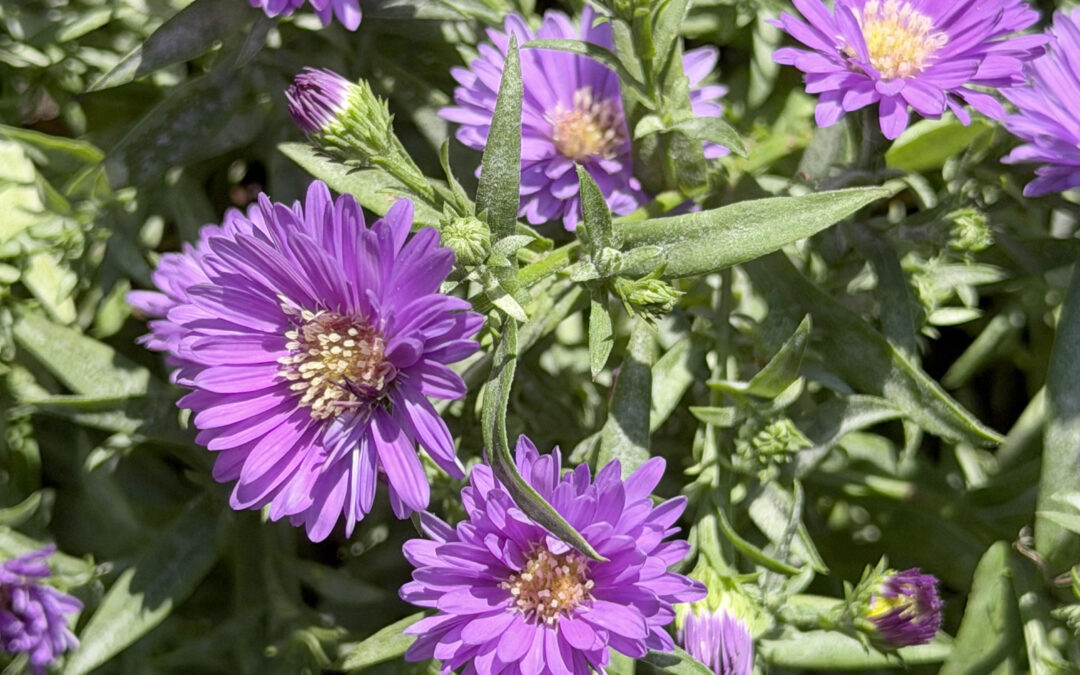
Now that Labor Day is in the rearview mirror, we will be bombarded with everything fall, including mums galore. Playing second only to the ubiquitous pumpkin, when we see mums (chrysanthemums), we can’t help but think of fall. You will see them at garden nurseries, farmer’s markets, school band sales, grocery stores, and before long, everyone’s front porches. But hiding among the mums (and often labeled as such), you will see purple flowers that look more daisy-like. These purple “mums” are actually fall asters, and you will want to scoop these babies up and bring them to live in your own garden.
Though asters are not mums, you can’t blame them for posing as mums, since they are kissing cousins but different plants within the Asteraceae family. Because of these family ties, they do share some of the same characteristics. Both mums and asters bloom in fall, although there are varieties of asters that will bloom in spring or summer. Mums and fall asters also share other traits that make their methods of care similar. They both bloom best in full sun and like to be kept well-watered, but must have good drainage. You can plant both of these plants in the ground in your garden. They don’t need to be relegated to pots as fall decorations, only to be tossed to the curb once they are done blooming. If planted in late summer or early fall, they will have time to establish their roots before the frosts and hard freezes of winter arrive. Asters are said to be more cold-tolerant, although, gardening along the New Jersey coast, I have reliably planted mums in the fall and enjoyed them year after year.
When you see asters blooming in the fall, they will most likely be New York asters or New England asters. These are both native Northeast perennials that are host plants for several butterfly species, including the caterpillars of the pearl crescent butterfly and the silver crescent butterfly. They are also beloved for their late-season nectar by pollinators such as bees, moths, hoverflies, and butterflies, including migrating monarchs.
One reason asters blend in with mums being sold in the fall is their small compact size. But they have been carefully bred to be compact dwarf cultivars. Gardeners will often pinch them back early in the season to keep them smaller and maximize the number of flowers. Left to their own devices, they will revert back to their natural taller growth and will look lovely near the back of your flower borders. However, you may find that they need to be staked if they are allowed to grow tall. If your asters become too dense, you will want to thin them by removing some of the stems and lower leaves. This will allow air to circulate among the leaves to help avoid powdery mildew. As with other flowers susceptible to powdery mildew (especially this time of year), water at the base of the plant and early in the morning so that the leaves can dry in the sun. You can also divide your asters every two to three years to avoid overcrowding.
While we often see fall asters in purple, they also come in shades of pink and white. Their name comes from the ancient Greek word for star because of their star-like appearance. However, if you are friends with someone from England or are a fan of English novels, you may have heard them referred to as Michaelmas daisies, because they bloom around the time of Michaelmas, also known as the Feast of St. Michael, celebrated on Sept. 29.
We would love to hear from our readers. Have you planted this late-season bloomer in your garden? Pollinators and migrating bees and butterflies will thank you. Send your pictures, comments, and questions to: shorelocalgardener@gmail.com.