By Douglas Keefe, Beachcomber Coins
Anyone who served in the U.S. military overseas following World War II through the Vietnam War may remember military payment certificates, or MPCs. Sometimes nicknamed “Monopoly money” because of their colorful designs and unusual sizes, these certificates served as currency for American troops stationed abroad. Today, they are a fascinating category of collectible paper money.
Following World War II, American troops occupying European countries were paid in U.S. dollars. However, local currencies were often weak and unstable, making American dollars highly desirable.
Residents frequently offered exchange rates above the official rate to obtain dollars. Black markets flourished, further weakening economies struggling to recover from the war.
To address the problem, the military introduced MPCs in 1946 to discourage black-market activity and help stabilize local economies.
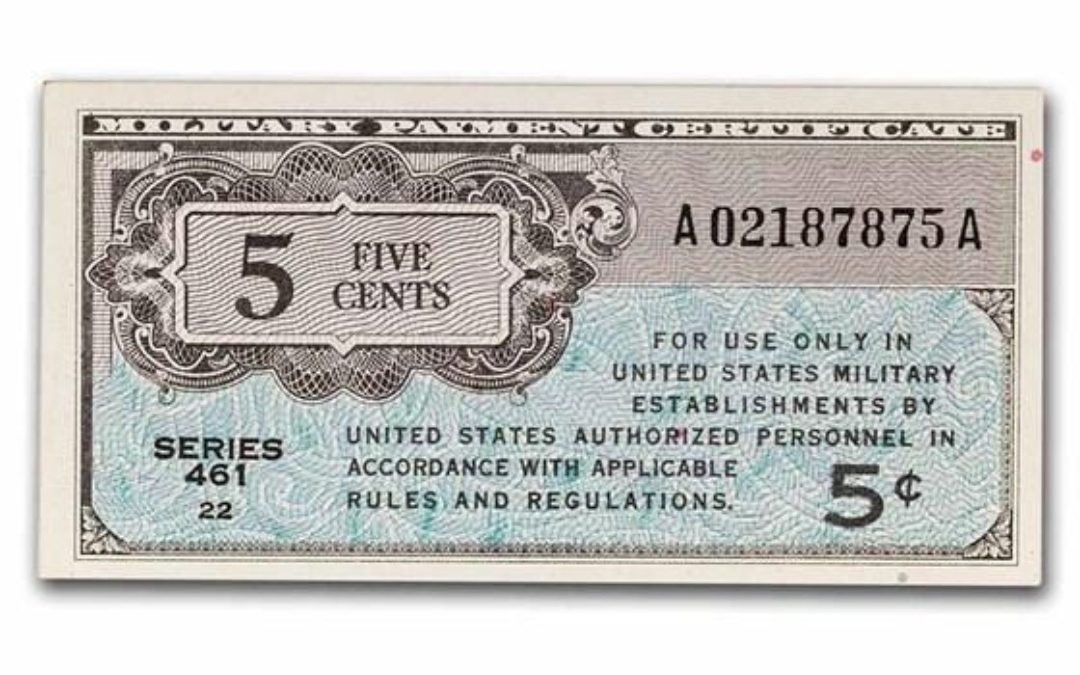
Certificates were issued in denominations of 5, 10, 25 and 50 cents, along with $1, $5 and $10. A $20 certificate was added in 1968.
Unlike regular U.S. currency, issued under the Treasury Department’s authority, MPCs were issued under the authority of the War Department, later known as the Department of Defense.
Military personnel stationed overseas received MPCs, which could be exchanged for local currency. However, local money could not be converted back into MPCs. Service members therefore had to be careful about how much local currency they obtained.
Despite restrictions, local residents sometimes accepted MPCs, hoping to benefit from their value.
To prevent unauthorized use and hoarding, the military periodically introduced new certificate series through a secretive process known as “C-day,” or conversion day.
On these days, military personnel were restricted to their bases and permitted to exchange old certificates for new ones. Once the exchange ended, previous certificates became worthless.
Anyone outside the military holding large quantities of MPCs could suddenly find their money had no value.
Authorized service members could exchange their certificates for U.S. dollars at face value when returning home.
Military payment certificates remained in use from 1946 through 1973, with 13 series comprising 94 different notes. Each series carried a three-digit identification number.
Today, MPCs attract collectors interested in military history and unusual currency.
Lower denominations are relatively plentiful because many service members saw little reason to exchange certificates worth less than a dollar.
Higher denominations, particularly $10 and $20 notes, are scarcer and can command premium prices, especially in uncirculated condition. However, because MPC collecting has a smaller following than traditional currency collecting, many examples remain affordable.
Replacement notes are especially interesting to collectors.
Like regular currency, MPCs occasionally contained printing errors requiring replacement notes. On U.S. currency, replacements are identified by a star in the serial number.
MPCs used a different system. Standard certificates have serial numbers with letters before and after the numerical sequence, known as the prefix and suffix. Replacement certificates contain only the prefix letter, making them considerably scarcer.
For veterans, these colorful certificates may revive memories of overseas service. For collectors, they offer a glimpse into military life, postwar economic recovery and a distinctive chapter in American monetary history.