
Drink Up!
“Que Sera, Sera (Whatever Will Be, Will Be)” was a very popular song made famous by the late Doris Day in 1955. I remember my mother singing this to me as a child. I am loosely using a variation of the song’s title to introduce a few wine questions I frequently hear. Are Syrah and Shiraz wines the same? What about Petite Sirah? The answer is yes, and no! Let me explain.
The exact origin of the Syrah grape and the wine produced from it is not known with certainty. Most believe that the grape was first planted by the Romans in the northern Rhone Valley of France in a region known today as the Côte-Rôtie. Some believe it was brought to this region by the Greeks 500 years before the Romans arrived, as it was the Greeks who first cultivated wine in the Rhone Valley. Though its origins are foggy, it was in this region that this grape became famous. The Hermitage subregion of the Rhone Valley is arguably the best demonstration of Syrah. In fact, the only red grape allowed to be grown in the Côte-Rôtie and Hermitage Appellations d’Origine Contrôlée (AOCs) is Syrah.
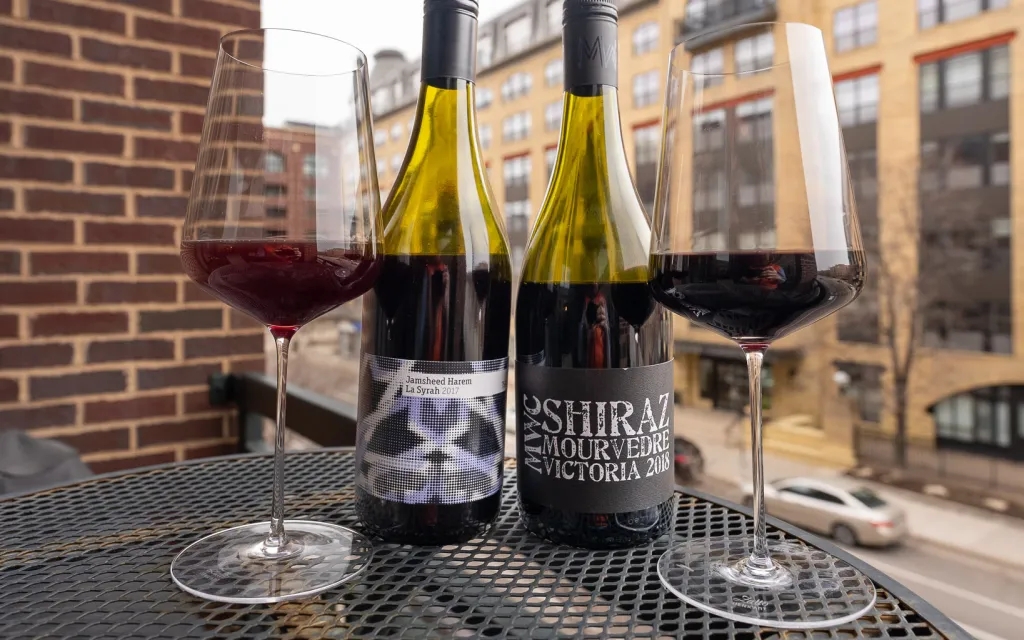
Genetically speaking, it has been proven that Syrah and Shiraz are the same grape. What is different is that wine term that I use so often: terroir! Shiraz is the Australian interpretation and spelling of this grape. In 1788, the British established a penal colony in Australia with 1,000 inhabitants. Crops, including grapevines, were planted immediately to feed the inhabitants. The colony’s first Governor, Arthur Phillip, is credited as the first to plant vines at his residence at Parramatta. Initial attempts at growing wine-worthy grapes were unsuccessful. In 1833, a Scotsman named James Busby, known as the “first British resident of New Zealand,” returned to his new home in the South Pacific from a trip to Europe. Busby stopped in Australia with hundreds of grapevine clippings from France, which included Cabernet Sauvignon, Merlot, Malbec, Grenache, and, you guessed it, Syrah. Of all the varietals planted in Australia, none adapted better to the soil and climate than Syrah. How it became known as Shiraz is not known, but it is not surprising. In Australia, a chicken is a “chook,” breakfast is a “brekky,” and a mosquito is a “mozzie.” So, it became known as Shiraz, mate!
So the wines must be the same, right? Au contraire, mon ami! Terroir is everything! Syrah, especially those from France that are classic Old-World wines, have lower alcohol levels, less intense fruit flavor, more noticeable earthiness, and smoother tannic structure. The Shiraz from Australia are New-World wines, meaning the alcohol levels tend to be higher, the boldness of the fruit flavors is more intense, there is less earthiness, and the tannins are much tighter. In addition to France and Australia, Syrah/Shiraz is widely grown in many other countries including the United States, Italy, Portugal, and South Africa. Each area’s terroir affects the resulting wine. Which is better? That is totally up to you to decide.
Have your own taste test comparison. Try a French Syrah, such as Domaine Brusset Laurent B. Côtes du Rhône or the Domaine Jaume-Côtes du Rhône 2020. In Old-World tradition, these are blended wines with Syrah sharing the marquee with Grenache, Mourvèdre, or Carignan. From Portugal, try Guarda Rios, a red blend with Syrah, Aragonez and Alicante Bouschet. Or, from Spain, try Juan Gil Blue Label, a red blend with Syrah and Monastrell. From Italy, try the Cantine Colosi Rosso, a blend of Syrah and Nerello Mascalese. Then try an Australian Shiraz, like First Drop Mothers Milk Shiraz. From South Africa, the A.A. Badenhorst Secateurs is an awesome red blend of Shiraz, Grenache, and Cinsault. One of my all-time favorites of this varietal comes from the United States; the Truchard Syrah Carneros Napa is a blend of Syrah, Zinfandel and Petite Sirah. You have probably noticed that this grape is frequently blended with other indigenous varietals from throughout the world.
On to Sirah, as in Petite Sirah. It must be the same grape in another location with another spelling, right? No, in this case, Petite Sirah is a totally different grape varietal. It seems likely that Petite Sirah, or Durif, as it was known in the 1800s, had its roots in France. This grape never grew well in its homeland but, in 1884, a vineyard owner named Charles McIver brought cuttings to his Mission San Jose in Alameda County. It took beautifully to its new home in Southern California. Although the popularity of California’s Petite Sirah wine peaked in the 1970s, in my humble opinion, it is one of two varietals California does better than anywhere else on earth. The other is Zinfandel. That is a story for another day.
Petite Sirah stands alone. This is a New-World wine with bold fruit flavors of black raspberry and plum, notes of pepper, plenty of tannins and relatively high alcohol levels. I am a big fan of this varietal. A few excellent examples include J. Lohr-Petite Sirah Tower Road from Paso Robles or Old Soul Petite Sirah from Lodi, California. If you are looking for your new favorite California red wine, start with one of these! Or, a truly outstanding example of Petite Sirah blended with Zinfandel is the Caymus-Suisun The Walking Fool Red Blend. Suisun Valley in California is a relatively new appellation that is getting a lot of attention. Try this wine and see why.
The best way to enjoy this article is with a glass of one of these wines in your hand. As always, contact me at dsetley@passionvines.com or stop by the Somers Point store if you have any questions or comments. Until next time, happy wining!
David Setley is enjoying his retirement from higher education as a wine educator and certified sommelier at Passion Vines in Somers Point, New Jersey.