With the summer season upon us, families are visiting the Jersey shore in droves and are in search of entertainment that those of all ages can enjoy. To some, that means amusement rides, whether at Atlantic City’s Steel Pier, the Showboat’s Island Waterpark, Central Pier’s go-karts, the kiddie rides at Storybook Land, or Playland’s Castaway Cove in Ocean City.
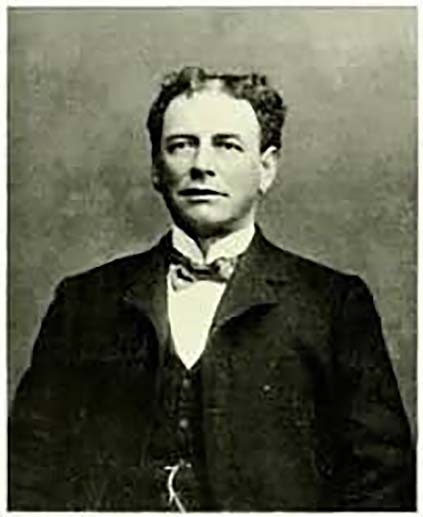
The concept of an amusement pier in Atlantic City — and there were several through the years — was the brainchild of a certifiable visionary named John L. Young, who left us some 87 years ago. Though he was an iconic and influential pioneer whose ideas live on today, mainly via the Steel Pier, Young is virtually forgotten. In his day, however, he was as famous as Paul “Skinny” D’Amato, “Nucky” Johnson, Reese Palley, or any of the other memorable characters who made Atlantic City their home and headquarters.
Young, born in Absecon in 1853, came to Atlantic City as a young carpenter’s apprentice who first saw the possibilities of the city as a major entertainment center during the time he worked on the crew that helped build Lucy the Elephant in 1881. Looking for something more lucrative and challenging, he first hooked up with a Philadelphia builder named Kevin Crossan to run Boardwalk carnival games and amusements. Though the set-up was modest, the two made out very well financially, and they earned enough to buy Applegate’s Pier, with the assistance of a banker named Stewart McShea.
Applegate’s, a 625-foot long amusement pier that stood on 1400 Boardwalk where Central Pier is now, opened in 1884 and was doing okay business until Young and his partners bought it in 1891. The first order of business was to expand the structure to around 2,000 feet, which opened the way for the installation of rides, games, and later, an aquarium and ballroom. It didn’t take long for Applegate’s to become, according to the history books, one of the leading amusement destinations in the city.
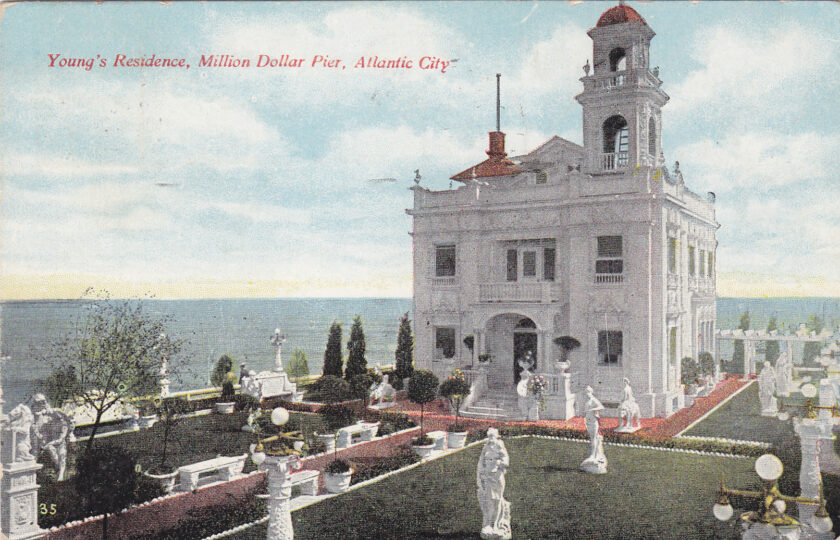
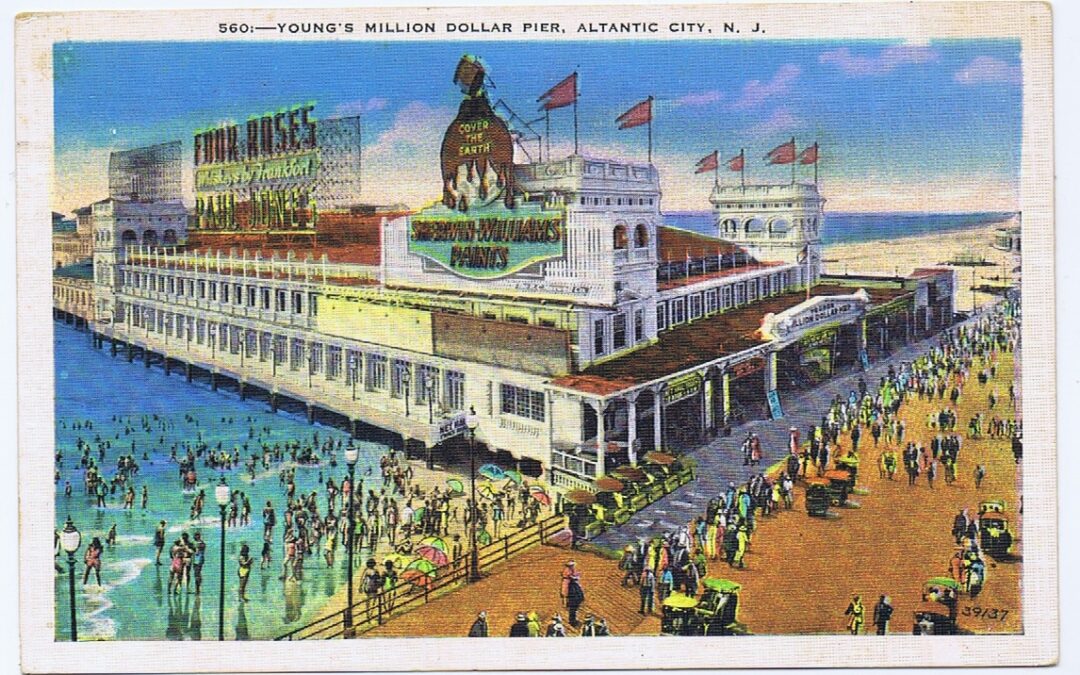
Young renamed the expanded pier Ocean Pier, and near the end of the structure, he built what was described as a nine-room Elizabethan- style mansion on the pier’s end. But the showman and visionary was just getting started. Seeing the success of Ocean Pier, Young decided to build something extraordinary for the time, i.e, something that cost a million dollars to construct. Young’s appropriately named “Million Dollar Pier” opened in 1907 on the Boardwalk at Arkansas Avenue.
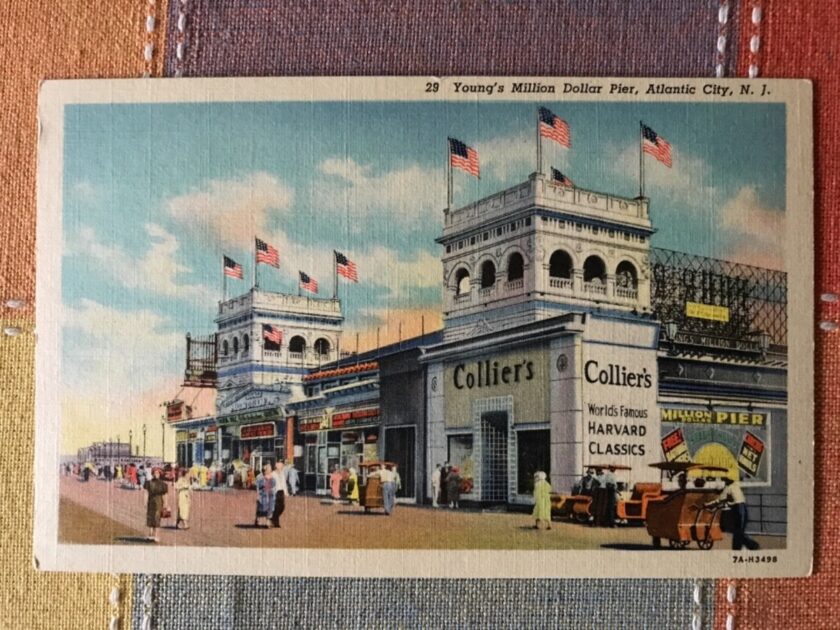
“It was everything Young had said it would be and more, elegantly designed like a castle and reeking of cash,” wrote Ken Surski, author of “Unremembered: Tales of the Nearly Famous and the Not Quite Forgotten.” “Young spared no expense right down to the elaborately designed oriental rugs and velvety ceiling to floor drapery. It was the perfect place to host parties, special events and distinguished guests, including President William Howard Taft who, typical of his reputation – and size – spent most of the time in the Million’s extended dining hall.”
Though wildly successful, there was one thing Young couldn’t change: The fact that tourism was a seasonal business in Atlantic City, and that business started to fall off each year at the end of August. The partial solution to this didn’t come from Young. It came by way of the owner of the Monticello Hotel, Conrad Eckholm, whose season-extending concept was called “Fall Frolic,” a series of events like a Rolling Chair Parade and a beauty/bathing pageant. Public announcements went out that girls were wanted for the contest, with the winner receiving, among other things, an all-expense paid trip to Atlantic City for a week, and a brand new wardrobe.
In September 1921, the first Miss America Pageant took place, with the gala contest held at — where else? — Young’s Million Dollar Pier.
In 1938, John L. Young died in Palm Springs, where he spent his winters, at the age of 84. George Hamid, of Steel Pier fame, leased Million Dollar Pier for the next ten years. It changed hands several times through the years and remained relatively successful until the 1970s, when the city was experiencing a terrible, economic downturn. Though the years, Million Dollar Pier managed to survive damage by fires, hurricanes, management and policy shifts, and changing times. But it could not survive an October 1981 decision to tear down the historic venue to make way for the Ocean One Mall. During the demolition process, a suspicious fire broke out and destroyed what little of the pier was left.
As detailed in these pages several times, Ocean One opened in 1981 and lasted until 2003. Its successor, The Pier Shops at Caesars was in business from 2006 until, approximately, 2013. In 2015, Bart Blatstein’s ambitious Playground Pier opened, only to close four years later. In 2024, the film production company, ACX1 Studios, moved in, but filed for Chapter 11 bankruptcy protection in March.
Sadly, this impressive structure is vacant. But the Atlantic City Boardwalk was and is a place of miracles, and it’s a good bet that what was the vision of John L. Young won’t be vacant for long.