
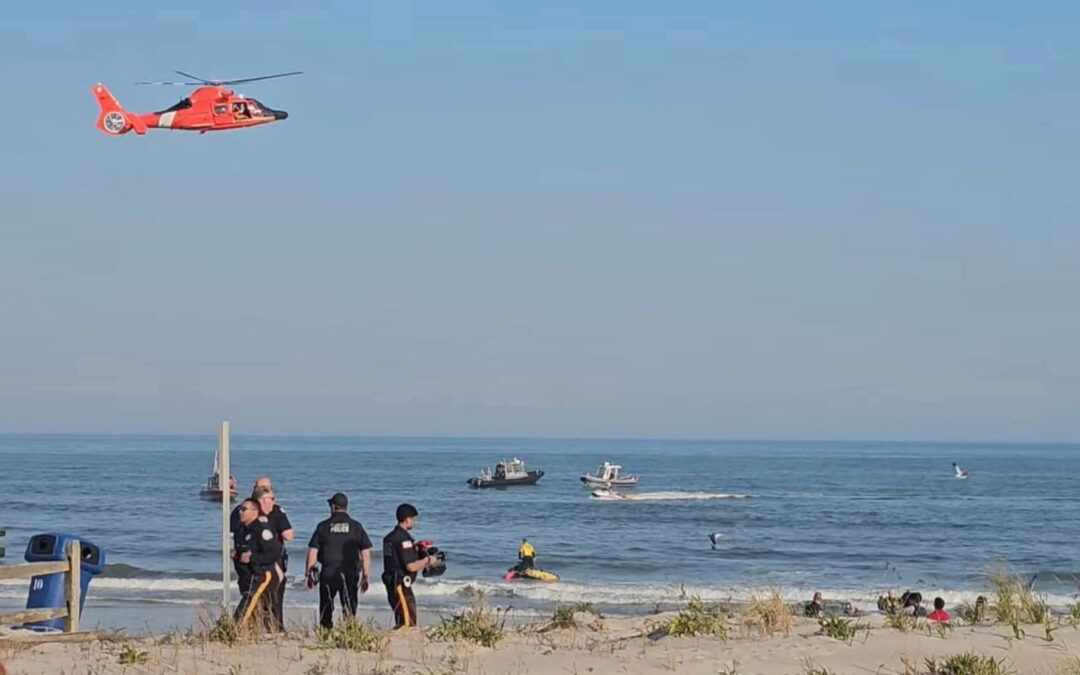
Emergency crews continue searching for a young man who disappeared in the water near Ocean City’s 10th Street beach Monday evening.
According to authorities, the swimmer was reported missing around 5 p.m. after he and another individual were riding boogie boards in rough surf. One of the two made it back to shore safely and told rescuers the missing swimmer was knocked off his board by a wave and never resurfaced.
The search resumed Tuesday morning with assistance from multiple agencies, including the U.S. Coast Guard, Ocean City Beach Patrol, police, fire rescue crews and the New Jersey State Police. Drones, rescue boats, personal watercraft and helicopters were all used as teams searched the coastline and ocean waters near 10th Street.
Officials closed portions of the beach while crews combed the area. Roughly two dozen individuals formed a human chain in the water to help rescuers search the area, ABC 6 reported. Witnesses described seeing rescuers spread across the shoreline while helicopters circled overhead.
Authorities have not publicly identified the missing swimmer. As of Wednesday evening, he had not been found, and officials said the search would continue into Thursday, May 21. The public is being asked to avoid the area.
The incident comes just days before Memorial Day weekend, when local beaches officially become guarded for the summer season.
Beach patrol officials are reminding the public that unguarded beaches can quickly become dangerous, even for strong swimmers.
“The ocean is always unpredictable,” Atlantic City Beach Patrol Chief Steve Downey said. “You never know when the tide changes, you never know what the depth is, you never know if there’s holes, you never know where there’s rip currents.”
Five reasons to swim near a lifeguard
1. Lifeguards spot trouble before most people do
Drowning often happens quietly. Lifeguards are trained to recognize subtle signs of distress, including exhaustion, panic or swimmers struggling against currents.
Downey said experienced guards are trained to constantly monitor movement in the water and quickly notice when swimmers disappear from view or begin drifting into dangerous conditions.
“I can look at [the ocean] anytime, and I know exactly who’s in trouble, when they’re in trouble, or if they’re going to get themselves in trouble,” he said.
2. Rip currents can form without warning
Ocean conditions can shift rapidly, especially during spring and early summer. Rip currents are often difficult for the average swimmer to identify, but lifeguards continuously monitor water movement and direct swimmers away from dangerous areas.
Downey said changing tides and underwater sandbars can cause water depth to change suddenly.
“You could go from 2 feet to 5 feet with one step,” he said. “People can go from knee-deep to over their head very, very quickly.”
3. Faster rescue times save lives
When someone is in trouble offshore, seconds matter. Swimming near an active lifeguard stand dramatically shortens response time because guards are already watching the water and equipped to enter immediately.
4. Lifeguards provide more than water rescues
Beach patrol members are trained in CPR, first aid, AED (Automated External Defibrillator) use and emergency response. They can assist with injuries, medical emergencies and other situations until paramedics arrive.
5. Guarded beaches are significantly safer
According to the United States Lifesaving Association, the odds of drowning at a beach protected by trained lifeguards is 1 in 18 million. Beach patrols across the Jersey Shore consistently urge visitors to swim near a lifeguard because it remains the most effective way to reduce risk in the ocean.
Downey said swimmers who become caught in a rip current should remain calm and swim parallel to shore rather than fighting directly against the current.
“Never panic, float with it, and never swim against it,” he said.
With crowds expected to increase over Memorial Day weekend, beach patrols are urging residents and visitors to avoid swimming at unguarded beaches, stay aware of surf conditions and warning flags, and follow instructions from beach patrol personnel.
Julia graduated from Rider University in 2024 with a BA in multiplatform journalism and minor in social media strategies. In addition to reporting on local news for Shore Local, she is a social media strategist for small businesses. Connect with her: shorelocaljulia@gmail.com or @juliatrain on Instagram.