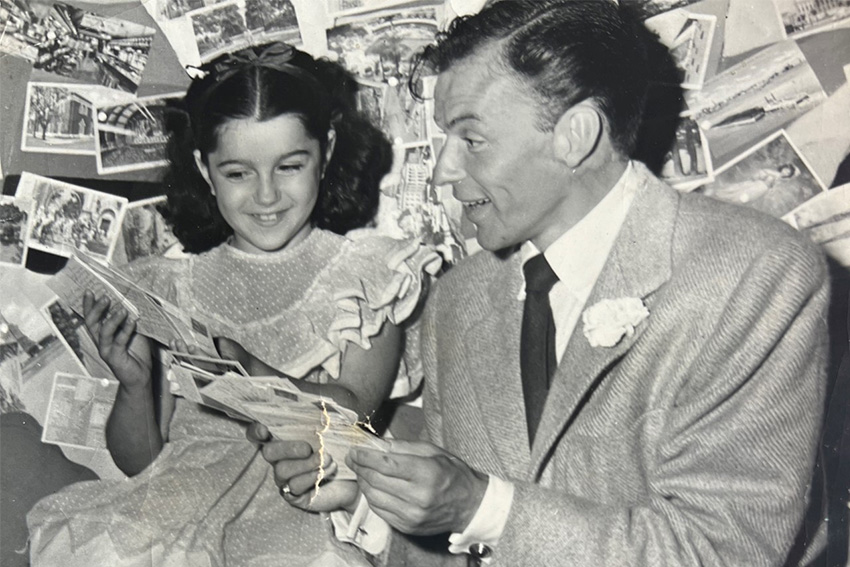
Those familiar with Atlantic City history are likely aware of Vicki Gold Levi. For more than five decades, Levi has been an Atlantic City historian, curator, collector and booster, as well as the founder of the Atlantic City Historical Museum, and a consultant for the HBO series, “Boardwalk Empire.” Her passion and love for “everything Atlantic City” was captured beautifully via a recent PBS documentary.
There’s no doubt that the foundation of this visual history begins with her father, Al Gold, the city’s official photographer from 1939 until his passing in 1964.
Many of the historic images we see today, notably the 1952 photograph of Marilyn Monroe as the grand marshal of the Miss America Parade, and the picture of Vicki with “Ol’ Blue Eyes” himself, circa 1950, are his. Many of his timeless images are included in Vicki Gold Levi’s landmark book, “Atlantic City: 125 Years of Ocean Madness.”
Al Gold may have been the city’s “official” photographer, but there were others who captured iconic images of Atlantic City through the years. One of the most unique ones was Robert Chester Maxwell, who specialized in different kinds of subject matter – subject matter that he created.
R.C. Maxwell’s photographs of Atlantic City, though memorable, were incidental to what he created. In 1921, he started the Electric Sign Manufacturing Company in Atlantic City. Maxwell’s company specialized in building electric, neon signs – called “spectaculars” in the trade back then – that could be seen on the Boardwalk, amusement piers and elsewhere.
Among his more outstanding and memorable contributions over his four-decade career were a 50-foot-tall thermometer that served as an ad for the Colgate company, and an immense sign for Chesterfield cigarettes that stood atop the Steel Pier for years. That creation had more than 27,000 lightbulbs and was said to be, in the 1920s, the largest sign of its kind in the world.
Thankfully, Maxwell meticulously documented his advertising work, which not only included photos of his singular signs, but also included images of the surrounding areas where the signs were placed. Those photos were taken for the purpose of showing prospective clients the specific neighborhoods and parts of the Boardwalk where the signs would potentially be placed. The photographs may have been incidental, but they were fabulous.
Maxwell’s more spectacular electric signs of the 1920s were constructed and designed for Squibb’s Dental Cream, Lucky Strike cigarettes, General Electric, and billboards for Cutex, El Producto Cigars and Lorraine Hair Nets (10 cents and fully guaranteed). In the 1930s, Maxwell became more prolific, designing signage for Calvert liquors, Noxzema, Bromo-Seltzer, Camel cigarettes and a billboard for the Steel Pier.
His non-ad images include pictures of rolling chairs, and aerial views of the Boardwalk and beach in the spring and summer. His photos of the Boardwalk during World War II have been reproduced countless times.
Though one might assume that the neon sign advertising business slowed during the war years in the city, that wasn’t the case. That decade brought Maxwell new clients, including Carstairs Whiskey, Seagram’s, Wrigley’s, Philip Morris and new billboards for the Steel Pier.
The early 1950s marked the final chapter of Maxwell’s career, yet remained among his busiest years. Billboards and neon signs included those for Schlitz and Ballantine beers, Sherwin-Williams paints, Four Roses liquor and Sea Nymph bathing suits.
Maxwell also branched out and took photos of the Miss America Pageant, and rare images of African-Americans strolling down the Boardwalk. All of them are housed in the Duke University Library under the title, “Maxwell Did It! Photographing the Atlantic City Boardwalk 1920s-1950s.”
Robert Maxwell died at the age of 81 in 1955.
Life magazine photographer Alfred Eisenstaedt helped define photojournalism via his 2,500 photo stories and 90 Life magazine covers through the years. Perhaps his most famous magazine cover was taken on V-J Day in New York’s Times Square on Aug. 14, 1945. The photo showed an American sailor kissing a nurse in a dancelike dip which, said his 1995 New York Times obituary, “summed up the euphoria many Americans felt as the war came to a close.”
Five years before that iconic photo was published, Eisenstaedt was sent to Atlantic City to, according to Life magazine writer Bill Syken, “chronicle the bustling activity and amusements of the beach town at its peak.”
According to Syken, “In those pictures you’ll see the 1940 Miss America, Frances Burke, who had been crowned the year before at Atlantic City’s Convention Hall, posing with her sash on the beach. You’ll see the crowds at night flocking to the legendary Steel Pier amusement park, while others enjoy fine dining in a grand hotel. You’ll see women wearing bathing caps into the ocean to protect their hairdos, as was common in those days.”
In the acclaimed 1980 film “Atlantic City,” directed by Louis Malle, the small-time mobster played by Burt Lancaster, had nothing but fond memories of days past in the city.
“You should have seen the Atlantic Ocean in those days” was one of Lancaster’s more memorable lines. Thanks to the work of artists like Gold, Maxwell and Eisenstaedt, those good old days live on.