
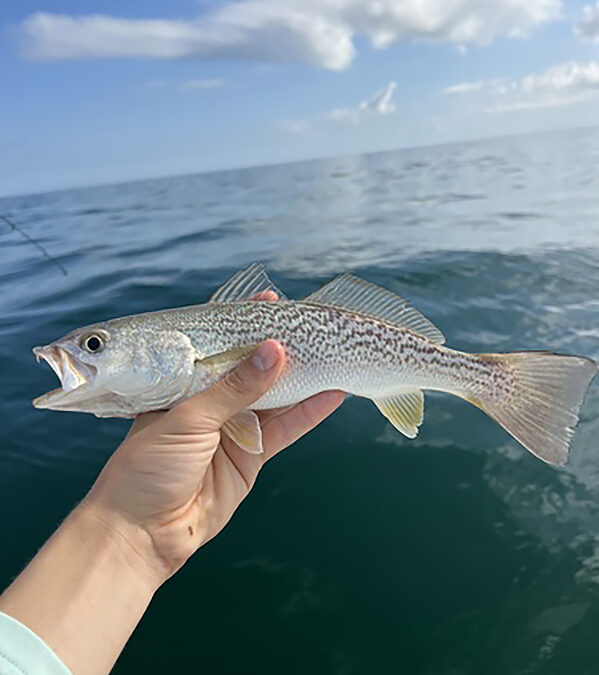
For generations of South Jersey anglers, weakfish were once as much a part of a day on the Bay as salt air, bait buckets and early-morning boat rides.
In Fortescue, the small Cumberland County fishing village that once proudly billed itself as the “Weakfish Capital of the World,” fishermen could expect to return to the dock with coolers full of the speckled fish.
Farther south, Cape May was another legendary destination for anglers hoping to hook a hefty “tide runner,” the nickname given to trophy-sized weakfish.
Today, those fish have become considerably harder to find.
Weakfish populations have been considered depleted along the Atlantic Coast since 2003, according to the Atlantic States Marine Fisheries Commission. Although fishing pressure itself is not currently considered excessive, scientists say unusually high natural mortality has prevented the stock from making a meaningful recovery.
The decline is particularly noticeable around the Delaware Bay, where weakfish once supported a thriving recreational fishing culture.
South Jersey has attracted generations of fishermen seeking weakfish, especially the enormous tide runners that migrated into local waters.
The connection is more than folklore. New Jersey’s state-record weakfish — an 18-pound, 8-ounce fish caught by Karl Jones in 1986 — came from the Delaware Bay. Those catches are almost unimaginable today.
Anglers are taking responsibility for the decline, assuming that overfishing has been the problem. Fifteen years ago, anglers could keep as many as 15 fish apiece. Today, New Jersey limits recreational fishermen to one weakfish of at least 13 inches per day.
But scientists say the reason weakfish have failed to rebound is more complicated.
The New Jersey Department of Environmental Protection claims that natural mortality — rather than current fishing pressure — appears to be one of the primary forces keeping the population low.
Researchers have examined predation from dolphins and striped bass, changes in water temperature, food availability, bycatch and other environmental factors. Gorzo said estimates have attributed a significant portion of weakfish mortality to dolphin predation, particularly when the fish move offshore during winter.
The Delaware River Basin Commission’s 2025 State of the Basin report classified the weakfish population as being in “poor” condition. While abundance measurements in the Delaware Bay were near historical averages in some surveys, the report found that weakfish survival remained low and catches of legal-sized fish had become uncommon.
Roughly 80% of weakfish recorded in one Delaware survey were younger than two years old, suggesting relatively few fish are surviving long enough to become the large adults anglers remember.
That matters because the giant weakfish of South Jersey fishing lore did not become tide runners overnight.
A fish had to survive multiple seasons, migrations and predators to reach trophy size.
Today, anglers may still encounter smaller weakfish in local bays and inlets, but the double-digit-pound fish that once drew people to Fortescue are increasingly rare.
The area was once such a well-known weakfish destination that a recent fishing podcast examining the species’ disappearance referred to the fish as the “Ghosts of Cape May.” Longtime fishermen have shared memories of childhood seasons when weakfish seemed almost limitless in South Jersey waters.
The question remains whether warmer water is pushing the fish farther north or changing their migration patterns. Some point to growing populations of predators such as striped bass and dolphins. Still others believe decades of historic harvesting played a role.
There may not be one simple answer.
The Atlantic States Marine Fisheries Commission currently lists weakfish as depleted but says overfishing is not occurring. A 2025 assessment update was not accepted for use in management decisions, and fisheries managers are beginning work on a new benchmark stock assessment to more closely examine the population and the causes of its unusually high mortality.
Until scientists better understand what is happening, strict harvest limits remain in place.
For South Jersey fishermen, however, weakfish are more than numbers in a fisheries report.
The weakfish are not gone entirely. Each spring and summer, anglers still find them along the South Jersey coast, and every big fish caught offers hope that the tide runners could someday become more than a memory.