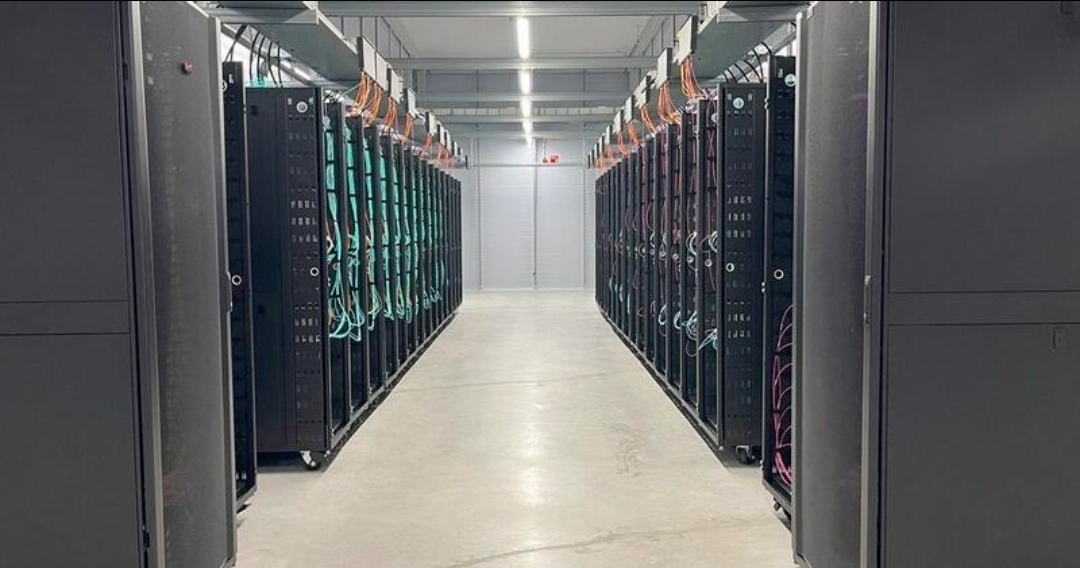
A massive data center in Vineland released significant amounts of air pollution while operating dozens of natural gas generators without required state permits for nearly a year, according to newly obtained public records and an analysis reported by Floodlight and The Guardian.
DataOne, a sprawling data center in Cumberland County, was fined $1.07 million by the New Jersey Department of Environmental Protection in September after inspectors discovered 62 large natural gas-powered generators installed and operating without required air pollution permits.
Now, additional records are providing a clearer picture of how long those generators were running — and how much pollution they may have produced.
According to an Oct. 1 investigation by Floodlight, generators began arriving at the Vineland facility in July 2025. Sixteen began operating in October 2025, another 16 went online in early February 2026 and all 62 were operating by June.
By the time state inspectors identified the generators during a July 29 inspection, they had collectively logged more than 46,000 hours of operation, according to a letter DataOne sent to the DEP and obtained through a public records request.
Researchers estimate 140 tons of nitrogen oxides
Floodlight provided technical information about the generators to Xiaomeng Jin, an assistant professor in Rutgers University’s Department of Environmental Sciences, and Bruce Buckheit, a former U.S. Environmental Protection Agency air enforcement official.
Jin estimated that the generators released approximately 140 tons of nitrogen oxides, commonly known as NOx, during their operation.
If compared with 2025 EPA emissions data, that amount would place the Vineland facility among New Jersey’s largest sources of NOx pollution, according to the analysis.
Nitrogen oxides are produced when fuels are burned. They contribute to the formation of ground-level ozone and fine particulate matter, both of which can pose health risks.
According to the EPA, exposure to elevated levels of nitrogen dioxide, one of the primary nitrogen oxides, can irritate the respiratory system and aggravate asthma. Children, older adults and people with asthma may be particularly vulnerable. Nitrogen oxides also contribute to particulate pollution and ground-level ozone.
At full operation, Jin and Buckheit estimated that DataOne’s generators could potentially release more than 1,500 tons of NOx annually. New Jersey considers a facility capable of emitting more than 25 tons of NOx per year a “major source,” a designation that triggers additional environmental review, pollution-control requirements and opportunities for public input.
State issues record fine
The DEP announced Sept. 22 that DataOne violated the New Jersey Air Pollution Control Act by installing and operating the 62 generators without required permits.
Each generator has a capacity of 1,982 kilowatts. New Jersey requires permits for generators with a capacity of 37 kilowatts or greater.
The DEP said inspectors discovered the generators during a July 29 inspection. The agency said they were not observed during its previous inspection of the property in December 2025.
The state ordered DataOne to obtain the appropriate permits or cease operation of the generators. The company was given 45 days to comply.
DataOne has disputed the DEP’s determination that the generators required permits under the circumstances but said it intends to apply for them. The company has also said it is transitioning the facility to lower-emission fuel cells as its permanent power source.
A Microsoft spokesperson said that the company expects its suppliers and partners to follow applicable environmental laws and said Microsoft was working with DataOne as the facility moves toward its permanent power system.
DataOne provides computing capacity connected with Dutch artificial-intelligence infrastructure company Nebius and Microsoft.
Residents had complained for months
For some Vineland residents, the revelations follow months of complaints about noise coming from the massive facility.
More than 100 noise complaints have been submitted to the Cumberland County Department of Health since March, according to records obtained by Floodlight. Several residents identified generators as a possible source.
A county health inspector investigating one complaint in May reported that the noise appeared to originate from at least two generators and exceeded nighttime noise limits, according to the records. A City of Vineland inspection report from February also noted that generators associated with the project’s first phase were online.
The timeline has raised questions among residents about why the unpermitted equipment was not identified earlier.
The DEP’s enforcement action came after a Floodlight and Guardian investigation used visual and thermal imagery to document large numbers of operating generators at the property. State officials subsequently confirmed the units lacked the necessary permits.
A growing local and national concern
The controversy comes as data centers rapidly expand across New Jersey and around the country to support cloud computing and artificial intelligence.
Data centers can require enormous amounts of electricity, prompting growing debates over how their power needs could affect utility infrastructure, energy costs and the environment.
The DEP’s order requires DataOne to come into compliance with state environmental regulations, but the generators are currently permitted to continue operating during the 45-day compliance period. According to the emissions analysis cited by Floodlight, the full generator fleet has the potential to emit more than four tons of nitrogen oxides in a single day.
As state officials determine what comes next for the Vineland facility, residents who spent months questioning the noise surrounding the property are now asking a larger question: what, exactly, has been entering the air around their homes — and how will New Jersey ensure it does not happen again?