
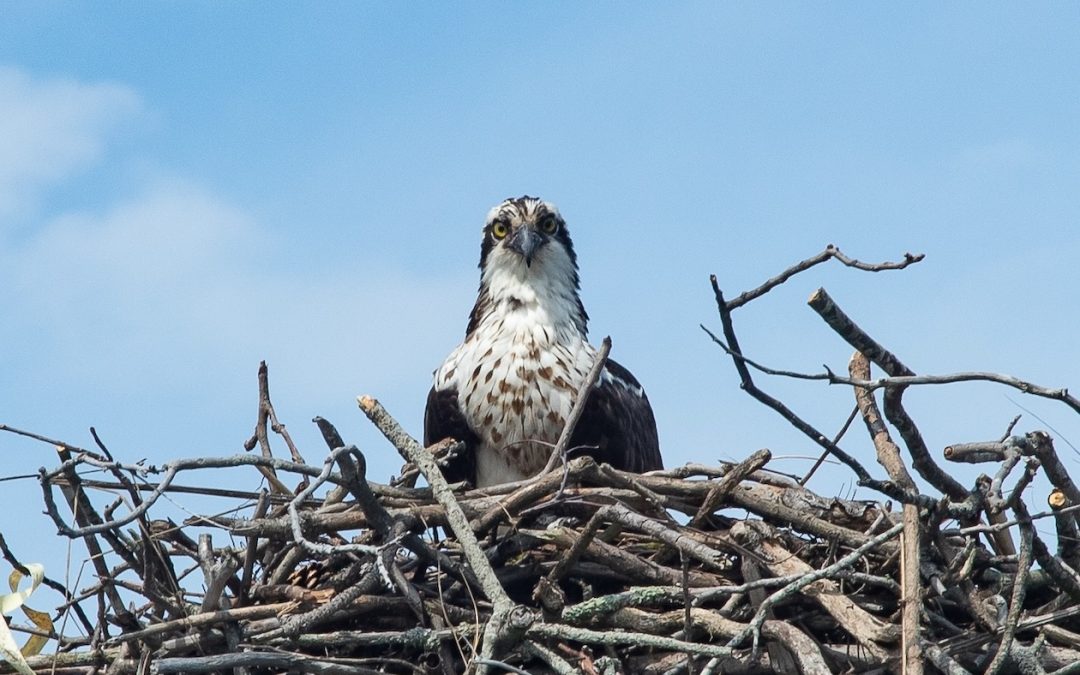
For decades, the return of the osprey has been one of New Jersey’s great conservation success stories.
Once pushed to the brink by pesticides and habitat loss, the distinctive brown-and-white raptors rebounded across the Jersey Shore. Their sprawling stick nests became familiar sights atop platforms, channel markers and utility structures overlooking marshes and back bays.
Now, researchers say that recovery is showing troubling signs of strain.
A recent Stockton University study along the Mullica River and Great Bay found an alarming loss of osprey chicks during the 2026 nesting season. Researchers monitored 27 nests, counting 54 eggs and three chicks during their first survey in May. By the end of June, they found 25 chicks. By mid-July, only 14 remained. The final survey in August counted just nine fledged young.
The roughly 85% loss recorded at those nest sites has raised concerns that the birds may not be finding enough food to successfully raise their young.
And South Jersey is not alone. Researchers around the Chesapeake Bay — one of the world’s most important osprey breeding areas — are documenting an even broader collapse in reproductive success. Scientists say the common thread may be a shortage of one small but extraordinarily important fish: Atlantic menhaden.
A comeback suddenly in question
Ospreys, sometimes called fish hawks, are exceptionally well adapted for life around the water. They feed almost entirely on fish, plunging feet-first into bays, rivers and creeks to grab prey with their curved talons.
That dependence on fish also makes them a useful gauge of the health of coastal ecosystems.
New Jersey’s osprey population was devastated during the 20th century, largely because of DDT, a pesticide that caused eggshell thinning in birds of prey. By the early 1970s, only about 50 to 60 nesting pairs remained in the state.
After DDT was banned and conservationists began installing artificial nesting platforms, the population steadily recovered. By 2023, New Jersey had recorded 800 occupied osprey nests. In January 2025, the state upgraded the osprey’s conservation status from threatened to stable.
However, during the 2025 season, the Conserve Wildlife Foundation of New Jersey surveyed 689 nests and determined outcomes at 507 active nests. Of those, 288 (about 57%) failed to produce any young. Only 352 young were produced statewide, a 56% decline from the recent five-year average.
Average productivity fell to 0.69 young per active nest, below the roughly 0.8 young per nest considered necessary to sustain the population.
The preliminary picture from 2026 has been no more reassuring.
Where have the menhaden gone?
Researchers are increasingly focusing on food availability. One particularly important species is Atlantic menhaden, commonly known as bunker.
Menhaden rarely receive the attention of dolphins, whales or striped bass, but they are a foundation of the coastal food web. The oily schooling fish are eaten by ospreys as well as larger game fish, marine mammals and seabirds.
For a growing osprey chick, they also provide a valuable package of calories.
Stockton researchers noticed adults bringing more flounder to some nests instead of menhaden. This can mean adult birds are expending more energy while returning with prey that provides fewer calories to their growing young.
Food stress can show up in several ways. Females may lay fewer eggs. Parents may spend longer periods away from their nests looking for fish. If one parent cannot bring home enough food, the other may have to leave the nest to hunt, potentially exposing eggs or chicks to predators.
And when food becomes especially scarce, the smallest chicks can starve.
Conserve Wildlife Foundation biologist Ben Wurst described finding dead or emaciated young in coastal New Jersey nests during the summer of 2026, including nests where multiple chicks initially hatched but none survived.
A warning from the Chesapeake Bay
The Chesapeake historically supports one of the world’s largest concentrations of breeding ospreys. Yet researchers with the Center for Conservation Biology reported that 2026 was the worst osprey breeding season ever recorded there.
Scientists monitored 973 osprey pairs across 23 study areas. In waters with salinity above 5 parts per thousand, pairs averaged just 0.25 fledged young, which is dramatically below the roughly 0.8 to 1.3 young per pair researchers say is generally required to maintain a stable population. Eighty-one percent of those pairs failed to fledge a single chick.
The contrast within the bay was striking. Ospreys living around fresher tidal waters, where other fish such as catfish and gizzard shad are available, performed significantly better.
Research published through the U.S. Geological Survey has likewise found strong differences between high- and low-salinity areas of the Chesapeake, with poor breeding performance associated with sections where ospreys depend heavily on menhaden.
Scientists are still studying the exact causes of changing menhaden availability. Commercial fishing is part of an ongoing fisheries-management debate in the Chesapeake, while weather, water conditions, fish distribution and other ecological factors can also influence when and where schools of menhaden are available.
The important connection for New Jersey is that researchers are seeing some of the same symptoms: hungry chicks, shrinking broods and parents apparently struggling to bring sufficient food back to their nests.
More than an osprey problem
The concern extends beyond one beloved bird.
Ospreys sit near the top of the coastal food chain, but their survival depends on what is happening below them. When fish populations change dramatically, the effects can ripple upward.
Menhaden are prey for striped bass, bluefish and other popular recreational species. They are also eaten by whales, dolphins, seals and numerous seabirds.
That makes struggling ospreys something like a warning light on the dashboard of the coastal ecosystem.
A shoreline can still have plenty of adult ospreys and appear healthy at first glance. The problem becomes more visible over time if those adults repeatedly fail to replace themselves with young birds.
New Jersey’s current adults are the products of decades of successful conservation. If too few chicks survive year after year, the effects may not become obvious until those older birds begin disappearing.
What can everyday people do to help?
There is no single backyard fix for a problem tied to an entire coastal food web, but South Jersey residents can still make a difference.
One of the simplest ways is to give active nests space. Boats, drones and people approaching too closely can disturb nesting birds, particularly during incubation and while chicks are young.
Residents can also pick up fishing line, plastic and other litter near waterways. Ospreys frequently carry human-made materials back to their nests, where fishing line and plastic can entangle adults or chicks. The Conserve Wildlife Foundation specifically encourages coastal cleanups and removing plastic litter from osprey habitat.
Citizen scientists can help researchers track the population, too. NJDEP encourages residents to contribute information about osprey nests through OspreyWatch, a monitoring program run by the Center for Conservation Biology. Observations collected by volunteers help scientists follow nesting activity and breeding success over time.
Supporting local wetlands and clean-water efforts also protects the marshes, creeks and bays where both ospreys and their prey live. Residents interested in the broader menhaden issue can follow fisheries-management proposals and scientific research as regulators consider how best to balance harvests with the needs of the wider ecosystem.
Perhaps most importantly, people can continue paying attention.
The osprey’s history in New Jersey is proof that wildlife populations can recover when people recognize a problem and respond. Half a century ago, seeing an osprey over a South Jersey marsh was becoming increasingly rare. Today, their nests are part of the landscape.
The challenge now is making sure there are enough young birds to keep filling those nests for generations to come.