
The terrier group, the final group of the AKC’s seven groups, is, in my opinion, the best group. Nearly all of the 32 breeds in the terrier group were bred to eliminate vermin without training or human prompting. All but eight of them originated in England or their territories. Known for being independent, I believe, if you want a dog with a big personality, you need a terrier.
Before the industrial revolution, rats and vermin, like mice, groundhogs, weasels, snakes, foxes, and badgers, posed health and safety threats to the human population, both by carrying disease and destroying crops and livestock. Farmers, in particular, needed to keep vermin populations under control and needed assistance in doing so. With the exception of four of the terriers, wire-coated independent dogs had needed to be bred to patrol farms and houses, killing vermin unguided by humans who had other chores to complete.
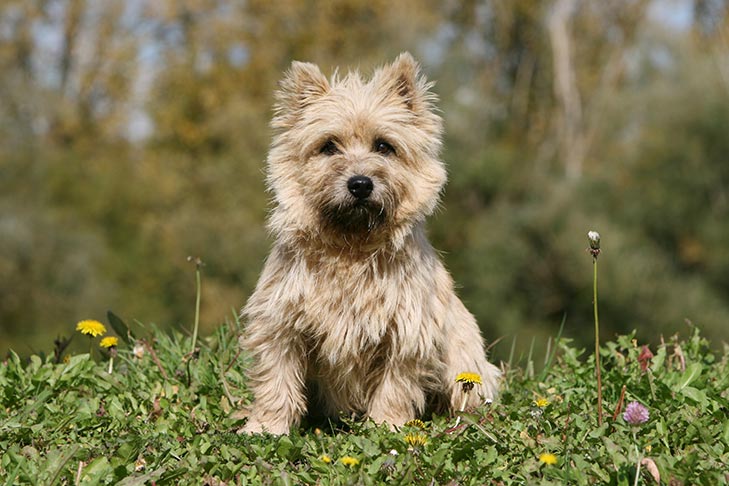
The oldest documented breed of terrier is the Cairn Terrier that dates back to the early 15th century and originated in the highlands of Scotland. The word “cairn” describes rock formations usually used as property boundaries, where foxes and rats would hide and later raid chicken coops or eat crops. The Cairn Terrier was used to flush the vermin out by going into the dens and holes underneath cairns. The word “terrier” means “of the earth,” which eventually meant, in the dog world, that terriers would “go to ground,” meaning they would go into holes or dig their own to get to the vermin. The Cairn Terrier is also most likely used to create the Scottish Terrier, Skye Terrier, and West Highland White Terrier.
As with Scottish Isle Terriers, English and Irish breeds of terriers were also bred to hunt vermin. Terriers such as the Smooth and Wire Fox Terriers, Lakeland Terriers, and the Parsons or Russell Terriers were bred to go into burrows and flush out foxes, skunks, otters, and badgers who would raid a farmer’s valuable chicken coops. Kerry Blue and Airedale Terriers are the taller of the vermin-oriented terriers and were known to be particularly fearless when it came to taking on foxes or badgers. The Manchester Terrier made records in the city of its origin, Manchester, England, for how many rats they could kill in one day.
Of the four breeds not developed in England or English territories, the Australian Terrier was deemed essential in protecting humans from venomous snakes in the rural, rough regions down under. The Cesky Terrier was created by a scientist of the Czech Republic Academy of Science who loved the tenacity of the Scottish Terrier but found their chests to be too wide for the narrower tunnels of their region. The Scotty was bred to the Sealyham Terrier to create the Czech Republic’s own version of ratting dogs. Four breeds unique to the United States are the Rat Terrier, the American Hairless Terrier, the American Staffordshire Terrier, and the newly added Teddy Roosevelt Terrier. The Rat Terrier was developed in the Midwest and is a mix of the Smooth Fox Terrier, the Manchester Terrier, and maybe the Bull Terrier. Farmers needed a fast small terrier to help quell a plague in the jackrabbit population, so they also mixed Whippet and Italian Greyhound into these dogs to create a very fast vermin-killer.
The four members of the terrier group that make up the bull and terrier crosses are the Staffordshire Bull Terrier, the Bull Terrier, American Staffordshire Terrier, and the Miniature Bull Terrier. Sadly, pit fighting dogs were a large part of England’s Victorian urban culture. The Staffy Bull and Bull Terrier both evolved from bulldogs who were the kings of bull-baiting and fighting because of their superior jaw strength. Both breeds were mixed with various terriers to create a very tenacious fighting dog. As pit-fighting became illegal, a man named James Hinks began to fine-tune the breeds into companion dogs and fancy-looking ratting dogs. The Bull Terrier was known as a “gentleman’s companion dog” of the Victorian times. As Staffy Bulls made their way to America, the Americans preferred a bigger-boned dog over their compact British cousins, hence the creation of the AmStaff as a separate breed. The Miniature Bull Terrier is exactly what the name implies: a miniature version of the Bull Terrier. For a brief time, miniaturizing dogs was a fad in England, though creating a smaller Bull Terrier proved to be difficult. The original Mini was plagued with health issues and almost died off. When the toy fad passed, the Mini Bull was saved from extinction by careful breeding.
There are no dogs like any of the terriers. Thanks to breeders that are as tenacious and dedicated as their dogs, these breeds retain their strong-willed, independent, and perhaps stubborn spirits. There is nothing like the devotion of a terrier breed. They will require an owner that is equally stubborn and strong-willed and, quite frankly, possessing a sense of humor to share the room with a terrier. Whether you prefer the smaller smart dog like the Scottish Terrier or the comic relief of my own breed, a Bull Terrier, the terrier group has something to offer everyone. And I promise you will never see a mouse in your home!
The dogs of the terrier group include: The Airedale, American Hairless, American Staffordshire, Australian, Bedlington, Border, Bull Terrier, Cairn, Cesky, Dandie Dinmont, Glen of Imaal, Irish, Kerry Blue, Lakeland, Manchester, Miniature Bull Terrier, Miniature Schnauzer, Norfolk, Norwich, Parson Russell, Rat, Russell, Scottish, Sealyham, Skye, Smooth Fox, Wire Fox, Soft Coated Wheaten, Staffordshire Bull Terrier, Teddy Roosevelt, Welsh, and the West Highland White Terrier.
If you have any questions, please feel free to email me at heidi@fouronthefloordogtraining.net.