
Margate is moving forward with another major flood-mitigation project after securing $2 million in federal funding to improve drainage around Minnie Creek, a low-lying back-bay area where heavy rain and high tides can combine to overwhelm the city’s stormwater system.
The Federal Emergency Management Agency grant will support the Minnie Creek Resiliency Project, which is intended to reduce flooding from rainfall events, particularly when tidal backwater prevents stormwater from draining efficiently into the creek. Minnie Creek sits behind North Exeter Avenue near residential cul-de-sacs and the Eugene A. Tighe School.
The work will include four new 24-inch storm outfalls at Marshall, Fremont and Fulton avenues. The project will also add a pile-supported concrete vault containing a self-regulating tidal gate. Under normal conditions, the gate will allow water to flow through the system, while helping limit tidal water from backing up during storms.
“The City of Margate continues to secure funding for projects to make our community more resilient,” Mayor Michael Collins said in the city’s Aug. 27 announcement.
The investment comes as flooding continues to be a recurring problem for the barrier-island community.
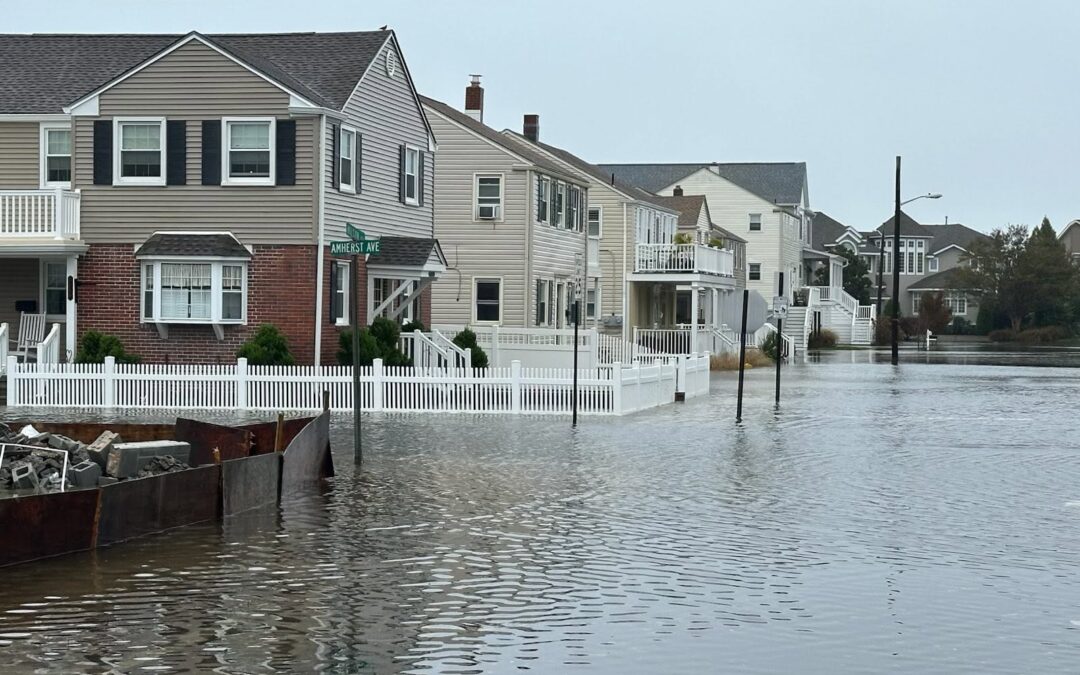
One of the most dramatic recent incidents occurred in August 2025, when tidal flooding associated with Hurricane Erin inundated streets even though the storm remained hundreds of miles offshore.
Margate firefighters rescued more than 50 people from flooded cars, restaurants and bars. Businesses along Amherst Avenue were inundated, and crews helped 16 people and three dogs escape vehicles stranded in floodwaters. Firefighters also responded to a gas leak, an underground transformer fire and an electrical fire during the storm.
The event illustrated how flooding in Margate does not require a direct hurricane strike. High tides, storm surge, heavy rainfall and drainage problems can overlap, leaving roads impassable and water surrounding homes and businesses.
That vulnerability has remained apparent this summer.
On Aug. 20, 2026, the National Weather Service placed coastal Atlantic County, including Margate, under a flood watch as forecasters warned that heavy rainfall could cause flooding in low-lying and poor-drainage areas.
Just eight days later, another round of thunderstorms prompted a flash flood warning for Atlantic County. Between one and three inches of rain had already fallen when the warning was issued, with another one to two inches possible. The National Weather Service specifically listed Margate among communities at risk and warned of flooding on streets, highways and in other low-lying areas.
By that afternoon, public reports indicated that two to four inches of rain had fallen in parts of southeastern Atlantic County and flash flooding was already occurring.
Long-term modeling also underscores Margate’s exposure. A First Street Foundation national flood assessment estimated in 2020 that roughly 93% of Margate properties faced some level of flood risk, with the share projected to rise to about 97% by 2050 under the model used at the time. First Street’s broader flood model incorporates rainfall, overflowing waterways, high tides and coastal storm surge when evaluating risk.
The Minnie Creek project is one piece of Margate’s wider effort to address that threat.
The city is also permitting a FEMA-funded pump station along Amherst Avenue, an area heavily affected during the Hurricane Erin flooding. More than $2.2 million from FEMA and other sources has been awarded for that project, with construction expected to begin later this year. Rutala Associates helped Margate obtain funding for both initiatives.
Together, the projects represent an effort to make Margate’s drainage infrastructure better equipped for the combination of rainfall and tides that has repeatedly put streets, businesses and neighborhoods underwater.