
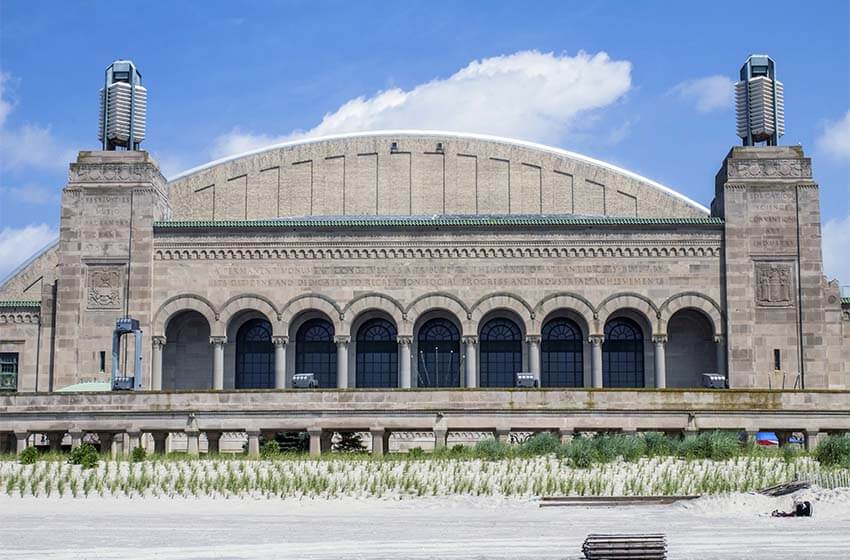
Atlantic City’s legacy as the birthplace of organized beach patrols will soon be highlighted at its permanent home.
The International Lifeguard Museum, a nonprofit founded in 2024, is working to create an immersive museum inside historic Jim Whelan Boardwalk Hall that celebrates the history, culture and life-saving mission of lifeguards while promoting water safety for future generations.
To help make that vision a reality, the organization will host a kickoff fundraiser on Aug. 19 at Boardwalk Hall. The museum has already received two reimbursable grants totaling $89,000 from the Casino Reinvestment Development Authority (CRDA) for concept development, budget planning and marketing, while organizers continue raising the $4 million needed for the full build-out.
The museum has been years in the making — approximately two, according to Dr. Rusty Silverman, a founding board member.
“We’ve been working on it pretty steady for the last couple years, and maybe conceptually a little bit before that,” he said.
Thomas Sykes, an architect and founding board member, credits former CRDA Executive Director Sean Patwell with helping move the idea forward.
Inspired by an immersive Van Gogh exhibit, Silverman envisioned a museum that would be more than a collection of artifacts.
“I was just so impressed by everything about it, especially the immersive experience where you would walk into this huge room and there were projected videos and images on the floor, ceiling, walls — all over the place,” he said.
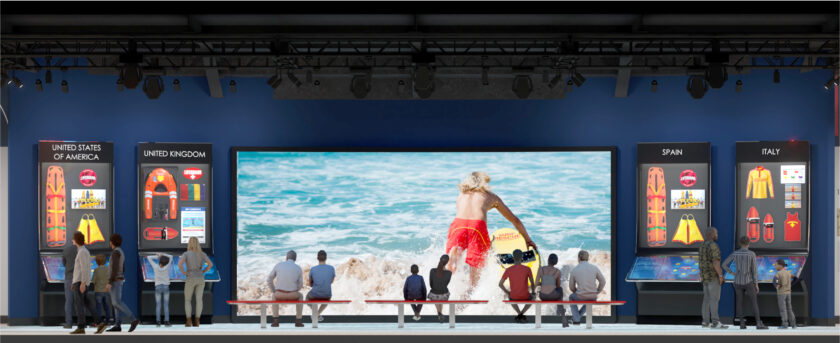
That vision evolved into plans for an interactive experience featuring storytelling, film and constantly changing audiovisual displays that will enable visitors to feel the unpredictability of the ocean.
“As you approach this little museum… you’ll feel like the water and the sand are beneath your feet. You’ll see the environment change around you constantly. You’ll see some very large audiovisual screens with some very dramatic rescues, and some very calm moments, and some very scary situations in which people demonstrated the training that’s common to lifeguarding around the world,” Sykes said. “So the idea is reflective of the reality and current abilities as well as the history, identity, art, culture of it. We want it to ever be fresh, like the ocean.”
Different backgrounds, one calling to showcase the lifeguard legacy
Silverman, a retired primary care physician who has spent more than 45 years photographing lifeguards, also has personal ties to the project.
He grew up admiring lifeguards and worked with them throughout his medical career, leading to his decision to use them as the subject of his photography.
When he was in medical school, his first job was as a medic at the States Avenue tent in Atlantic City, but as a child his experience was different.
“We looked at these lifeguards as the royalty of the beach. We just wanted to be close. We wanted to participate in their lifesaving,” he said.
Silverman recalled seeing lifeguards taking their boats out to guard the beaches from the water, and practicing by throwing out their buoys to the kids and pulling them into the boat.
In the latter part of his career, though, Silverman said he worked in longevity and health and wellness, where he conducted specialized tests on how individuals utilized oxygen while exercising.
“I was able to test some of these lifeguards, and they were in the best condition that I’ve seen people in,” he said. “So there was a connection between fitness and as part of subject matter, what I am looking for… [is] somebody that’s got a special charisma. But part of that charisma is part of their fitness.”
The museum will also provide a permanent home for Silverman’s collection of photographs.
For Sykes, whose family has a lifeguarding tradition dating back to the early 1900s, the museum is an opportunity to celebrate the values the profession instills.
“I welcome the idea of being able to celebrate both the educational, the athletic, the life-saving, especially, but the character that builds from the respect and from the identity of lifeguarding,” he said.
Education is also a key concept of the museum’s mission for board member Thomas McCann, a retired principal, author and lifelong South Jersey lifeguard.
“Chris Brown… had this urge to create a lifeguard museum… and he asked me if I would join them,” McCann said. “I’m enjoying it very, very much because it expands what I was doing in my books, making people aware of the ocean… and making people aware of how to be safe.”
McCann, who has written three books on lifeguarding history, said the profession shaped his entire life.
“It changed my life in so many ways… I got sand in my shoes right then, and it’s still there. I just can’t get the sand out,” he said.
He hopes the museum helps people understand that lifeguards are much more than people sitting in elevated chairs watching the surf.
“The misconception is that they know everything they’re doing, and they don’t,” McCann said. “You never know what’s going to happen, but when you are a lifeguard and you feel that responsibility, you will react.”
He also believes the museum will become an important educational resource for schools.
Preserving history, teaching water safety
Beyond preserving history, organizers hope the museum becomes a center for water safety education. According to the Centers for Disease Control and Prevention, about 4,000 people die from drowning each year in the United States.
“I think safety is the primary feature,” Sykes said. “Everyone needs to learn to swim, and that’s the number one priority.”
Organizers also envision the museum as an international resource where lifeguarding techniques, technology and experiences can be shared around the world.
“I see this as a hub,” Sykes said. “Nothing’s going to be static in any of our environments.”
The museum’s location inside Boardwalk Hall was made possible through the support of the CRDA, which also helped provide early funding.
“They not only identified a site, but they really created a funding source to make it happen,” Sykes said. “I think we all should be very grateful to them.”
Although the museum remains in the planning stages, Sykes said the project is moving forward, with construction expected to follow the design process.
In the meantime, the nonprofit continues raising funds while building excitement for what organizers hope will become a must-see attraction on the Atlantic City Boardwalk.
When asked what he hopes visitors leave with, Sykes said, “Gratitude to lifeguards.”
Silverman hopes they’ll leave feeling excited.
“I think that there’s going to be a wow factor,” he said. “I think that this museum is really going to pop, and people are going to walk away with that feeling. There’s going to be a level of excitement that will be palpable.”
Julia graduated from Rider University in 2024 with a BA in multiplatform journalism and minor in social media strategies. In addition to reporting on local news for Shore Local, she is a social media strategist for small businesses. Connect with her: shorelocaljulia@gmail.com or @juliatrain on Instagram.