
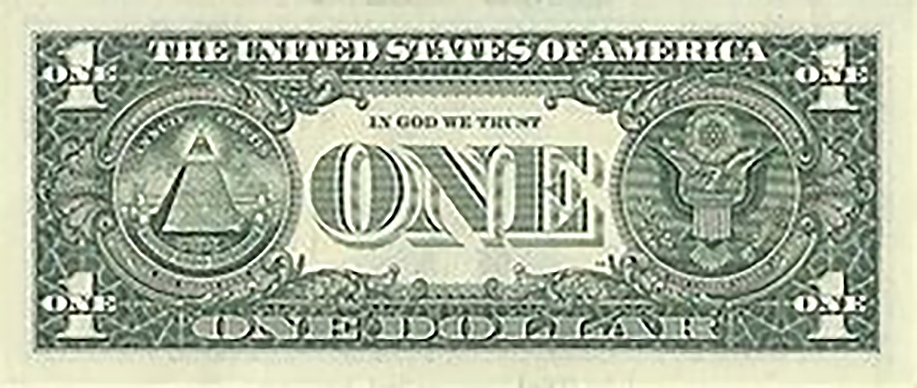
Let’s explore the reverse of the $1 bill and the meaning behind its design.
“United States of America” is printed prominently across the top, clearly identifying the country of origin. The word “one” and the numeral 1 appear a total of 10 times on the reverse, making the bill’s value difficult to overlook.
The phrase “In God We Trust” appears above the large word “One” in the center. It was first added to paper currency on the Series 1957 $1 silver certificate after President Dwight D. Eisenhower signed legislation requiring the motto to appear on U.S. currency.
As a side note — no pun intended — “In God We Trust” first appeared on U.S. coins in 1864, during the Civil War, when it was placed on the newly created 2-cent coin. The motto reflected the heightened religious sentiment of the country during the war.
Both sides of the Great Seal of the United States are represented on the reverse of the $1 bill.
The front, or obverse, of the seal appears on the right and features an American bald eagle, representing national sovereignty, with the national shield on its breast. The eagle holds an olive branch with 13 leaves and 13 olives in its right talon, symbolizing peace. In its left talon are 13 arrows, representing the nation’s readiness to defend itself. The number 13 is a recurring reference to the original colonies.
A ribbon held in the eagle’s beak bears the Latin motto “E Pluribus Unum,” meaning “Out of many, one.” The phrase refers to the unity of the original colonies under one national government. Above the eagle’s head is a group of 13 stars surrounded by clouds.
The reverse of the Great Seal, shown on the left side of the bill, depicts an unfinished pyramid representing strength and permanence. Its unfinished condition suggests that the United States remains a work in progress, with room to continue growing and improving.
The pyramid contains 13 levels, again representing the original states. At its base is the Roman numeral MDCCLXXVI, which translates to 1776, the year the Declaration of Independence was adopted.
Above the pyramid are the Latin words “Annuit Coeptis,” which are generally translated as “He has favored our undertakings.” The phrase contains 13 letters. Below the pyramid are the words “Novus Ordo Seclorum,” meaning “A new order of the ages.”
At the top of the pyramid is the Eye of Providence, surrounded by rays of light. The image traditionally symbolizes divine guidance watching over the nation.
There is a remarkable amount of history and symbolism packed into that small piece of paper.