
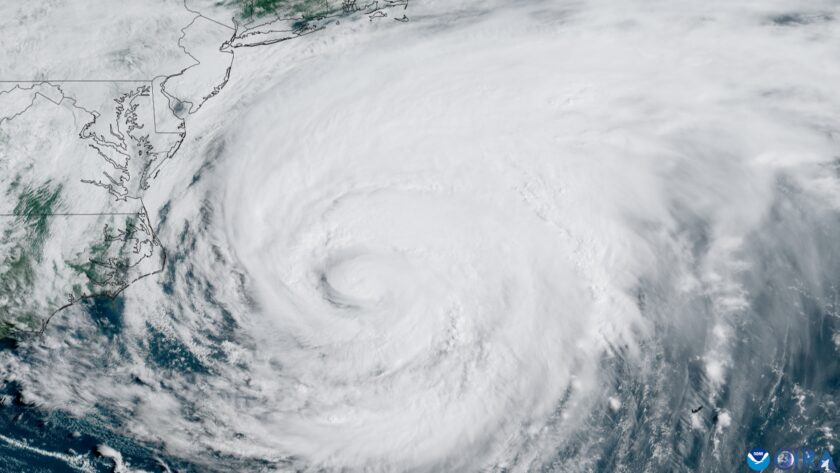
The Atlantic Hurricane season runs from June 1 to Nov. 30. We know that very well here in New Jersey, as does Colorado State University – yes, landlocked Colorado State University which just put out one of the most anticipated hurricane forecasts of the season.
On April 9, CSU released its 2026 Atlantic Hurricane Season forecast at the National Tropical Weather Conference in South Padre Island, Texas.
2026 Atlantic Hurricane Season forecast
The forecast calls for 13 named storms (a tropical storm or a hurricane) including six hurricanes, two major hurricanes – a Category 3, 4 or 5 with maximum sustained winds of at least 111 mph.
This is slightly less active than average, and less than last season. The difference is that last season had four major hurricanes, while the forecast for this year calls for two.
Likelihood of a tropical storm or hurricane
Colorado State University also breaks down the forecast into probabilities for statewide impacts.
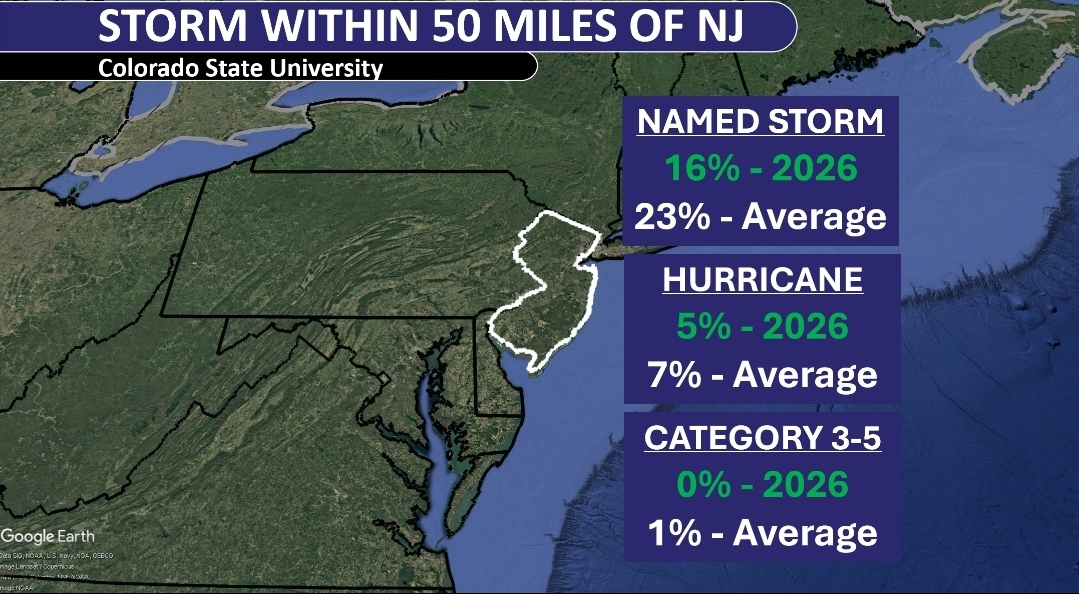
New Jersey faces a 16% chance of a named storm this season, which is 7% below the historical average. The outlook for hurricanes is also quiet: the 5% probability of a standard hurricane is below average, and the risk of a major hurricane – Category 3, 4, or 5 – is effectively 0%. That isn’t a major departure from the norm as the state’s average risk for a major strike is just 1%.
Virginia and Massachusetts are the only two states with a double-digit percentage chance of a hurricane being within 50 miles of their states, at 14% and 10% respectively. All other states are in the single digits.
El Niño, the biggest hurricane season factor
When we look at the hurricane forecast factors for 2026, the biggest one is the transition to El Niño, which we are expected to have by July. This suppresses hurricanes.
When you have an El Niño, that means you have warmer-than-average ocean temperatures off the equatorial Pacific Ocean. In other words, the ocean is warmer than average off the coast of South America, extending to about south of Hawaii. That helps rip storms apart as they try to develop and move westward across the Atlantic.
Secondly, the trade winds that blow from Africa to the Caribbean are stronger. That means more stability in the atmosphere and fewer storms. We are expecting to transition to El Niño during July or August, and we could even see a Super El Niño as we go into the late fall and winter.That impacts on our 2026–2027 winter forecast, which we wrote about in Shore Local April 2.
Other hurricane season factors
Beyond El Niño, all other factors point toward more activity than usual.
From January through March of this year, we had warmer-than-usual Atlantic Ocean waters, stronger upper-level winds and a warmer-than-usual western Pacific Ocean.
All of that, for different reasons, increases the likelihood of more storms.
As we get to August, temperatures are forecast to be warmer than average in the Central Atlantic Ocean. The Central Atlantic is the key breeding ground for the long-track hurricanes that go from Africa to the Caribbean, and possibly up the East Coast of the United States.
So, imagine a tug of war – let us say one strong person matches up against four children. The El Niño-suppressing hurricane season is usually going to win out. However, you still have four smaller factors, the children, pointing the other way toward a more active season.
Learning from history
Colorado State University looks at analog years, or years with similar conditions going into the hurricane season as we have now. Four stood out to them.
- 2006 was one example – that had lower-than-average tropical activity.
- 2009 was another example. Here, only nine named storms occurred, with three hurricanes. That is significantly quieter than usual.
- 2015 was also less active.
- 2023 is the most recent analog year. However, that was more active than average.
More of the analog years point toward a less active hurricane season.
Another way to look at hurricane season
Accumulated Cyclone Energy, or ACE, combines the intensity and duration of a storm into one number. The stronger a storm is, the higher the ACE.
For example, Superstorm Sandy in 2012 had an ACE of about 13.5 on its entire journey from the Caribbean to a Brigantine landfall.
Sandy lasted for eight days as a tropical cyclone, peaking as a major Category 3 hurricane. This did not even include ACE potential had Sandy been a tropical cyclone during the time of landfall.
Meanwhile, Tropical Storm Fay in July 2020, which also made landfall near Brigantine, had an ACE of 1.5. Fay spanned just three days, and it was never more than a mid-range tropical storm.
CSU predicts a below-average year for total storm power, forecasting an Accumulated Cyclone Energy (ACE) score of 90 compared to the historical average of 123.
Closing thoughts
This forecast is good news for us at the Jersey Shore and for the entire Atlantic Hurricane Basin.
But remember, it only takes one storm to hit New Jersey for it to feel like an active season near us. Even last year, where no hurricanes struck the United States, we still had Hurricane Erin bring the highest summertime tide on record for much of the South Jersey shoreline.
Joe Martucci, a Certified Broadcast Meteorologist and Digital Meteorologist, is the President and Director of Meteorology for Cup A Joe Weather and Drone. You can connect with him at cupajoe.live.