
Every second matters when someone is struggling in the ocean. Lifeguards sprint toward the water. Police officers race across the beach. Beachgoers point frantically toward the waves.
Hovering hundreds of feet overhead, drones are becoming one of most effective tools helping police departments and beach patrols locate distressed swimmers, monitor dangerous conditions and, in some cases, deliver lifesaving flotation devices before rescuers can physically reach someone in trouble.
Along the South Jersey coastline, the technology is changing the way emergency responders approach water rescues. Rather than replacing lifeguards, drones are providing them with something they have never had before: an aerial perspective that can make the difference between minutes and seconds.
That advantage was on display in Ocean City on July 12, when police deployed one of the department’s rescue drones during an emergency involving swimmers in distress offshore.
Equipped with a flotation device, the drone flew directly over the victims and dropped the buoy into the water while lifeguards made their way through the surf. The additional flotation helped stabilize the situation until rescuers reached the swimmers, highlighting exactly why departments across the region have begun investing in drone technology.
Rip currents remain one of the greatest dangers facing beachgoers each summer. According to the National Weather Service, these powerful channels of fast-moving water can pull even experienced swimmers away from shore.
Traditionally, rescues relied solely on the speed of nearby lifeguards or emergency personnel. While Ocean City Beach Patrol has long been regarded as one of the nation’s premier lifeguard organizations, even the fastest response requires time.
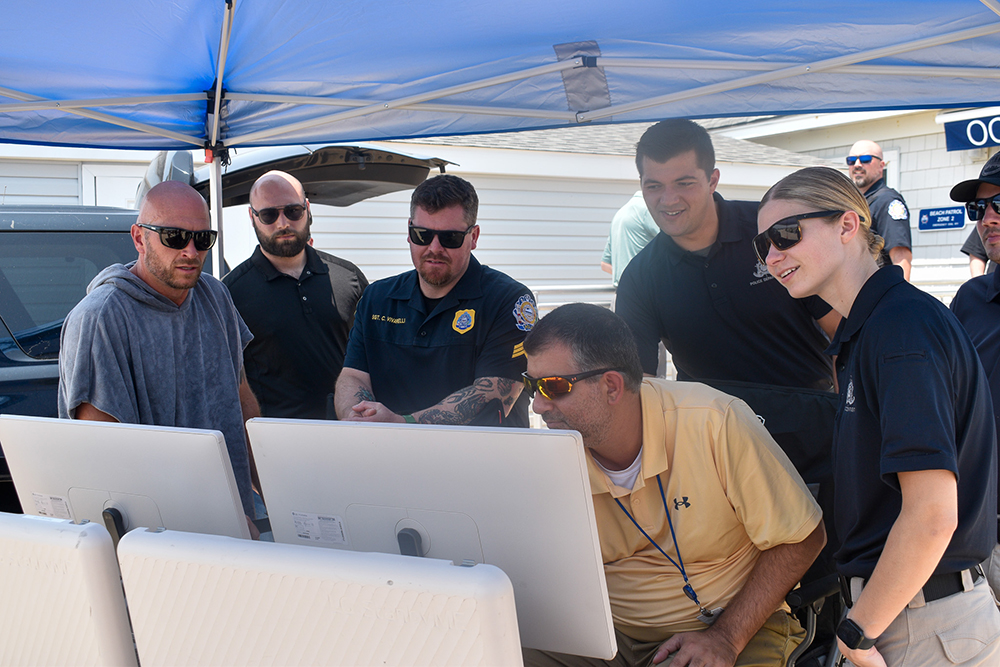
Ocean City’s Police Department now operates specialized drones capable of carrying and releasing inflatable flotation devices. Once an emergency is reported, operators can launch the aircraft within moments and send it directly to the victim using GPS and onboard cameras. If needed, the flotation device can be released with remarkable accuracy, providing something for the swimmer to hold onto while awaiting rescue.
“It’s like another piece of lifesaving equipment,” Ocean City Police Lt. Mark Pancoast explained during a public demonstration of the program. Rather than replacing human rescuers, the drones serve as an additional resource that buys valuable time.
Ocean City Beach Patrol officials say that extra time can be critical.
Someone caught in a rip current often exhausts themselves fighting the water. Simply having something to grab can reduce panic, conserve energy and significantly improve their chances of survival before lifeguards arrive.
Beyond delivering flotation devices, drones provide something equally valuable: visibility.
Standing on the beach, rescuers can quickly lose sight of a swimmer amid breaking waves, glare from the sun or crowded shorelines.
From above, however, drone cameras provide a clear, real-time picture of the entire rescue scene.
Operators can identify the exact location of a struggling swimmer, monitor changing rip currents and guide lifeguards toward the safest approach. During large-scale incidents involving multiple victims, aerial footage helps emergency responders coordinate their efforts more effectively.
That perspective has already proven invaluable in Ocean City.
Drone footage released by police has documented complex rescues involving numerous swimmers caught in dangerous surf, giving emergency personnel an immediate overview of conditions that would otherwise be impossible to obtain from ground level. The technology also helps identify hazards before emergencies occur.
Police can monitor overcrowded beaches, observe dangerous swimming conditions and quickly locate missing children or vulnerable individuals in the crowds that fill Jersey Shore beaches every summer.
Atlantic City first responders have also incorporated drones into their emergency response strategy, particularly for ocean rescues. Similar to Ocean City’s program, the drones are equipped to quickly reach victims offshore and deploy flotation devices while emergency crews make their way through the water.
Officials say the technology allows responders to cover much greater distances than they could by foot alone, particularly along Atlantic City’s expansive beachfront.
In rescue situations, those saved seconds can become lifesaving minutes. Despite the growing capabilities of drones, beach officials are quick to point out that the aircraft are not replacing trained lifeguards.
A drone cannot swim through pounding surf. It cannot perform CPR. It cannot physically pull someone from the water. Instead, drones function as an extension of the rescue team.
Ocean City Beach Patrol continues to rely on highly trained lifeguards whose knowledge of surf conditions, rip currents and rescue techniques remains the cornerstone of beach safety. The drone simply gives those rescuers additional information and another tool during the crucial first moments of an emergency.
The capabilities of rescue drones continue to improve each year. Many newer systems feature high-definition zoom cameras, thermal imaging that can help locate people in low-light conditions, automated flight paths and increasingly precise payload release mechanisms.
Artificial intelligence is also beginning to assist operators by identifying swimmers, detecting unusual movement patterns and helping search large areas more efficiently.
While much of that technology is still emerging, South Jersey departments are already demonstrating how practical drone applications can enhance public safety today.
Earlier this year, Egg Harbor Township Police participated in an intensive multi-agency search for 17-year-old Joel Medina, a teenager with autism who disappeared from his home and wandered into dense woods. For nearly 36 hours, local, county, state and federal agencies searched the area using K-9 teams, helicopters, drones and specialized search crews.
The breakthrough came late on the second night of the search. Using aerial infrared technology, search teams detected a heat signature deep within a densely wooded area. The teen was found curled beneath a tree after spending two nights outdoors in temperatures that had fallen to about 35 degrees. Rescuers navigated swampy terrain, heavy brush and fallen trees to reach him before safely reuniting him with his family.
The investment reflects a broader shift in emergency response, where technology complements — not replaces — the judgment and experience of first responders. Even with sophisticated equipment overhead though, officials emphasize that prevention remains the most effective lifesaving strategy.
Sarah Fertsch of Egg Harbor Township holds a Bachelors of Arts in Public Relations. She is a locally renowned poet, storyteller, and dog lover.