
The Route 50 bridge over Cedar Swamp Creek in Upper Township will be replaced in a new project starting this fall, and the governor is excited about it.
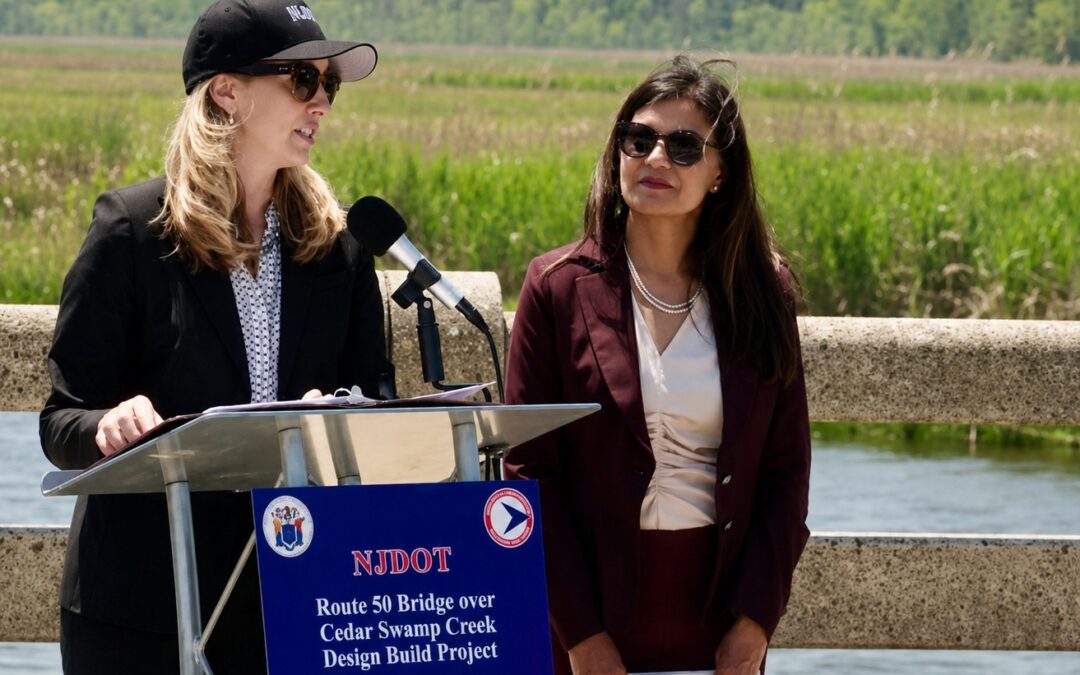
Gov. Mikie Sherrill came to Cape May County Wednesday, May 20, to announce the award of a $47.7 million contract to replace the Petersburg span. She was eager to tout the potential efficiencies of a new procurement process called “design-build.”
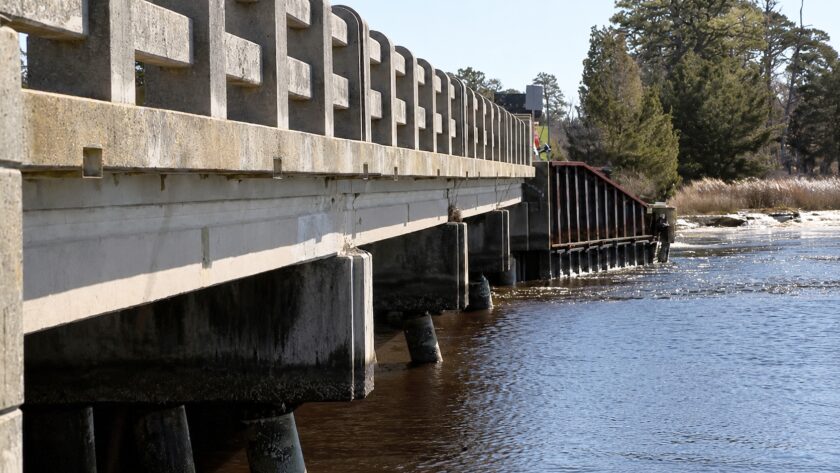
While the 65-year-old structure is rusting with visible cracks in its concrete, the design-build method is brand new – at least to the New Jersey Department of Transportation.
“Today, we’re not only replacing this bridge as planned, but for the first time in DOT history we’re doing it in a new way,” Sherrill said during a wind-swept press conference on the bridge.
Under the design-build method, design and construction work are merged into a single contract. Processes occur simultaneously instead of in sequence, allowing construction to begin while the final design details are still being finalized.
It replaces the traditional design-bid-build framework, which requires a project to be fully designed and put out to bid before the first hole is dug. The new, streamlined approach is expected to be faster and more efficient.
It shows so much promise that NJDOT is advancing two more design-build projects – a Route 9W bridge project in Bergen County, and an I-295 project in Mercer County.
The single contract was awarded to Agate Construction Co., Inc. and a joint venture partnership of A. Servidone Inc. and B. Anthony Construction Corp.
“We don’t need two different companies designing and building these kinds of projects,” Sherrill said. “Too much can get lost in translation, causing delays and driving up costs.”
NJDOT Commissioner Priya Jain pointed out that the bridge, which spans just 162 feet, is vital for the safety of residents and the millions of visitors traveling to and from the shore each year.
“It is also part of the official coastal evacuation route, making reliability and resiliency especially important,” said Jain, noting that the county’s population swells from 90,000 to 700,000 at the height of the tourist season.
“This is a key bridge right here,” Sherrill said. “This is how people evacuate in a hurricane.”
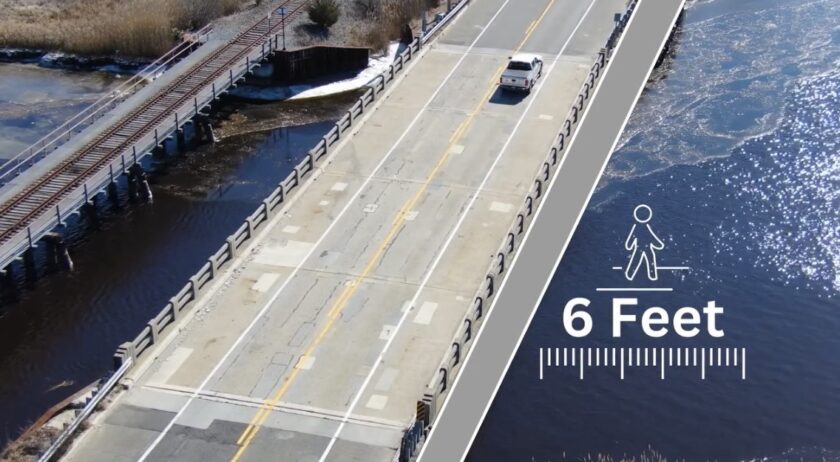
The new bridge will be tall enough to survive the flood of a 100-year storm, according to the project specifications. Its vertical clearance will increase by 4.75 feet to 11.64 feet above mean low water, and 8.65 feet above mean high water, according to Steve Schapiro, DOT spokesman.
The existing bridge currently has two lanes that are 12 feet wide each, with 8-foot-wide shoulders. It runs parallel to and downstream from an NJ Transit railroad bridge, operated by the Cape May Seashore Line. The new bridge will have 10-foot-wide shoulders making it safer for disabled vehicles, a 6-foot-wide future-use pedestrian pathway along the southbound lane, and improved drainage.
Though it’s higher, the project adds no advantage to boaters because the adjacent rail bridge will remain unchanged. And, although a 6-foot-wide pedestrian pathway is being added, anglers are also out of luck as fishing will remain prohibited on the bridge for safety reasons, as it is today.
“Currently no fishing is allowed on the bridge, and it will continue to be prohibited after the completion of the new bridge for safety purposes,” Schapiro said.
Construction is expected to start in the fall with some preliminary work beginning sooner than that.
“The bridge will stay open during construction and it will take about 2½ years for it to be done,” Jain said. “The teams will start getting ready next week.”
The bridge will stay at least partially open throughout the project, with construction expected to proceed on one side before moving to the other, according to NJ.com. Lane closures are also not anticipated during the summer months, website reported.
NJDOT will issue advisories, post updates to its website, inform local officials and the media before making any lane closures or detours, Schapiro said.
Cost estimates for replacing the bridge have risen steadily since first presented to the public. NJDOT estimated the project at approximately $12 million in January 2019, with construction then planned for 2023–2025. By July 2025, the anticipated cost in conceptual planning documents had climbed to $35.8 million. When the bridge went out to bid this time, the budgeted range was $50-$75 million.
With a final number coming in at a $47.7 million, design-build can claim its first win.
Copy editor and Contributing Writer James FitzPatrick has been a community journalist in Atlantic and Cape May counties for more than 30 years, including 20 years as editor of The Current Newspapers. He lives in Hammonton.
Photos provided by the New Jersey Department of Transportation