I always say if you are going to do anything, do it right.
And that is especially true when it comes to writing an autobiography. How many times have you ripped open a celebrity’s supposed “tell-all” to find out they haven’t really told you anything you already didn’t know?
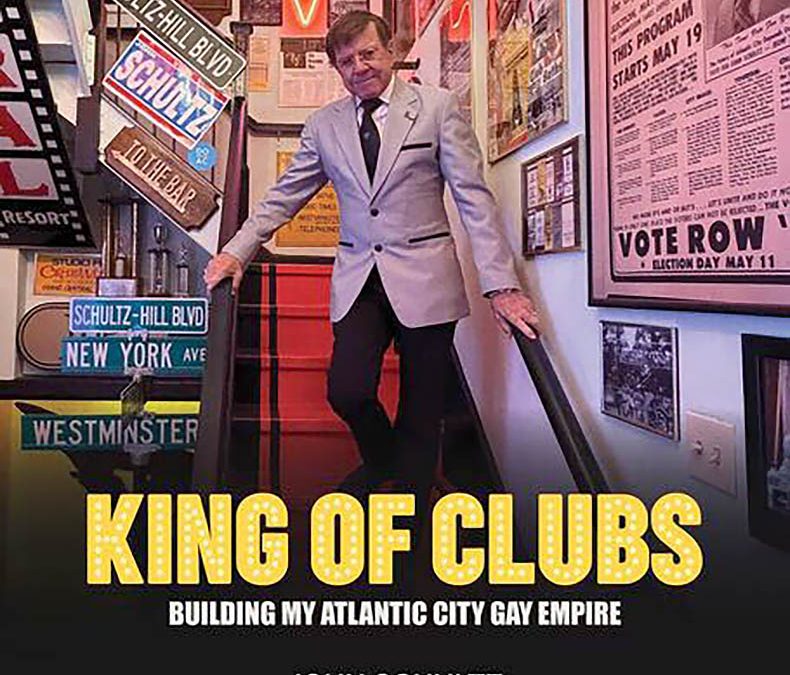
I guarantee that will NOT be the case if you read “King of Clubs: Building my Atlantic City Gay Empire,” the four-year project of my good friend John Schultz, an Atlantic City icon who did not hold back anything in his autobiography that is available at Schultz-Hill.org.
As he said, “no bulls—t!”
If you know Schultz, the fact that he bared it all — including some pretty risqué photos of himself showing off his still impressive physique — is not a surprise. Whether you like it or not, or whether you like him or not, Schultz has made a career telling people the way it is.
“This was a labor of love, if there ever was one,” Schultz said “It took me four and a half years to write this book. There’s no BS in it. It’s really all factual. I didn’t exaggerate anything. You know, it’s funny. All my friends would tell me … I would tell stories about the clubs and the city and all of my experiences, and they would always say, ‘You should write a book, John, you should write a book.’ So, now it’s done.”
Schultz is blunt, candid, to the point, proud, embarrassed, loving, angry and pretty much every emotion you would expect from a man who has lived a loud and proud gay lifestyle for most of his 85 years on the planet.
In the 382-page riveting page-turner, Schultz could have easily danced around subjects like his first gay encounter, coming out of the closet, politics, his response to the HIV/AIDS crisis and his time in prison, but that’s not how John Schultz approaches anything.
What truly validates “King of Clubs” as a great biography is that you don’t have to know him to appreciate it. If you know him, it’s even more special, but if you don’t, it’s the kind of story that could be made into a movie for the masses.
“I love it when strangers come up to me and tell me how much they liked the book,” Schultz said. “That means more to me than when my friends tell me they like it.”
“King of Clubs” is a classic underdog story as Schultz chronicles his journey from living in poverty in Atlantic City and dropping out of school after eighth grade to become a prominent hotel owner, nightclub entrepreneur, legendary businessman, cutthroat politician, creative philanthropist and advocate and the challenges getting there.
If you’re love reading about Atlantic City in its heyday, Schultz vividly describes pre-casino-era Atlantic City and its evolution to the second largest gaming empire in the United States.
Like everything else Schultz does, the book is gorgeous. Every page of the hardcover is glossy, meaning Schultz can put black and white or color photos on any page he chooses to better illustrate each chapter. That’s part of the reason why the book is $55, a little pricier than some. The other reason is that the proceeds of the book will go to the South Jersey AIDS Alliance, one of the many entities he helped create.
“I wanted the book to be a classy book,” Schultz said. “I’m not worried about making a profit. There’s no profit. The profit all goes to the charities. I’m not going to make any money on the book, but I just wanted to do something in my life to finish off all the things that people told me I should do with my stories I told. And there’s some very interesting stories.”
That’s an understatement.
Humble beginnings
Even though Schultz now lives part-time in Florida with his longtime partner and husband Gary Hill, Schultz is an Atlantic City guy through and through.
“I grew up in the inlet section of Atlantic City,” he said. “My first business was when my father got a television. He was a truck driver, and a television got damaged. So, he got the television for $60, and we put it in our living room. And my first business at 7 years old was you could come see the ‘Howdy Doody Show,’ but you had to bring two 2-cent returnable bottles. That was my first business. I never got a bicycle for Christmas. We couldn’t afford the bicycle.”
But Schultz grew up in a loving household even though it was a poor one.
“I love my parents, Schultz said. “My parents were the best parents in the world. They were just loving, and my father was my mentor. He gave me all my advice. One of the things he said, ‘Son, you got to make your mark before you’re 30.’ And when I was 29 years old, I was doing really well. And a lot of it had to do with luck and perseverance. My father always said to me, ‘Son, what you have in your life is your word. Always keep your word. And admit it when you’re right. And defend it when you’re wrong.’ And I get goose pimples talking about it because he was such a good mentor to me. He kind of said, ‘If somebody really hurts you bad, really, really bad, and you want real good revenge, the best revenge is make yourself better. That will piss them off more than anything.’ So that’s what I did in my life. I made myself better.”
Hard work defined Schultz’s life, but luck and relationships also came into play.
“The biggest break in my life was the cheapest break in my life,” Schultz explained. “That was when I bought the Larkin bar on the boardwalk. And I was working at the Flanders Hotel. I was there for 10 years. And I was making $15,000 a year, which was pretty good back in 1973. And I worked there. And I worked in Philadelphia. These two guys came in who owned the Larkin on the boardwalk at New York Avenue, and they said, ‘You want to buy the bar?’ And I said, I can’t afford it. I said there’s no way I can afford $25,000. They said, ‘How much can you afford? Can you afford $15,000?’ I said, ‘Yeah, but I don’t have the money.’ ‘Can you get us $5,000 down?’ I couldn’t believe it. They were giving me an offer I couldn’t refuse.”
That resulted in Schultz getting into the bar and club business, which would later make him a fortune. Schultz eventually systematically acquired real estate around the New York Avenue and Westminster Avenue corridors — now known as Schultz-Hill Boulevard. At his peak, he owned and operated nine gay clubs, discos, and hotels simultaneously, building what locals dubbed “Schultz World.” The narrative brings readers directly into the glitz of legendary properties like Studio Six, his crown jewel and a national nightclub phenomenon that hosted massive dance crowds before finally closing its doors in 2004; The Grand Central Resort, the largest gay hotel and resort complex on the East Coast; and The Brass Rail/Club Tru, Saratoga, and Chez Paree, high-energy entertainment hubs that attracted an estimated 250,000 LGBTQ+ tourists to Atlantic City during holiday weekends in the 1970s.
“When I first started figuring it out, everybody wanted to get into disco business,” Schultz said. “And I’m saying to myself, ‘What about the older guys that went on a piano bar? Or what about the lesbians? Or what about the locals?’ And I started figuring this out. If a gay person is going to spend a dollar in Atlantic City, they’re not going to spend it in the disco. There’s going to be different markets. And I started covering all the markets.”
Schultz’s success even blew his mind, particularly after he went after the gay beach crowd.
“The first weekend, the Memorial Day weekend, I went up to my office to count the money,” he said. “And everything was cash. There was no credit card. And all the money was soaking wet from the bar. It’s funny I remember stuff like that. But I would put a pile there and say, There’s the payroll. There’s the liquor bill. There’s the rent. There’s the insurance. And I put all the cash out there. And that weekend, I paid all the bills, and the last pile had $16,000 in it. Wow! I worked a whole year for $15,000. I went to my boss. I gave him my two-week notice. He said, ‘I’ll give you $25,000.’ I said, ‘No, it’s too late now. I got it.’ Now I know I can make money.”
Schultz attributes a great deal of his success to the way he treated others
“I made sure I took care of my employees,” Schultz said. “They were the most important asset I had. And that’s one of the reasons why it was a good success. I took care of all my employees just like they were family. And they were honest and loved me back and helped me become a success. There’s no shortcuts in life. My father said to me, ‘Son, find a job you love and you’ll never work for the rest of your life.’ And I love bartending. I love the bar business. And it’s true. I don’t know how I did it. I do not know where I got the energy from. I worked 23 hours a day. I guess I loved it.”
Touchy subjects
Throughout the 48 chapters, Schultz mostly chronologically tells his story starting from his first job peddling newspapers for The Press of Atlantic City to revealing fun, thorough stories of his sex life.
“Some of the stuff in the book is a little touchy. I mean, I went on just a little bit about my sex life, but everything is the truth. A friend of mine said he wouldn’t have the guts to write a book that revealed so much about yourself. And I said, ‘Yeah, but I’m 85 years old. I have nothing to worry about.’ I was in my 20s, and I realized I was gay. I had girlfriends and good times and everything like that. But all of a sudden, I don’t know what happened to me. But I’m very happy now. I’m with Gary going on 40 years now.”
One of the stories revealed how Schultz wouldn’t sleep with his customers when he was a bartender.
“Oh, no, no. That would ruin my tips.” Schultz said with a laugh. “When you’re a bartender, honestly, you become a psychiatrist. Because everybody comes to bring to you their problems. And you learn a lot. You learn a lot about people. And you can figure out people real quick. And I could figure out people in my life really fast. I knew what to do to advance myself and what not to do.”
The memoir takes a somber, analytical turn during the late 1970s and 1980s. Schultz explains how the legalization of casino gambling in Atlantic City artificially caused land values to skyrocket. Corporate casino developers bought out and demolished the historic gay resorts and bars. He outlines what historians call the “opportunity of emptiness” that allowed the neighborhood to flourish initially, and how corporate encroachment ultimately fractured the physical gay district.
Schultz also wrote about his 6-month prison sentence.
“I got 6 months for $32,000 if you can figure that out …. $32,000 I didn’t pay in taxes,” Schultz said. “It was a setup. I looked at it this way: I used it as a mechanism to retreat myself. When I went into prison, I knew what I was doing for the next two years. When I came out of prison, I knew what I was doing for the rest of my life. I analyzed myself. It was 6 months of calculating your whole life and realize what you are doing, and why I am doing it.”
If he did hold back anywhere, it was not naming casino executives and politicians in a bad light, especially in his thoughts how legislation hurt Atlantic City by limiting casinos to 500-room hotels and other restrictions.
“You could build a McDonald’s anywhere in the United States, but you can only build a casino in Atlantic City and Las Vegas,” Schultz said. “Had this town copied Las Vegas’ model, this town would have been booming, and the real estate would have been worth a fortune. They blew it.”
Celebrities and music
Music and entertainment plays a big part in the book and Schultz’s life. The book mentions Patsy Cline, Sinatra, Joan Rivers, Liza Minnelli, Billy Joel and a plethora of entertainers who came through Altantic City, many who Schultz got to know because they frequented his clubs.
“Our motto in Studio 6 was, ‘We’re entertainers, we’re entertained.’ And the biggest part was when casinos had to close at 4 in the morning, all the entertainers would come to Studio 6. There was just so many of them that I can’t even name them.”
Many of them were closeted looking for a comfortable place.
“Of course. Yeah. Peter Allen used to come. He used to do Resorts for New Year’s Eve, and I used to have breakfast with him every day,” Schultz said. “You know, he’d come in the club at night, we’d have breakfast, and then he’d go back to the hotel. But, Connie Francis, Michael Feinstein, all these entertainers, they would all come in. I would get a call at 4 in the morning saying, ‘So-and-so is here,’ and I had to get dressed and go over there and do all the stuff, you know?’ Some celebrities wanted privacy, some didn’t mind being bothered.”
More to come
Schultz also details his role as a foundational creator of the famous Miss’d America Pageant, a drag pageant born as a parody of the Miss America pageant that raised millions for HIV/AIDS charities, as well as the other philanthropic endeavors he still is part of, including the MBCA Foundation, which beautifies Atlantic City to make it a better place to live, work and visit, and the Schultz-Hill Foundation, which promotes the arts in Atlantic City.
The book’s mid to late chapters shifts focus toward the devastating onset of the HIV/AIDS epidemic, chronicles his political organizing, his tenure as an Atlantic City Councilman, becoming a pilot and owning an airplane, his devoted partnership with Hill and facing getting older.
Most of the buildings Schultz made his fortunes in are gone, but Schultz remains a fixture of Atlantic City’s community scene, raising money for nonprofits and politicians and hosting some of the city’s most elaborate, chic parties like he always has with the who’s-who of South Jersey along with Hill.
“Gary has never stopped supporting me,” Schultz said. “He has always been there for me. When they named Westminister Avenue Schultz-Hill Boulevard a couple of years ago, I was ending the book with the last chapter, ‘It’s a Sign,’ and was going to be about the sign and Schultz-Hill Boulevard, but Gary said, ‘I think you should end it with a chapter titled Sunrise/Sunset’ because we have a house in Florida and we love our sunsets. The book ends by saying, ‘God, I’m in the fourth quarter of my life now. I’m just asking for a little overtime.’”
Well said.
“King of Clubs: Building my Atlantic City Gay Empire” by John Schultz is available at Schultz-Hill.org.
Scott Cronick is an award-winning journalist who has written about entertainment, food, news and more in South Jersey for nearly three decades. He hosts a daily radio show – “Off The Press with Scott Cronick” – 4 to 6 p.m. weekdays on Newstalk WOND 1400-AM, 92.3-FM, and WONDRadio.com. He can be reached at scronick@comcast.net.