
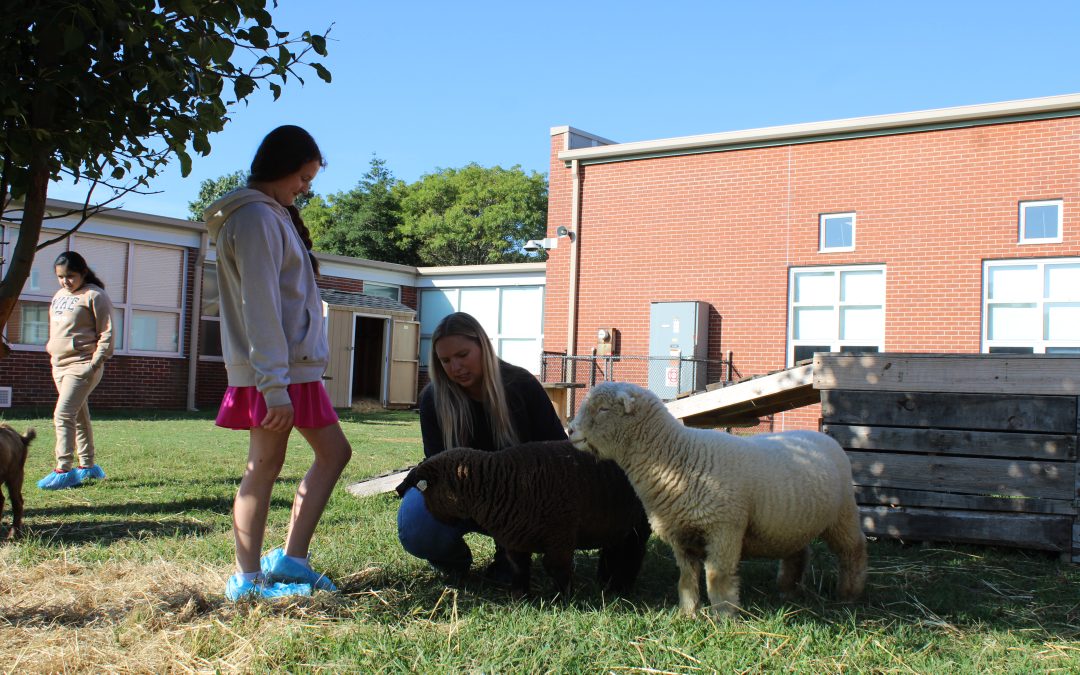
At Absecon Public Schools, a student having a difficult day might step outside the classroom and find something unexpected waiting just a few feet away: two goats and two sheep.
The district’s new Therapy Animal Farm is home to Nigerian dwarf goats VanGoat and Goatzart and babydoll sheep Midnight and Marshmallow, four furry additions whose names were chosen with help from students, staff and the community.
The animals arrived on the Absecon school campus in May, giving them time to acclimate to their new environment before the district began expanding student programming around them during the summer. Absecon Public Schools describes the project as the first therapy farm of its kind at a New Jersey public school.
But Superintendent Dr. Daniel Dooley is quick to make an important distinction. “It’s not a petting zoo,” Dooley said.
Instead, the farm is the latest evolution of Absecon’s years-long work with therapy animals, designed to give educators, counselors and specialists another tool to support students academically, socially and emotionally.
The idea grew from more than a decade of Dooley’s experience with therapy dogs, first in another district and later in Absecon. Therapy dogs became part of Absecon Public Schools after Dooley arrived as superintendent in 2018, with animals incorporated into literacy programs, counseling, physical therapy, self-contained classrooms, behavioral incentives and the district’s Reset Rooms.
Dooley said those experiences encouraged the district to look more broadly at the connection between children and animals.
District officials researched animal-assisted interventions, visited farms and traveled to Green Chimneys in New York, where a therapeutic educational setting uses animals and farm environments extensively in its work with children.
“There was just no denying that there is something special there for certain subpopulations of children,” Dooley said.
Before moving forward, the district sent board members and staff to observe programs and learn about the research behind animal-assisted interventions. Staff also visited multiple farms as they learned the practical side of caring for goats and sheep.
“I grew up in a townhome,” Dooley joked. “I didn’t know much about what it took to take care of a sheep or a goat.” That meant finding people who did.
Green Chimneys began providing professional development for members of Absecon’s Child Study Team in May 2026. Shelby McCardell, owner of Straight Shot Farm in Egg Harbor City, has advised the district on animal care, while Dayna Troiano of Dayna Troiano Pet Services provides training for the animals and handlers.
Dr. Rachel Scotland-Aschenbach, one of the owners of Absecon Veterinary Hospital, donates her time to provide veterinary care for the farm animals, while Merck Pharmaceuticals has donated their vaccinations and medications.
“It’s just been an amazing collaboration,” Dooley said.
A farm in the middle of a school campus
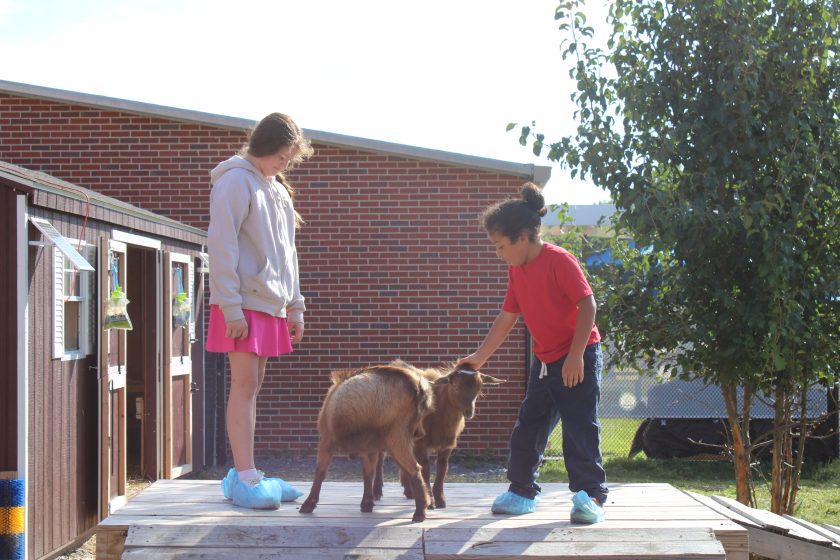
The result sits along the athletic side of the Absecon school campus, tucked into an enclosed area close to classrooms at the Marsh Elementary and Attales Middle School complex.
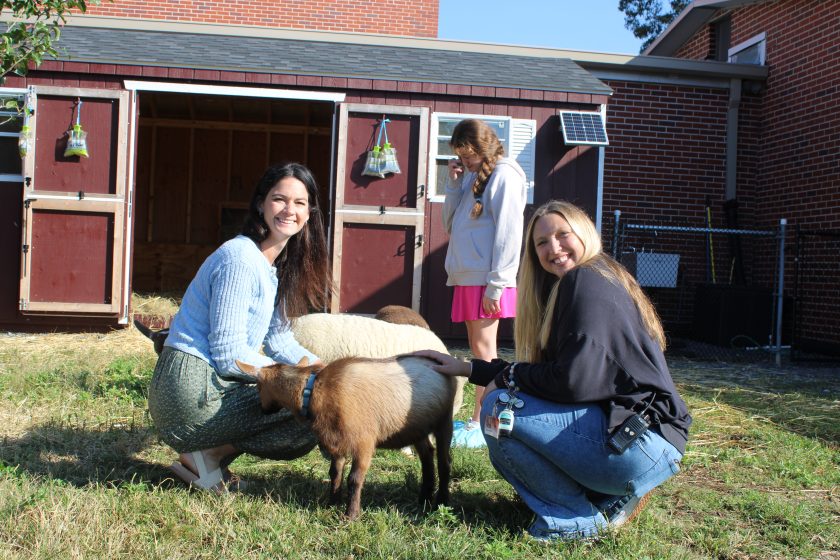
The animals have two barns, fenced outdoor space, play and climbing areas and specialized water systems. One barn measures about 20 by 16 feet, and Dooley said the enclosure gives the four animals roughly four times the recommended amount of space.
The water system allows the animals to activate a fountain when they need a drink, with water immediately draining rather than sitting in a shared container. That reduces the risk of cross-contamination while helping prevent water from becoming excessively warm in summer or freezing during winter.
Facilities Secretary and Therapy Farm Caretaker Kelci Allen said the animals are already showing very different personalities.
The goats, she said, can almost resemble dogs in their eagerness for human attention. Because they were bottle-fed, they are accustomed to close contact with people and often seek out petting, scratches and interaction.
The sheep are a little more independent.
“We kind of speak of them like cats,” Allen said. “They do what they want when they want.”
Marshmallow was bottle-fed and was initially more outgoing, while Midnight took more time to become comfortable. Now, Allen said, both will approach students, walk alongside them and make it clear when they would like attention — and when they are ready for some space.
Understanding those signals is part of the experience.
Students from preschool through eighth grade can participate in the program, but time at the farm is purposeful and requires parental permission. Permission forms also identify allergies or other concerns that could affect a child’s participation.
“Education is not one size fits all,” Dooley said. “This may not be for everyone, and that’s okay.”
The farm, he said, is another resource available when it makes sense for an individual child.
Turning four animals into motivation
For some students, simply earning a trip to see VanGoat, Goatzart, Midnight and Marshmallow can be a powerful incentive.
Taylor D’Augustine, behavior specialist for Absecon Public Schools, said she has worked with students who struggle with following directions, communicating their needs or regulating their emotions.
One strategy involves a puzzle depicting one of the farm animals. When a child successfully meets a behavioral goal, another puzzle piece is earned. Once the animal is complete, the student earns a visit to the farm.
The incentive proved memorable enough that students returned to school already asking about it.
“I already have students coming up to me from last year saying that they’re ready to build their puzzle and do it again,” D’Augustine said.
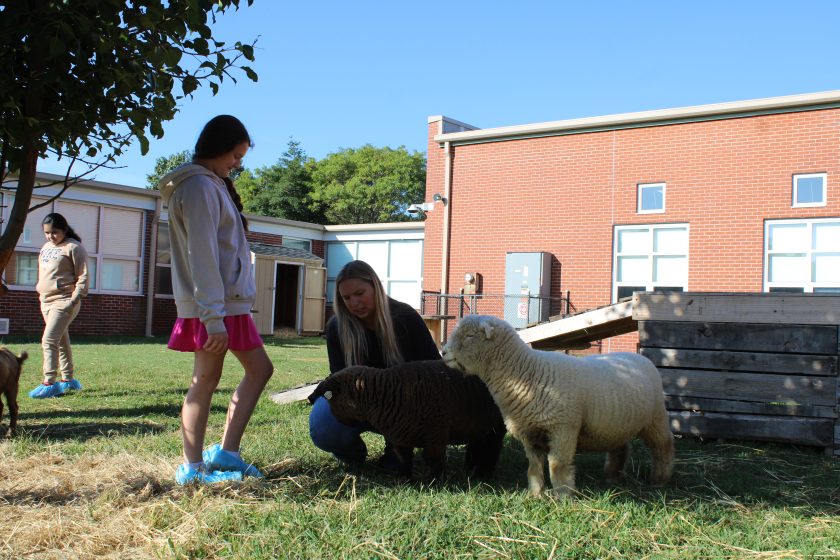
At H.A. Marsh Elementary School, counselor Mary Alvarado said time with therapy animals is also offered through “Marshy’s Market,” the school’s positive reinforcement program.
Students earn tickets for positive behavior and can select among different rewards.
Spending time with the therapy animals, Alvarado said, is the “number one seller.”
The animals may also provide motivation for students struggling with attendance. Knowing that an interaction with an animal awaits them can give a child something positive to anticipate when coming to school.
Alvarado also uses therapy animals while working with students on empathy, responsibility, self-control and positive interactions with others.
“They’re part of our Marsh family,” she said.
The farm is also beginning to move beyond behavioral rewards and counseling.
One of the district’s self-contained classes has expressed interest in helping care for the animals as part of life-skills instruction. Staff are exploring ways students can practice following directions, communicating appropriately, waiting, interacting with peers and learning the daily responsibilities involved in caring for animals.
D’Augustine said the outdoor environment can also offer another setting for students who may find the traditional classroom distracting or challenging.
Building on results with therapy dogs
The concept is new, but Dooley said Absecon is building it on lessons learned from years of using therapy dogs.
According to internal data cited by Dooley, when a child experiencing a meltdown or crisis had access to a therapy dog, staff were able to help the child return to class in under three minutes. Without a therapy animal available, he said, the process took more than 17 minutes.
The district also observed an academic difference among students participating in its therapy-dog-supported literacy efforts. Dooley said about 80% of participating students reached their end-of-year benchmark, compared with fewer than 40% of a comparison group without the same therapy-animal incentive.
Absecon’s therapy dog program has changed over the past year.
Skye retired in June 2025 and died earlier this year. His sister, Hope, retired in June after nearly nine years as a working therapy dog. During her career, Hope logged 1,383 visits at schools and other community facilities, according to the district.
The district’s current therapy dog is Luna, another Greater Swiss Mountain Dog, who completed her certification this spring and began working with students.
The farm gives Absecon an opportunity to determine how some of the benefits it has seen with dogs might translate to a very different animal-assisted setting.
For Dooley, one part of the benefit may simply be leaving the physical space where a student became upset.
He compared it with Absecon’s Reset Rooms, which give children in distress an opportunity to enter a different environment with multisensory tools designed to promote calm.
At the farm, that separation can be even more pronounced.
A child can leave a classroom and, within a few steps, be “out in the middle of four animals and something unrecognizable from a school, but also part of the school,” Dooley said.
Keeping students and animals safe
That does not mean students simply walk outside and begin petting the animals.
Safety is a central part of the program, Dooley said.
Absecon is using what the Association of Animal-Assisted Intervention Professionals, or AAAIP, calls a “Diamond Model” for animal-assisted interventions.
Under that approach, a trained staff member focuses on the student and the educational, behavioral, social or emotional goal of the interaction, while a separate caretaker focuses on the animal’s needs and behavior.
That differs from a “Triangle Model,” in which one handler may have responsibility for both the student and animal at the same time.
“We send a caretaker out there of the animals at the same time,” Dooley explained. “The caretaker is advocating for the animals, and the licensed staff member is advocating for the child.”
Absecon has approximately 10 to 15 people involved in caretaking duties. During the school day, staff members are available to feed and check on the animals, while an evening rotation ensures someone returns to check water, hay and the animals’ condition.
Handlers have also completed a proctored exam through AAAIP covering subjects such as animal temperament, safety, health and zoonotic diseases.
Dayna Troiano Pet Services works with the animals and handlers, and an outside evaluator observes interactions as part of the certification process.
“We’re dealing with people’s most prized resources in their children,” Dooley said. “There’s zero room for error.”
Grants and community partners foot the bill
The project has largely been made possible through grants and outside partnerships rather than local tax dollars, according to district officials.
Absecon received grants through AtlantiCare and the Charlotte Helen Bacon Foundation to help establish the farm. Those funds paid for the animals, structures, fencing, water equipment, hay, straw, minerals and other startup needs.
Dooley said the district finished the previous school year with approximately $10,000 remaining in the program even after the initial farm had been established.
Ongoing veterinary care from Scotland-Aschenbach is donated, while Merck is providing vaccinations and medications.
The district has also launched a Therapy Farm T-shirt fundraiser to generate additional support for the program.
More than 300 children had already positively interacted with the farm animals during summer programming, including students participating in the district’s STARS summer program and tutoring, according to Dooley.
Recognition beyond the district
Absecon’s work with therapy animals has increasingly taken Dooley beyond the city’s schools.
In December 2024, Dooley testified as an expert witness before the New Jersey Assembly Education Committee in Trenton in support of A-1165, proposed legislation that would establish a three-year pilot program to study the academic, social and emotional effects of therapy dogs in elementary schools.
The district said Dooley drew on more than a decade of experience with school-based therapy animals while speaking in support of the legislation.
His work also extends to the Association of Animal-Assisted Intervention Professionals. Dooley is a founding member of AAAIP, an affiliate of Pet Partners, and has served as its chairperson since 2020. He has presented on therapy animals at education and therapy-dog conferences and helped other schools establish programs of their own.
During the Shore Local interview, Dooley said he was scheduled to travel to Washington, D.C., the following day for a meeting with U.S. Rep. Jeff Van Drew regarding the district’s therapy-animal work.
Dooley said interest from other educators has continued to grow as well, with Absecon helping dozens of other New Jersey school districts explore therapy-animal programming.
That attention is now turning toward the farm.
Learning as the program grows
Absecon is not treating the arrival of four animals as the finished product.
The district plans an Oct. 9 professional development program focused on animal-assisted interventions, bringing together experts from organizations and universities around the country. Dooley said school districts from Atlantic, Cape May, Cumberland and Ocean counties were invited to participate either in person or virtually.
Some of the professionals involved in the training have already worked with Absecon staff, including experts who provided professional development earlier this summer.
Dooley said he wants staff members to develop an understanding of the farm organically, identifying ways the program fits within their own roles rather than rushing to make the animals part of every aspect of the school day.
“The goal,” he said, is to understand what the program can offer and how it can benefit the specific children in front of educators this year — while recognizing that those needs may look different next year.
For now, VanGoat, Goatzart, Midnight and Marshmallow are settling into life as some of the most unusual members of the Absecon school community.
And sometimes, a student who needs a reset can leave behind desks, hallways and classroom walls and spend a few minutes in a place that feels nothing like school.
Even though it is still part of it.