
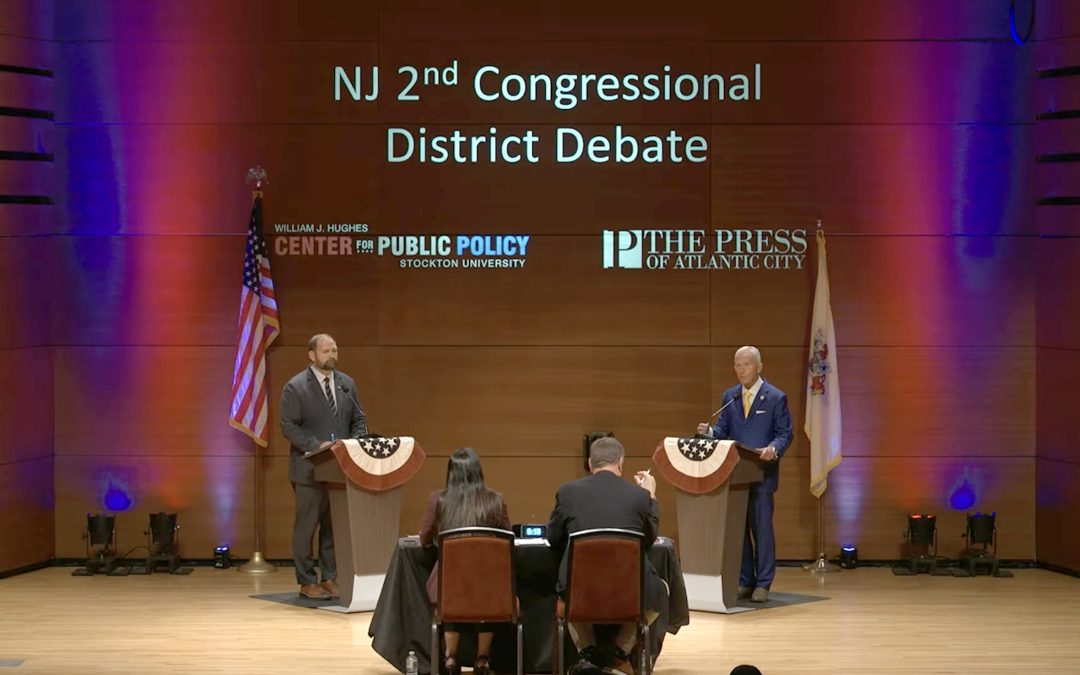
Republican U.S. Rep. Jeff Van Drew and Democratic challenger Zach Mullock clashed over the economy, health care, energy policy, immigration and government accountability during an Oct. 22 debate for New Jersey’s 2nd Congressional District.
The one-hour debate, co-sponsored by Stockton University’s William J. Hughes Center for Public Policy and The Press of Atlantic City, was held at Stockton’s Galloway campus without an in-person audience. Press of Atlantic City Digital Editor Nicholas Huba and Hughes Center Assistant Director Alyssa Maurice moderated the discussion.
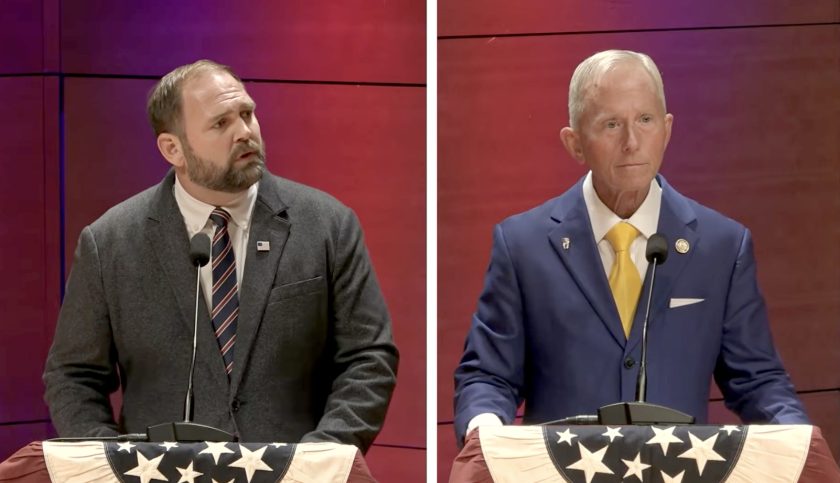
and Cape May Mayor Zack Mullock debate at Stockton University.
Mullock, the nonpartisan mayor of Cape May, repeatedly criticized Van Drew’s support for President Donald Trump, arguing that federal policies have increased costs for South Jersey families. Van Drew defended his record, accused Mullock of misrepresenting his votes and highlighted federal funding he said he secured for the district.
The candidates frequently interrupted one another, particularly during discussions of Medicaid, offshore wind, the war in Iran and data center development.
Affordability and health care
The candidates offered competing explanations for rising household costs, including electricity bills, grocery prices and health insurance premiums.
Mullock said he would work to reverse policies he attributed to Van Drew and Trump, citing tariffs, federal health care changes and the war in Iran.
He argued that changes to Medicare and Medicaid funding would disproportionately affect South Jersey’s poorest counties and called for policies to strengthen the middle class.
Van Drew rejected Mullock’s characterization of his voting record, saying he had never voted to cut Medicare or Social Security. He argued that Mullock’s proposals would increase taxes on workers, retirees and families.
“I never voted to cut Medicare,” Van Drew said. “There was never even a vote on cutting Medicare that ever existed.”
On Medicaid, Van Drew said seniors, people with disabilities and working families with children would continue receiving benefits. He defended proposed work requirements for some recipients, saying eligible individuals could work, attend school or participate in volunteer programs.
Mullock cited the Congressional Budget Office in arguing that federal legislation would reduce Medicaid funding. He also raised concerns about Social Security’s long-term financial outlook, proposing changes to the interest rate earned by the program’s trust fund and an increase in the income cap on Social Security taxes.
Van Drew said protecting Social Security would require bipartisan cooperation and said he was open to raising the income cap as part of a broader solution.
Energy costs and offshore wind
Rising electricity and fuel prices prompted another exchange, with both candidates blaming the other party’s policies.
Van Drew criticized New Jersey’s energy policies and argued that the state needed additional energy generation capacity, including natural gas. He also opposed offshore wind development, saying it could increase costs and harm the environment and commercial fishing industry.
Mullock challenged Van Drew’s position, pointing to his previous support for offshore wind during his time in the state Senate. Mullock said he voted against an offshore wind measure as Cape May mayor because of concerns about the environment and commercial fishing, while maintaining support for renewable energy where appropriate.
“I believe very much in our future in renewable energy,” Mullock said. “We need to go full steam ahead with solar panels.”
Both candidates also connected energy costs to the conflict in Iran. Mullock argued that the war had contributed to rising fuel prices and criticized Van Drew’s support for the administration.
Van Drew denied that Congress had held a vote to authorize the war, saying his opposition to a measure calling for an immediate end to hostilities was intended to protect U.S. troops and prevent instability in the Middle East.
Mullock called the conflict “a war of stupidity” and argued that the United States lacked a clear agenda and exit strategy.
On fuel prices, Van Drew said his approach includes improved domestic refining capacity and reduced dependence on foreign energy sources.
“The issue with gas, and with diesel — and with oil in general — is the ability to refine it,” Van Drew said. “There is something that’s called sweet crude, and there’s also something that’s called sour crude. In this country, we haven’t built the refineries that we need. We should no longer be depending on the Mideast and other countries.”
Immigration and coastal protection
The candidates expressed support for border security but differed over enforcement tactics and the treatment of immigrants living in the district.
Van Drew called for faster processing of legal immigration applications and defended stricter enforcement of immigration laws. He criticized New Jersey’s sanctuary policies, arguing that cooperation between state and federal authorities would improve enforcement.
Mullock also supported a strong border and the removal of violent criminals but called for a pathway to citizenship for immigrants who have lived in the United States for years without breaking the law.
He criticized immigration enforcement tactics that he said frightened residents and children, arguing that enforcement should be carried out with “decency and dignity.”
The discussion also turned to coastal protection, a significant issue for communities along the Jersey Shore.
Mullock criticized Van Drew’s support for federal budget legislation, arguing that it jeopardized beach replenishment funding and made projects vulnerable to political disputes. He called for a comprehensive 10-year plan that would include utilities, jetties and other infrastructure.
“This needs to be well planned out. This was chaos this year, and it was terrible for our tourists, and it’s terrible for our towns, and yes, Cape May’s beach replenishment didn’t even happen,” Mullock said.
Van Drew said the federal government had brought $99 million into the district for beach replenishment that year. He defended the use of supplemental funding and earmarks and proposed creating a permanent funding source supported by oil and gas manufacturers.
Data centers and government accountability
Data center development emerged as another major point of contention, particularly regarding energy costs and environmental impacts.
Mullock accused Van Drew of failing to support adequate safeguards for artificial intelligence and data center development. He also criticized a project in Vineland, arguing that residents deserved greater protection from environmental and economic consequences.
Mullock alleged that Van Drew received money from a data center developer, which the incumbent denied and said the House had recently approved bipartisan legislation intended to prevent data centers from increasing electricity costs for other consumers.
The candidates also disagreed over congressional transparency and constituent access.
Mullock criticized Van Drew for not holding regular in-person town halls, contrasting his approach with Cape May’s public meetings, where residents can address local officials.
Van Drew said he supported town halls when they could be conducted safely, citing confrontations at congressional events as a concern. He also said he regularly spoke with constituents by phone.
The debate concluded with questions about higher education, the federal deficit and trade. Mullock proposed making student loans interest-free, while Van Drew emphasized reducing wasteful spending and growing the economy to address the national debt.
In their closing statements, both candidates appealed to voters’ concerns about the American dream. Van Drew emphasized his commitment to the country and his record of securing federal support for South Jersey. Mullock argued that working families were struggling under current policies and asked voters to consider whether they were better off than they had been two years earlier.
The 2nd Congressional District includes Atlantic, Cape May, Cumberland and Salem counties, along with portions of other South Jersey counties.
Julia graduated from Rider University in 2024 with a BA in multiplatform journalism and minor in social media strategies. In addition to reporting on local news for Shore Local, she is a social media strategist for small businesses. Connect with her: shorelocaljulia@gmail.com or @juliatrain on Instagram.