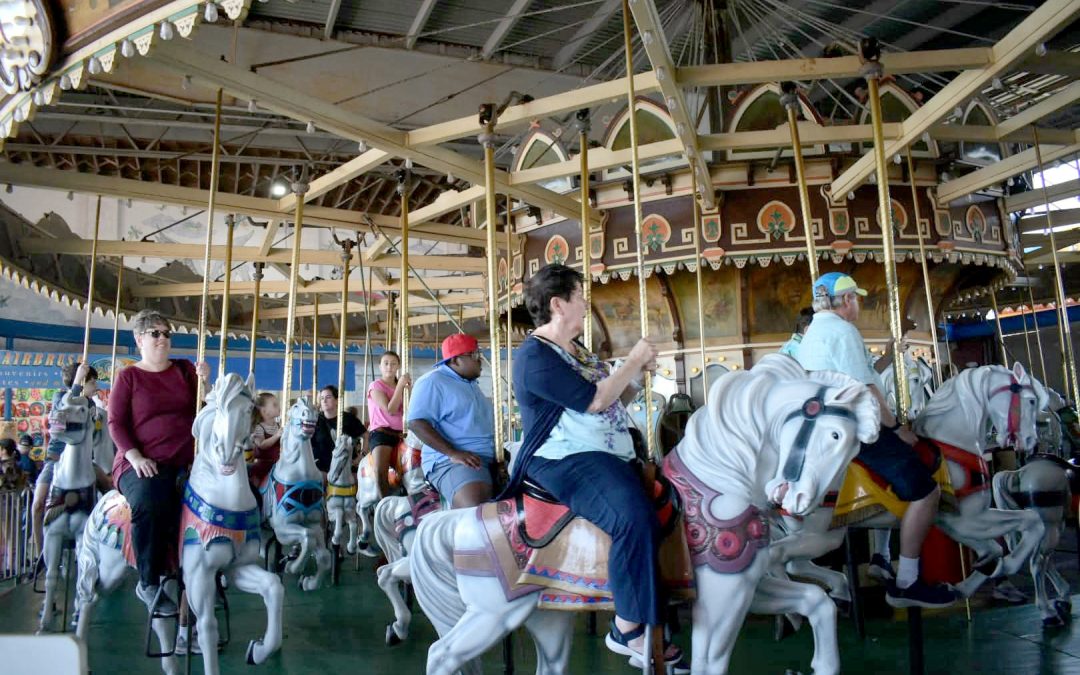
For generations of Ocean City families, the soundtrack of summer included the cheerful music of Wonderland Pier’s historic carousel. Beneath its glowing lights, children climbed aboard hand-carved horses, parents snapped photographs, and riders stretched their arms toward the elusive brass ring.
Now, two years after Gillian’s Wonderland Pier closed its gates for the final time, the music has stopped. But a growing group of residents and preservation advocates is determined to make sure the carousel’s story is far from over.
Led in part by longtime Ocean City resident Donna Saber, the Save the Carousel movement is working to preserve the century-old attraction, even as questions swirl around the future of the former amusement park property at Sixth Street and the Boardwalk.
For Saber, the effort is about more than saving an amusement ride. It is about preserving a piece of Ocean City’s identity.
The carousel, manufactured by the Philadelphia Toboggan Company in 1926, has stood at Wonderland Pier since 1972. Known as PTC No. 75, the attraction features elaborate hand-carved horses, chariots and an increasingly rare brass-ring game.
As the ride celebrates its 100th anniversary, preservationists fear that a remarkable piece of amusement history could disappear.
A carousel worth saving
Few people know the carousel as intimately as Andrew Boylan, a former Wonderland Pier employee who worked at the amusement park from 2012 until its closure in October 2024.
Beginning as a ride operator before moving into maintenance, Boylan spent more than a decade working among the attractions he had admired since childhood.
Although he loved all of Wonderland’s rides, the carousel held special significance.
“I think there’s only three left in the United States,” Boylan said, emphasizing the rarity of the historic attraction and its brass-ring game.
For Boylan, what makes the carousel especially remarkable is its original craftsmanship.
“All of the horses are original except one of them,” he said. “But they’re all hand carved.”
Boylan remembers operating the attraction on busy summer nights, when the music drew families through the entrance and the brass-ring game captivated curious onlookers.
“It was fun explaining the rings game to everybody waiting in line,” he recalled. “People waiting in line who didn’t know about the game, they would look at that … and they would say, ‘Well, hey, what’s that thing? What’s that all about?'”
Operating the historic ride also required some surprising technical knowledge. Unlike modern amusement attractions, the carousel needed careful balancing before it could operate.
“If it wasn’t balanced properly and you had all your weight on one side of the ride but nothing on the other side, if you would pull the lever to get it to go, it wouldn’t go,” Boylan explained.
His greatest concern about any future restoration involves preserving the carousel’s original decorative artwork, including the murals, mirrors and intricate painted details surrounding the ride.
The million-dollar question
Despite widespread affection for the carousel, saving it presents considerable financial and logistical challenges.
During the Oct. 22 Ocean City Council meeting, Councilman Tony Polcini indicated that the city was not interested in accepting the carousel as a donation, according to Saber, who attended the meeting.
City officials have raised concerns about the potential cost of restoring and housing the attraction, with estimates reaching into the millions.
Saber, however, questions whether those figures reflect what would actually be necessary to restore the carousel.
She said conversations involving the National Carousel Association have suggested a substantially lower figure, potentially between $200,000 and $250,000 for restoration work.
Those preliminary figures have not been verified through a comprehensive professional assessment, and Saber acknowledges that a closer examination would be necessary to determine the carousel’s true condition and financial needs.
“We need an approval … from Mita to go in there and have a restorer look at it,” Saber said, referring to property owner and ICONA Resorts developer Eustace Mita.
Boylan, who performed routine maintenance on the carousel, is similarly reluctant to speculate about its restoration costs.
“When we closed, it wasn’t in that bad of shape,” he said, while acknowledging that prolonged inactivity could have worsened its condition.
He emphasized that while he understands the attraction’s daily operation, he does not have the expertise to estimate a full mechanical restoration.
A second spin in Seaside Heights
For supporters of the Ocean City carousel, an encouraging example lies approximately 60 miles north in Seaside Heights, where another beloved Boardwalk attraction was rescued from an uncertain future.
The historic Dr. Floyd L. Moreland Carousel, originally located at Casino Pier, faced its own preservation challenges before an extensive restoration brought it back to life in July 2024.
The project involved dismantling the attraction, restoring its historic wooden animals, repairing its mechanical and electrical components, and constructing a new enclosed building to house the carousel along the Boardwalk.
The restoration took approximately five years and cost $2.5 million, according to the New Jersey Department of Environmental Protection. The project also received significant financial assistance, including a $750,000 grant from the New Jersey Historic Trust.
The attraction reopened to the public on July 3, 2024, allowing a new generation of visitors to experience a piece of Jersey Shore amusement history.
Unlike the proposed Ocean City effort, the Seaside Heights carousel ultimately came under municipal ownership. The borough acquired the attraction as part of a land-transfer agreement involving Casino Pier and established a permanent public home for the ride.
The new building also includes historical displays, creating an experience that celebrates the area’s amusement heritage alongside the restored carousel.
Although the financial and ownership circumstances differ, Saber believes the project offers valuable lessons for Ocean City.
She said members of the preservation movement have contacted individuals involved in the Seaside Heights project to learn more about the funding and organizational strategies that made its restoration possible.
For supporters, the example raises an important question: If Seaside Heights could bring its historic carousel back to life, could Ocean City do the same?
Building a movement
Rather than waiting for the city to take action, Saber and a small group of supporters are organizing an independent preservation effort under the name Save OC Carousel.
The group is working toward establishing a nonprofit organization that could pursue donations, grants and other funding opportunities.
According to Saber, the forming team includes approximately six individuals, among them Boylan, fellow former Wonderland employee Matt McDermott, Jeff Miller and Kristen Lee, who is affiliated with the National Carousel Association.
The organization has also made contact with legal and financial professionals to explore the process of formalizing its operations.
Among the fundraising possibilities under consideration is a program allowing donors to sponsor individual carousel horses, giving residents and families an opportunity to contribute directly to the attraction’s preservation.
The group is also exploring potential locations where the carousel could eventually be housed.
Possibilities discussed include city-owned property, space near the Ocean City Historical Museum and land associated with the Ocean City Tabernacle. However, no permanent location has been selected or secured.
Saber said supporters have also mentioned possible storage arrangements that could help protect the attraction while a long-term plan takes shape.
Whether the ride ultimately remains privately owned, becomes part of a nonprofit operation or finds a home on public property remains an open question.
The debate has also become a legal matter. In August, several community organizations and residents filed a lawsuit challenging City Council’s decision to designate the former Wonderland property as an area in need of rehabilitation. That designation allows the city to negotiate a redevelopment plan but does not itself authorize construction of a hotel.
Saber said the preservation effort has attracted interest from individuals on opposing sides of the redevelopment debate, including some who support Mita’s proposed hotel.
For her, that support is an encouraging sign that saving the carousel could become a shared goal rather than another source of division.
While the preservation group has not secured an agreement with Mita or the city, Saber hopes cooperation could eventually provide a path toward saving the attraction.
Preserving the magic of Wonderland
The road ahead is uncertain. Saving a century-old carousel will require more than nostalgia. It will take money, cooperation, expertise and a place to call home.
But the success of the Seaside Heights restoration offers a reminder that even after the music stops, a historic carousel can find its way back into motion.
Wonderland Pier may be gone, but its history does not have to disappear with it. And perhaps, someday, a new generation of Ocean City children will have the chance to reach for the brass ring.
Sarah Fertsch of Egg Harbor Township holds a Bachelors of Arts in Public Relations. She is a locally renowned poet, storyteller, and dog lover.