

Atlantic City’s casino industry has survived competition, recessions and closures before. But regional leaders say this time may be different.
Three casinos are expected to open in New York City by 2030. North Jersey lawmakers are again discussing casinos outside Atlantic City, and a $3 billion convention center has been proposed for the Meadowlands.
At the same time, more gamblers are playing online instead of visiting casino floors. Inflation continues to drive up the cost of doing business.
A report released this week by the Atlantic County Economic Alliance warns that those pressures could put thousands of local jobs at risk.
South Jersey lawmakers, casino executives and business leaders gathered Tuesday, Oct. 20, at the National Aerospace Research & Technology Park in Egg Harbor Township to discuss the findings.
The news conference followed a private briefing on ACEA’s Greater Atlantic City Casino-Hotel Employment Exposure Assessment.
The report identifies five major threats: the growth of online gaming and sports betting, three planned New York City casinos, possible casinos in North Jersey, continued inflation and a proposed Meadowlands convention center.
The report estimates that 5,105 Atlantic County jobs could be at risk by 2035, even without casinos opening in North Jersey. Under a more severe scenario that includes North Jersey casinos, that number rises to 8,005 jobs — more than one-third of Atlantic City’s remaining casino-hotel workforce.
If several of those threats hit at once, leaders fear Atlantic City could face an economic crisis similar to the one it experienced from 2013 through 2016. Five casinos closed during that period, costing the region thousands of jobs. Two later reopened under new names, but the recovery took years.
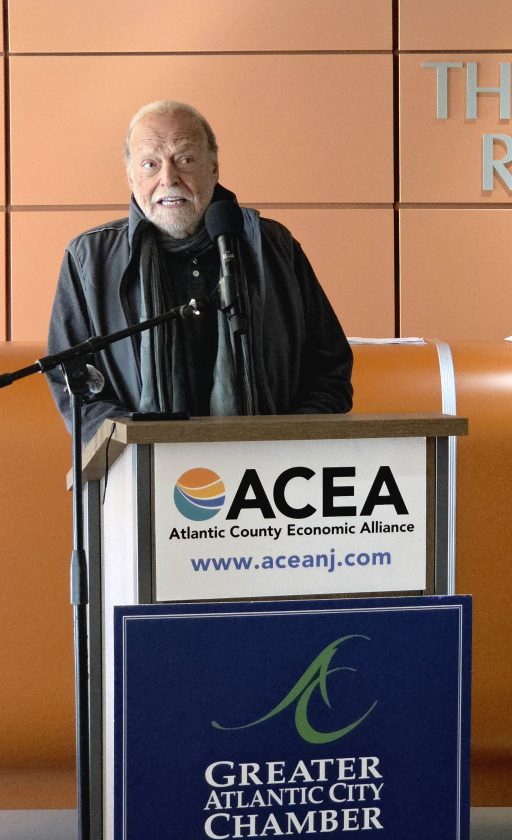
Dr. Max Slusher, ACEA’s director of business development and author of the report, said the concern is not one threat by itself. It is the combined effect of several problems arriving at the same time.
“We have online gaming substitution, which we’re watching take place,” Slusher said. He also pointed to the New York casino projects and possible casino expansion in North Jersey.
Atlantic City has shown it can absorb one setback at a time, he said. The greater danger comes when several major challenges hit the market together.
The warning comes as New Jersey’s total gaming revenue climbs while Atlantic City casino employment falls.
New Jersey generated a record $6.98 billion in total gaming revenue in 2025. Meanwhile, Atlantic City’s casino-hotel workforce fell to 21,172 jobs in April 2026, its lowest level in nine years — even lower than during the height of the COVID-19 pandemic.
Online gaming revenue reached $2.91 billion in 2025, surpassing Atlantic City casino-floor revenue of $2.89 billion for the first time.
That difference matters locally. Online gambling brings in revenue, but it does not require the same number of dealers, cooks, housekeepers, security officers and hotel workers needed to operate a casino resort. Online revenue is also shared with technology companies and other outside partners.
The effects reach far beyond the casino floor. Local linen companies, food suppliers, transportation providers, restaurants and other businesses depend on Atlantic City’s casino and tourism economy.
Nearly 70% of Atlantic City casino-hotel employees live in five Atlantic County communities: Atlantic City, Pleasantville, Egg Harbor Township, Galloway Township and Hamilton Township.
Leaders said the impact would not stop at the county line. New Jersey’s Casino Revenue Fund supports property tax relief, prescription assistance, transportation and long-term care programs for senior citizens and residents with disabilities across the state.
A decline in Atlantic City’s in-person casino business could cause a domino effect, cutting local jobs and business activity while putting added pressure on statewide programs.
Atlantic County’s state lawmakers presented a united front against expanding casino gambling beyond Atlantic City.
State Sen. Vincent Polistina, R-Atlantic, said opposition to North Jersey gaming crosses party lines.
“It is crucial that the state does not compete with itself with gaming or a convention center,” Polistina said.
He said the region’s path forward should focus on what makes the area special, including its beaches, Boardwalk, entertainment, restaurants and the Federal Aviation Administration’s William J. Hughes Technical Center.
Atlantic County Executive Dennis Levinson said public safety must also be addressed if the city hopes to attract more visitors and business.
“Google the most dangerous city in New Jersey. Atlantic City will come up,” Levinson said. “With all its assets, how can Atlantic City be the most dangerous city in the state?”
Levinson called for more police officers to provide a stronger, more visible presence and help visitors feel comfortable.
Assemblywoman Maureen Rowan, D-Atlantic, said the issue is also about fairness. Bergen and Monmouth counties are among the wealthiest in New Jersey, while Atlantic County ranks near the bottom.
Moving gaming opportunities into already wealthy areas would put more pressure on a region that still depends heavily on casino jobs and revenue, she said.
Allowing casinos outside Atlantic City would require voters to approve an amendment to the state constitution. No referendum is planned for this year.
ACEA identified Atlantic City’s convention and meeting industry as one possible lifeline. Many casino workers already have skills that transfer to banquet service, cooking, housekeeping, transportation and audiovisual production.
Atlantic City has more than 1.83 million square feet of meeting space. Visit Atlantic City booked 205 events in 2025, drawing 533,242 people, generating 328,067 hotel room nights and creating $362.3 million in direct economic impact.
A Meadowlands convention center, however, could compete for the same business while benefiting from its location near New York City.
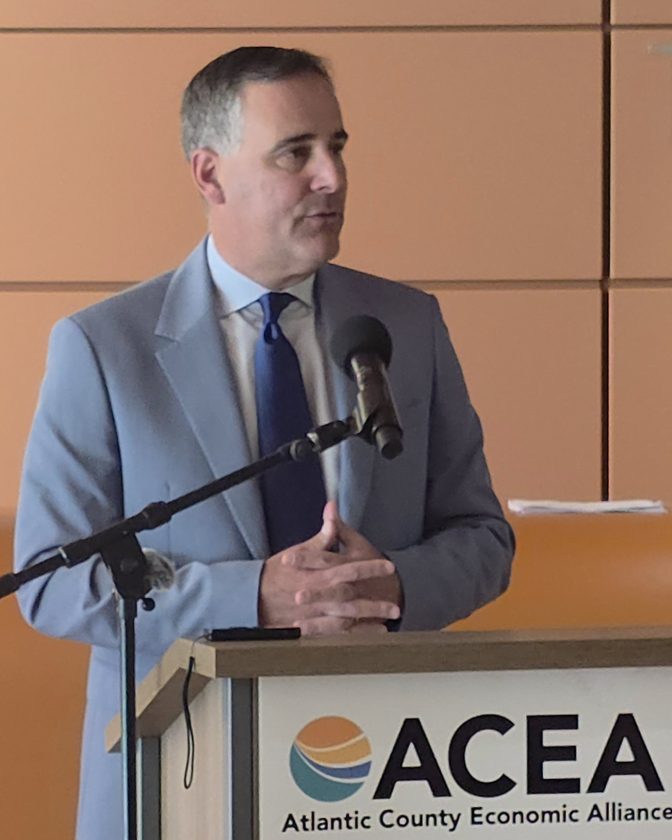
Tuesday’s speakers included Greater Atlantic City Chamber President Danielle Norcross; ACEA President and CEO Lauren Moore; Casino Association of New Jersey President George Goldhoff; Polistina; Assembly members Don Guardian, William Moen Jr. and Rowan; and Levinson.
Their message was clear: South Jersey needs a united plan to protect casino jobs while growing conventions, nongaming tourism and year-round business.
The report does not say thousands of jobs will definitely disappear. It is a warning that without action, losses could spread through families, businesses and communities across the region.
Atlantic City has been knocked down before and found a way back up. Leaders say the goal now is to act before the next blow lands.