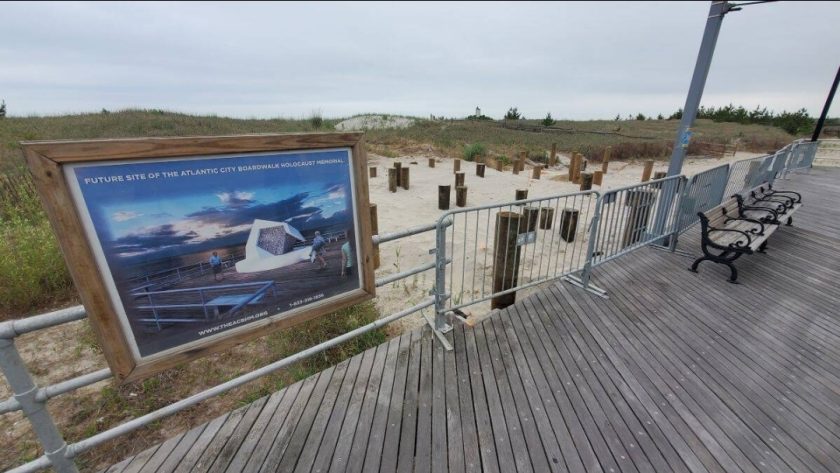
The sign, announcing the future construction of the Boardwalk Holocaust Memorial and posted on the Boardwalk at Roosevelt Pavilion, had been up for several years. However, during a good deal of that time, the website and the phone number listed on the sign were both down and those contacted at area synagogues knew nothing about the Memorial’s progress.
Fund-raising efforts for the Memorial date back to 2008 when the Atlantic City Boardwalk Holocaust Memorial, Inc. was approved as a non-profit organization. It took ten or so years to raise the necessary funding, but in 2019, the Casino Redevelopment Authority “approved reserving” — the CRDA’s phrase — $500,000 in funding. There have been substantial private contributions through the years as well.
After years of delays, on June 5, the following announcement came from the City of Atlantic City Department of Public Works: “A project years in the making is now on the path to fulfillment. The Department of Public Works has begun removing boards from the future site of the Atlantic City Boardwalk Holocaust Memorial. The Atlantic City Boardwalk Holocaust Memorial Committee, with the support of Mayor Marty Small, Sr. and the City of Atlantic City, broke ground on Thursday, June 5, 2025. The monument is intended to honor and preserve the memory of the victims and survivors of the Holocaust.
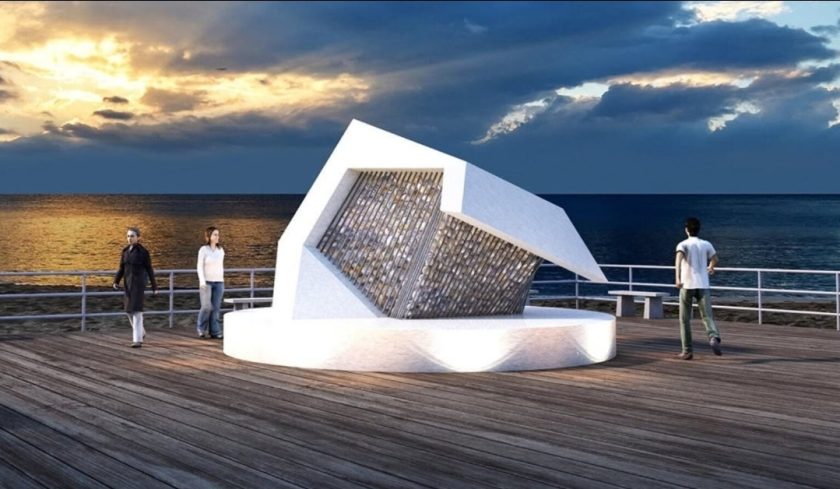
“The Memorial site, at Roosevelt Pavilion on the Atlantic City Boardwalk overlooking the ocean, will encourage visitors to sit on the provided benches and reflect on remembrance and hope. The Atlantic City Boardwalk Holocaust Memorial is anticipated to be completed this fall.”
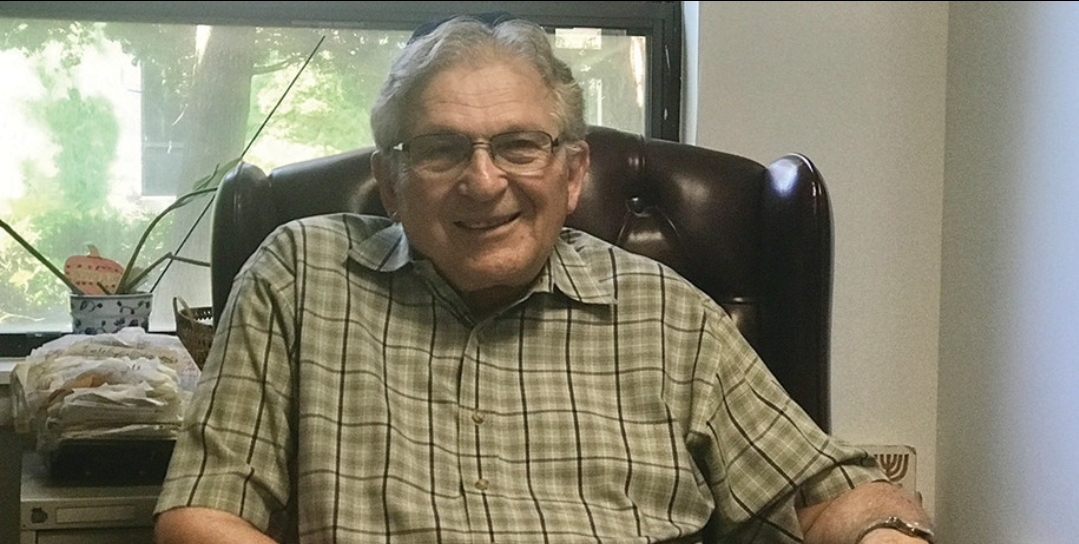
Actual movement on building the Memorial, championed from the beginning by Rabbi Gordon Geller of Shirat Hayam synagogue in Ventnor, began two years after the non-profit was formed. In 2010, the organization sponsored an international design competition that drew over 700 entries. The winner was something called “Fractured Landscapes,” a design by architects Patrick Lausell and Paola Marquez. The actual structure would incorporate a symbolic “river of light” cutting through a buckled, broken section of the boardwalk. Lausell and Marquez said that the “river of light” actually represented a disrupted history and a collective hope for peace.
Further details came via a July post on the Downbeach Buzz web site. “The memorial integrates multimedia educational features and infographics developed in collaboration with Stockton University’s Holocaust Resource Center,” according to the post. The ‘Genocidal Tsunami’ design is intended to raise the consciousness of visiting multitudes, for generations to come, about the continual need to urgently combat human intolerance.”
The big question, of course, is why it took nearly 16 years to start actual work on the project. There was next to no information forthcoming during a lot of those years, save for a couple of articles in the Cherry Hill, NJ-based newspaper, Jewish Community Voice. The publication detailed some of the reasons behind the extraordinary delay.
Location was initially an issue, and a number of options — including building the Memorial on Garden Pier, on Kentucky Avenue, or on Stockton’s Galloway campus — were found not to be suitable. It reportedly took years before the final decision to build on the Boardwalk at Roosevelt Pavilion in front of Stockton was made.
Despite the striking beauty of the original design, a closer look at it by construction experts concluded that the “Fractured Landscapes” design could prove to be too expensive and complex, given the small size of the Boardwalk space. It had to be modified extensively. That, of course, meant that more essential funds had to be raised.
Once all those factors were in place, Downbeach Buzz reported that construction challenges — and there have been a lot of them — contributed to the delays. Here’s a short list of some of those issues:
Sometime in January, citing a harsh winter, contractors shut down their businesses for several months.
Availability of materials, especially given the Memorial’s modified design, proved to be a problem, as did the rising costs of those materials and labor. The relatively new design also called for structural changes dictated by on-site conditions. More pilings had to be place, substructure girders and joists had to be added and all the old ones had to be trashed. The new pilings, hopefully, would support a new pavilion deck.
City approval for this work, notoriously slow in these parts, was needed for the additional construction to begin and to ensure that the safety of the Boardwalk would not be compromised. Next steps included hiring a framing contractor to resurface the deck, hiring an electrical contractor, off-site building of benches and the actual monument, installation of a railing system and light standards.
All of this, and it’s certainly likely that there were and will be additional construction issues, has taken a considerable amount of time. And given the additional work that a modified design called for, even more funds had to be raised along the way.
In 2019, when it appeared that the Memorial was actually going to become reality, Rabbi Geller gave an extensive interview to the Voice newspaper. “The project has been a long time coming,” Geller said. “Historically, the project goes way back into the 1980s. That’s when a group of locals first came up with a plan for a Boardwalk Holocaust Memorial. But the idea came and went. The same thing happened in the 1990s.
“I’m hoping people will understand that this is an idea whose time has come, because of the unprecedented degree of divisiveness, ethnically and racially, in our society. I’m hoping people will see this as a universal memorial to combat intolerance and will be willing to donate, will want the honor of seeing their name on a noble enterprise like this that will last for generations.
“Sometimes, good things take patience. You have to wait for the right circumstances. I urge people to support the memorial by making a donation at www.acbhm.org, the website for Atlantic City Boardwalk Memorial Inc.”
Bruce Klauber is the author of four books, an award-winning music journalist, concert and record producer and publicist, producer of the Warner Brothers and Hudson Music “Jazz Legends” film series, and performs both as a drummer and vocalist.