
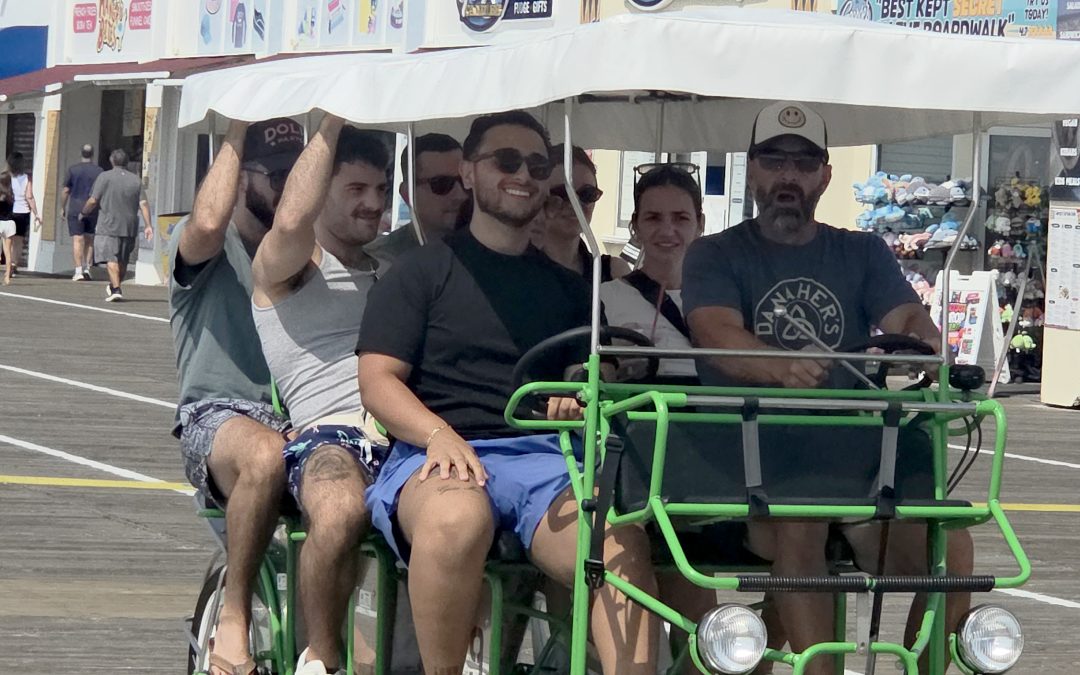
Certain sights instantly signal a morning in Ocean City: beachgoers carrying chairs toward the sand, the smell of breakfast drifting from Boardwalk restaurants, cyclists ringing their bells and a brightly colored surrey slowly making its way down the boards.
Often topped with a striped or solid canopy, filled with family members and propelled by several sets of pedaling feet, the four-wheeled vehicles have become a familiar part of the Jersey Shore landscape.
Surreys are particularly at home in Ocean City, where generations of vacationers have climbed aboard for morning trips along the Boardwalk. Unlike a traditional bicycle, a surrey allows the entire family to ride together.
But the unusual pedal-powered vehicle has a history that extends far beyond the Shore.
From the quadricycle to the surrey
A surrey bike is a human-powered vehicle with four wheels, bench seating and pedals for multiple riders. Depending on its size, a modern surrey may accommodate two, four or six adults, often with additional seating for children in front.
The design belongs to a broader family of vehicles known as quadricycles, which emerged during the cycling boom of the late 19th and early 20th centuries.
Early models were simpler than the brightly painted versions familiar to Shore visitors today. Designed for leisure, they allowed several passengers to pedal together without balancing on two wheels. Manufacturers eventually added metal frames, multiple rows of seats, steering wheels and canopies to shade riders from the sun.
The name “surrey” predates the bicycle. It originally referred to a four-wheeled, horse-drawn carriage with open seating. The resemblance between those leisurely carriages and pedal-powered quadricycles likely helped the name endure.
The word became especially famous through Rodgers and Hammerstein’s 1943 musical “Oklahoma!” and its song “The Surrey With the Fringe on Top.” Although the musical’s surrey was horse-drawn, its romantic image as an open-air vehicle with a canopy resembles the modern pedal-powered version.
By the 20th century, multipassenger pedal vehicles had found a natural home in parks, amusement destinations and seaside resorts, where enjoying the ride mattered more than reaching a destination quickly.
Few places were better suited to them than New Jersey’s boardwalks.
Made for the boards
Boardwalks are generally flat, wide and easy to navigate. Shore towns also attract families traveling together, giving rental shops a steady stream of groups seeking an activity everyone can share. Parents, grandparents and children can all climb aboard the same vehicle.
Riders sit side by side, talk as they pedal and quickly discover that moving several hundred pounds of bicycle and passengers requires teamwork.
North Beach Mini Golf and Bike Rentals in Atlantic City notes that surreys are particularly well suited to New Jersey’s boardwalk culture because of the flat terrain, mild Shore weather and abundance of rental businesses.
Their leisurely pace also adds to the appeal. A surrey is not designed to win a race. Steering around pedestrians and other bicycles takes cooperation, while getting a fully loaded vehicle moving from a stop sometimes requires everyone to contribute a little muscle.
That slight awkwardness is part of the tradition.
A Jersey Shore tradition
In Ocean City, bicycles and surreys fit naturally into a resort long associated with family recreation.
The Ocean City Boardwalk dates to the community’s earliest years as a seaside resort and has been rebuilt and relocated several times. Today, it stretches about 2.5 miles and remains one of the city’s defining attractions.
Cycling also has deep roots in Ocean City. As early as 1893, the city’s Excursion House featured an elevated bicycle railroad that allowed riders to pedal above the beachfront. More than a century later, bicycles remain central to how many visitors experience the island.
Ocean City’s 2026 regulations generally allow bicycles on the Boardwalk from 5 a.m. to noon during the peak summer season, with expanded hours during parts of the shoulder season and exceptions for certain special events. The municipal code places wide surreys and other people-powered vehicles under the Boardwalk’s bicycle restrictions.
Although surreys operate in vacation destinations across the country, they have become closely associated with New Jersey’s boardwalk culture. The state’s wide, recreation-focused promenades — including those in Atlantic City, Ocean City and the Wildwoods — provide an ideal setting for the slow-moving vehicles.
New Jersey also claims the nation’s first boardwalk, built in Atlantic City in 1870. Cycling has since become part of the experience on many of the state’s oceanfront promenades.
The connection is so recognizable that Disney’s BoardWalk Inn in Florida, designed to evoke an early-20th-century Atlantic Coast resort, offers surrey rentals for guests traveling around Crescent Lake. The surrey has become more than a rental bike; it is part of the visual shorthand for the classic American boardwalk.
Why the surrey survives
The surrey can seem comically old-fashioned in an era of electric bicycles, scooters and increasingly sophisticated transportation.
That may be exactly why it has endured.
A surrey offers few shortcuts. Someone must steer, and several people usually need to pedal. Passengers sit beside one another instead of staring at separate screens. The pace is slow enough to notice the ocean, wave to pedestrians and decide where to stop for breakfast.
Modern versions are sturdier and more comfortable, with steel frames, adjustable seating and protective canopies. Some manufacturers also offer electric-assist models. Still, the basic experience remains largely unchanged: a group of people moving forward together.
For many Ocean City vacationers, a surrey ride becomes part of the rhythm of returning to the Shore year after year. Children who once sat in the front basket eventually grow tall enough to reach the pedals. Teenagers reluctantly join the family ride. Years later, some return with children of their own.
Plenty has changed along the Boardwalk, from its attractions and businesses to the bicycles themselves.
But on a beautiful morning, a family can still gather beneath a canopy, put their feet on the pedals and slowly roll down the boards.