
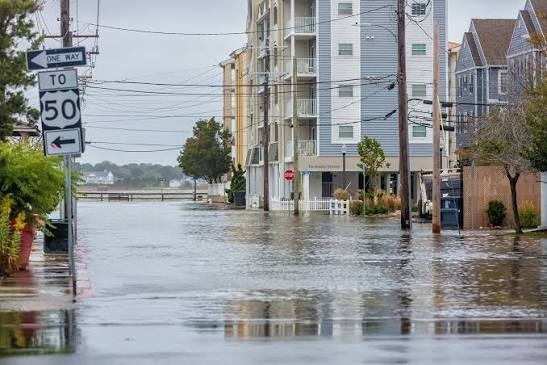
In Ocean City, flooding has long been part of life on a low-lying barrier island. A coastal storm, a period of heavy rain or even an unusually high tide can leave water pooling on streets and creeping into some of the city’s most vulnerable neighborhoods.
But as sea levels rise and high-tide flooding becomes more frequent along the east coast, the city is increasingly treating flood mitigation not as a one-time fix, but as a long-term infrastructure priority.
Ocean City recently took another major step in that effort, awarding a nearly $5 million contract for a new flood-mitigation project covering the area from 19th to 26th streets between West and Bay avenues.
City Council awarded the $4.97 million contract Aug. 20 to Richard E. Pierson Construction Co. Inc. of Pilesgrove. Work is expected to begin in September or early fall and, according to city officials, could be finished by Easter 2027.
The project will include two underground stormwater pumping stations designed to remove floodwater from streets more quickly and send it back toward the bay. One station will be constructed near the Stainton Wildlife Refuge around 25th Street, while the other will be located near the Cape May County Municipal Utilities Authority facility at 20th Street and Bay Avenue.
Road elevations and drainage improvements are also part of the broader project, according to the city’s capital improvement plans.
The investment is the latest chapter in a much larger story unfolding in Ocean City: how a densely developed beach town adapts to water that is expected to become an increasingly common presence.
“All of Ocean City, New Jersey is within a floodplain,” the city states on its Flood Smart website, adding that while infrastructure improvements can reduce the frequency and severity of flooding, they cannot completely eliminate it.
The reason is partly geographic. Ocean City sits on a narrow barrier island bordered by the Atlantic Ocean and a network of bays, marshes and tidal waterways.
That leaves the community vulnerable not only to major coastal storms, but also to tidal flooding that can occur without a hurricane or nor’easter.
Sometimes called “sunny day” or nuisance flooding, high-tide flooding occurs when tides rise high enough to push ocean or bay water into streets and other low-lying areas. NOAA says high-tide flooding is now roughly twice as frequent in U.S. coastal communities as it was 20 years ago.
Across the Mid-Atlantic, the trend has been even more pronounced. NOAA reports that the region now experiences an average of about eight more high-tide flood days per year than it did in 2000 — an increase of nearly 250%.
The agency expects those numbers to continue climbing as sea levels rise.
NOAA’s 2026-27 outlook predicts a national median of seven to 12 high-tide flood days during the year, a new record. The agency says the Mid-Atlantic continues to experience rapid increases in high-tide flooding because of long-term sea-level change.
Ocean City’s own planning documents acknowledge the same trajectory. A recent municipal assessment cites research showing that sea level along the New Jersey coast has risen about 17.6 inches since 1911, including approximately 8.2 inches since 1979.
Over the next 30 years, the report says sea level could rise another six to 15 inches, depending on the rate of change.
That may sound gradual, but even a few additional inches can make a significant difference in a place where roads, homes and stormwater systems already sit close to current tide levels.
Ocean City’s Community Resilience Plan warns that sea-level rise is expected to worsen existing vulnerabilities throughout the island, particularly when high tides combine with rain and push saltwater onto roads, yards and low-lying structures.
First Street experiences flooding from several sources, including heavy rainfall, high tides and coastal storm surge. Its earlier national assessment found Ocean City had the largest number of flood-risk properties of any New Jersey municipality included in its comparison: about 17,255 properties in 2020, projected to grow to roughly 19,876 by 2050.
Several Ocean City properties carry Flood Factor ratings of 8, 9 or 10 out of 10, with First Street estimating an 80% or greater chance of floodwater reaching the building during the next 30 years.
Ocean City has spent years building a network of defenses.
Stormwater pumping stations have become one of the city’s primary tools. Instead of waiting for water to drain naturally, the pumps move it off streets and into surrounding waterways much more quickly.
Recent projects include an approximately $8 million flood-mitigation effort in the north end between First and Eighth streets and a roughly $6.5 million project between 29th and 34th streets.
The city says some completed drainage projects have largely eliminated routine nuisance flooding in the neighborhoods they serve. The new 19th-to-26th Street project continues that strategy.
Preliminary designs have already been completed for another flood-mitigation project in the Ocean City Homes neighborhood between 52nd and 56th streets. Plans there are expected to include additional pumping stations, drainage improvements and road work.
At the same time, Ocean City is investing in protection on its oceanfront.
A separate $19.5 million U.S. Army Corps of Engineers beach replenishment project underway this summer is adding approximately 1.6 million cubic yards of sand to the beaches from the north end toward 12th Street. The replenishment program is intended to help protect coastal property from erosion and storms.
Together, the projects illustrate the two-sided challenge of living on a barrier island: defending against water from the ocean while improving the city’s ability to handle water accumulating behind the dunes.
No pumping station, raised road or replenished beach can make a barrier island flood-proof. Ocean City officials themselves emphasize that point.
Instead, the goal is to make flooding less frequent, move water away faster when it does arrive and reduce damage to homes, businesses and infrastructure.
NOAA projects that by 2050, the United States as a whole could experience an average of 55 to 85 high-tide flood days per year, meaning water levels currently considered unusual could eventually become much more routine.
For Ocean City, the response is already visible beneath streets, behind dunes and in millions of dollars of public construction.
The latest $4.97 million project will not end flooding on the island. But combined with an expanding system of pumps, improved drainage, elevated roads and beach replenishment, city officials hope it will give Ocean City more room to live with the water — even as the water continues to rise.