
The Casino File
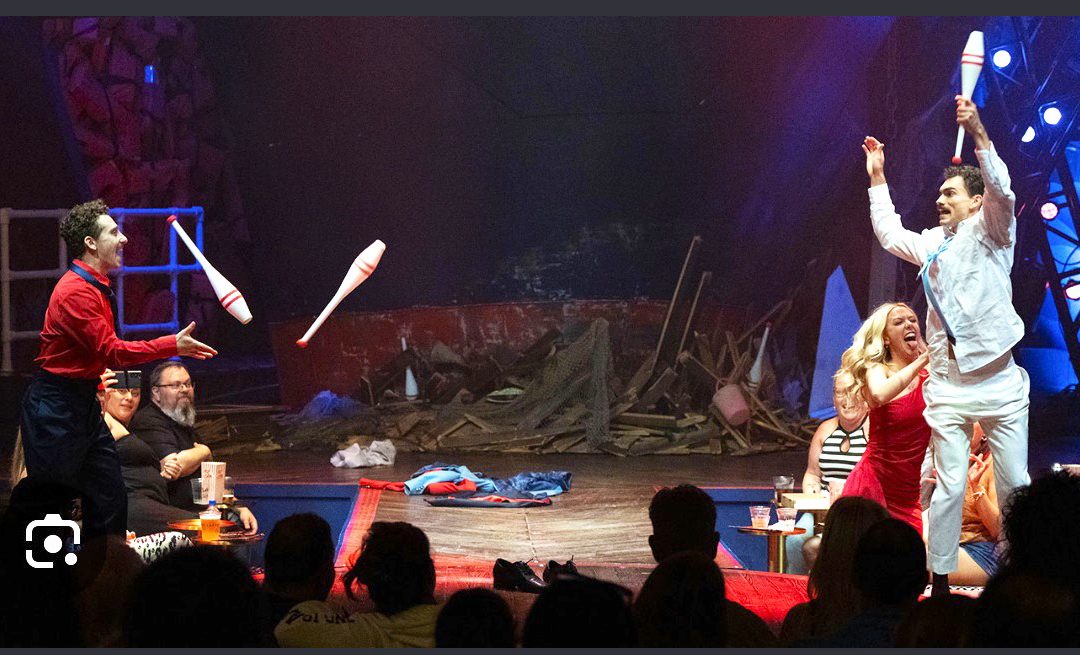
Roughly three-and-a-quarter years after its oh-so-promising debut, “The Hook,” the groundbreaking (for Atlantic City) production show at Caesars Atlantic City is in its home stretch.
On Sept. 6, the program that reportedly cost $40 million to bring to life ($36 million of which went into building out the theater that is also called The Hook) will cease operations.
While plans for the facility have yet to be revealed by Caesars’ management, now isn’t the time to gaze into the future, but to limn the past and dive into what was right, and what went wrong, with the concept that was supposed to usher in a new era of casino entertainment in Our Town.
When, in December, 2022, Las Vegas-based production company Spiegelworld announced the deal to develop the concept — which included the theater, show and a “psychedelic Italian” restaurant called Superfrico — the news was the equivalent of a 10,000-volt shot of electricity to Atlantic City’s show biz scene. As laid out by Spiegelworld overlord Ross Mollinson, the plan was to provide Atlantic City with a foundational element of Las Vegas’ casino-entertainment landscape: A permanent, year-round production housed in its own, custom-built theater.
The show itself was hardly groundbreaking, as it combined raunchy, adults-only comedy with the kind of specialty acts (aerialists, jugglers, contortionists) that fill the rosters of Cirque du Soliel extravaganzas and the countless knockoffs that followed in their wake. But, especially in its early days when the talented Scout Durwood shared star billing with the first of several performers who appeared as emcee “Dick Marlin,” “The Hook” was a sharp, breezy and fun 75 minutes.
But what made the concept exciting was that it would — theoretically anyway — provide people living within three hours or so of AC a reason to come here on weeknights during the cold-weather months.
But Mollinson and his team, though bullish on the city, apparently didn’t think things through to a large-enough degree: History has long proved that short of Elvis Presley or Michael Jackson returning from the dead and performing, it’s unlikely anything would bring in enough paying customers from Staten Island or Cherry Hill or the Philly Main Line on a Tuesday night in January or February. Quite frankly, from that first winter (of 2024) the year-round format clearly made no business sense.
Of course, weather wasn’t the only impediment to bringing the Vegas playbook to town. The reason attractions like the various Cirque shows, Penn & Teller’s decades-long residency at the Rio casino and Spiegelworld’s long-running (and hilarious) “Absinthe” at Caesars Palace not only survive but thrive is that even in the dead of winter, tens of thousands of people are going there for massive industry expos. For instance, the Consumer Electronic Show, which during the first week of 2026 — pretty much the slowest week of all locally — had an attendance just south of 150,000. And once the festivities shut down for the day, many of those attendees went looking for entertainment.

Unfortunately, Atlantic City simply doesn’t do business anywhere near that scale.
Another issue with “The Hook” was that, as Mollison told this column in early 2023, it was significantly dependent on repeat business. However, while cast members were regularly replaced, the nature of the acts remained constant; one aerialist simply took over for another. Which meant there was little incentive for a large swath of the public to see “The Hook” more than once or twice.
So, what will be the legacy of “The Hook?” To put it as succinctly as possible, it should be remembered for what it was: A noble idea that was doomed from the start by conditions and situations over which it had virtually no control.
And while Mollison and the Spiegelword crew may go down in local history as the authors of the biggest entertainment failure of the legal-gaming era (with $40 million worth of help from the no-longer-in-place Caesars management team that signed off on the deal), it would be unfair to not give them credit for taking a shot others were too timid to attempt.
The hope here is that somehow, some way, someone will not be scared off by what happened and figure out how to successfully achieve what “The Hook” couldn’t.
For tickets, go to ticketmaster.com.
Stray Cats rip it up at Ocean
Those rippin’ rajahs of rockabilly known as Stray Cats turned in a typically raucous and wholly entertaining performance last Saturday night at a sold-out Ovation Hall at Ocean Casino Resort.
The almost-50-year-old trio — which also includes virtuoso standup bass player Lee Rocker and human metronome Slim Jim Phantom on drums — is back on the road for the first time since guitarist-lead vocalist-composer Brian Setzer successfully completed treatment for an unnamed-but-debilitating autoimmune disease that caused him to lose use of his hands — a condition that seemed hard to fathom Saturday given Setzer’s set-long, six-string pyrotechnics.
The musical turf the Cats inhabit is 1950s rockabilly, a building block of rock ‘n’ roll marked by twangy, echo-enhanced guitar. While highly energetic and often irresistible, it’s a musically limited format based almost entirely on a three-chord blueprint known in musical circles as I-IV-V. Though elemental, it can also be quite tedious after 20 or 30 minutes.
But what made the almost-two-dozen-song set so exciting and downright enjoyable was the combination of the three musicians’ top-shelf playing, their loosey-goosey stage presence (including Phantom beating the skins while standing throughout the entire program) and a repertoire that combined such beloved band signatures as “Stray Cat Strut,” “Runaway Boys,” “Rumble in Brighton” and their biggest hit, “Rock This Town,” with a number of perfectly suited covers.
The latter included a typically high-octane “Twenty Flight Rock” (an iconic rockabilly track originally recorded by the late Eddie Cochran), Arthur Crudup’s “My Baby Left Me” (delivered with solid lead vocals by Rocker) and a mid-show run-through of Santo & Johnny’s haunting instrumental “Sleepwalk,” which provided a nice respite from the otherwise revved-up numbers that filled out the bulk of the performance.
Chuck Darrow has spent more than 40 years writing about Atlantic City casinos.