
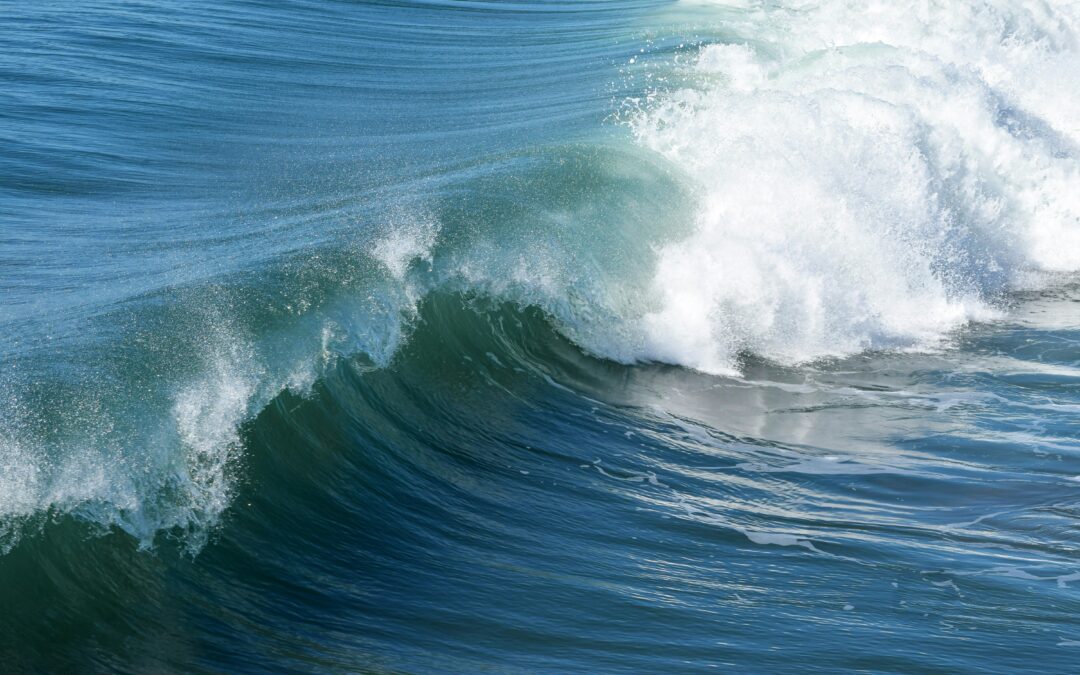
Along the Jersey Shore, tides shape nearly every coastal experience. They determine how much beach is available for a towel, when boats can safely move through shallow waterways and where anglers may find feeding fish. Tides also influence where waves break and how currents move through inlets and back bays.
Understanding the rhythm of the tides can help boaters avoid an unexpected grounding — and help everyone plan a safer, more enjoyable day at the Shore.
A constantly changing coastline
Changing tides can make or break a day at the beach. Many beachgoers have settled into a comfortable spot only to discover the ocean creeping closer to their towels, chairs and umbrellas.
At high tide, the water reaches farther up the sand, leaving less room for beachgoers. Low tide exposes more of the beach and may reveal sandbars, shells and other features that were underwater only hours earlier.
Boaters must pay close attention to changing water depths, especially in shallow back bays, tidal creeks and inlets. A route that is passable at high tide may become too shallow as the water recedes. Tide charts are useful, but boaters must also consider local channel markers, shifting shoals, wind and weather conditions.
Tides can affect swimmers, although they are only one part of ocean safety. Wind, waves, rip currents, storms and the shape of the shoreline also influence conditions. Beachgoers should always swim near a lifeguard and follow posted warnings.
What tides mean for surfers and anglers
Surfers pay close attention to the tides because water depth can influence where and how waves break. Some surf spots perform best at high tide, while others produce better waves at low or mid-tide. If the tide is too high, waves may lose their shape or break too close to shore. At low tide, waves may break over shallow sandbars.
Many surfers favor a rising tide because incoming water can sometimes improve wave conditions. This is commonly described as a “tidal push,” although its effect varies by location and depends on the swell, wind, seafloor and shoreline.
Tides also influence fishing. Anglers often prefer periods of moving water because tidal currents carry baitfish and other food sources. Larger fish may follow those food sources or gather near areas where currents concentrate them.
Jetties, reefs, bridges, channels and inlets can become productive fishing locations as water flows around them. However, the strongest current does not necessarily occur at the exact time of high or low tide. Tide height and tidal current are related but distinct, and the timing of slack water varies by location.
The moon’s pull
What causes the ocean’s regular rise and fall?
The moon is the primary force behind Earth’s tides. Its gravitational pull creates a bulge in the ocean on the side of Earth closest to the moon. A second bulge forms on the opposite side because the moon’s gravity is weaker there than it is at Earth’s center. This difference in gravitational pull stretches the planet and its oceans along the Earth-moon line.
As Earth rotates through these bulges, most coastal locations experience two high tides and two low tides during a lunar day, which lasts approximately 24 hours and 50 minutes.
The Jersey Shore generally experiences this twice-daily, or semidiurnal, tidal pattern. Successive high tides are usually about 12 hours and 25 minutes apart, and tide times occur roughly 50 minutes later from one day to the next.
The actual timing and height of the tides vary from place to place. Landmasses, water depth, the shape of the coastline and the configuration of bays and inlets prevent the ocean from responding to the moon’s pull in a simple, uniform way.
Local geography and weather
The shape of bays, estuaries and inlets can increase or decrease the height and timing of tides. Narrow or shallow waterways may restrict the movement of water, while funnel-shaped bays can amplify tidal changes.
That means the tide at an oceanfront beach may differ from conditions in a nearby back bay. It can also take time for the tidal change to move through winding creeks and inland waterways.
Weather can create noticeable differences between predicted and observed water levels. Strong offshore winds may push water away from the coast, producing lower-than-expected water levels. Onshore winds can pile water against the shoreline and raise water levels.
Atmospheric pressure also plays a role. Lower pressure associated with storms can contribute to elevated water levels, while higher pressure can slightly suppress them. During major coastal storms, storm surge can push water well above the predicted astronomical tide.
Spring and neap tides
The sun also contributes to Earth’s tides. Although it is much farther away than the moon, its enormous mass gives it significant gravitational influence.
When the sun, moon and Earth align during a new moon or full moon, their combined gravitational forces produce a greater difference between high and low tide. These are known as spring tides, although the name has nothing to do with the season. Spring tides occur throughout the year.
When the sun and moon are positioned at approximately right angles to Earth during the moon’s first- and third-quarter phases, their tidal forces partially counteract one another. This produces neap tides, when the difference between high and low tide is smaller.
Spring tides typically bring higher high tides and lower low tides. Neap tides generally produce lower high tides and higher low tides.
Check before heading out
Tide predictions are available through the National Oceanic and Atmospheric Administration’s Tides and Currents website. Boaters should check the predictions for the station closest to where they will be traveling, rather than relying on the times listed for a distant oceanfront location.
Anglers, surfers and beachgoers can also use tide predictions to plan their day, but they should remember that tides do not tell the whole story. Wind, waves, currents, storms and local geography can all change conditions.
The ocean is always moving. A little knowledge of the tides can help boaters avoid getting stranded, guide anglers and surfers toward favorable conditions and keep beach towels safely above the advancing water.