
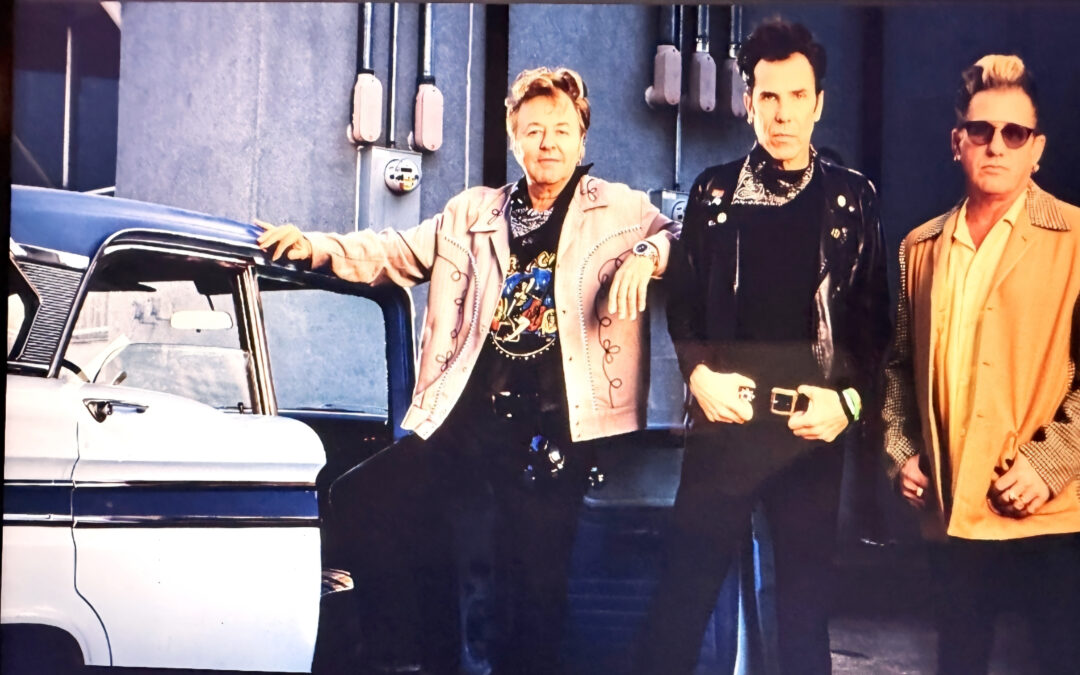
You’ll forgive the members of Stray Cats if they forego the “Rock & Roll” ride on Steel Pier when they hit Ocean Casino Resort on Aug. 15. That’s because the past year or so has been quite the roller coaster ride for the Long Island-born trio that first came to fame and fortune in the early 1980s by reviving rockabilly, the late-1950s pop format that combined the twangy guitar of country music with the “big beat” of the emerging rock & roll movement.
It all started, recounted drummer Slim Jim Phantom during a recent phone call, in February 2025 when Brian Setzer, the trio’s guitarist, lead singer and primary composer, developed a still-publicly unidentified autoimmune disease in his hands that left him unable to tie his shoes much less play guitar.
But by October of that year, what Phantom (real name, James McDonnell) described as an incomplete round of IV treatments had alleviated Setzer’s condition to the point that the group was in Detroit on the eve of a tour. And then:
“We were in the theater, and we had done a little soundcheck the night before,” he explained. “Our usual way of doing it is the night before a tour starts, we make sure that the venue we’re playing in is [open] so everyone can set everything up and we can run through everything, make sure the equipment works. And everything seemed OK.”
However, he continued, “The next night, we’re in our rooms — I’m ironing my pants — and 3,000 people were seated in the audience. And that’s when we got the phone call that Brian’s hands just…he couldn’t pick up a pencil. He’d had a relapse of this kind of neuropathy thing, this nerve damage that he has in his hands. And that’s when it happened. Not the night before, not the week before. At the gig.”
Not surprisingly, it was a devastating blow to the group and everyone connected to it. But, offered the 61-year-old beat-keeper, none more so than his pal-since-childhood Setzer.
“For him, playing the guitar is like breathing. If he’s in a good mood, he plays guitar for four hours. If he’s in a bad mood, he plays guitar for four hours. That’s a regular day for him. That’s just how he’s been since we were kids.”
Setzer subsequently returned to the IV treatments, but this time, he stuck it out for the prescribed six-month course. “And here we go!” beamed Phantom.
Forging a future from the past
Phantom, who famously performs standing up, started drumming in the 1970s during a time when progressive rock was at its peak and the likes of Phil Collins of Genesis, Bill Bruford of Yes and King Crimson and Carl Palmer of Emerson, Lake & Palmer were redefining the instrument by playing patterns and time signatures far more intricate than those that had been the foundations of the blues-based rock music of the ’50s and ’60s.
Like so many of his stick-wielding contemporaries, Phantom was a fan of those groundbreaking musicians. But he was also aware of the limits of his abilities.
“I knew I couldn’t really make it as a jazz fusion guy like Billy Cobham [of Mahavishnu Orchestra]. You’d practice and then you’d see Bill Bruford play somewhere and you’re like, ‘No, I can’t do that.’
“So, when [he, Setzer and upright-bass player Lee Rocker discovered the music of rockabilly artists like Gene Vincent and Eddie Cochran], it was something that we knew we could do. I had a background for being able to swing from the jazz guy that I took listens from. So, we could do that.”
Phantom explained that he would “listen to people like Freddy Below who played with Chuck Berry, and Dickie Harrell [who backed] Gene Vincent — my favorite. And [Elvis Presley’s original drummer] D.J. Fontana. Then it all made sense to me.”
He added that discovering the Elvis of the mid-and-late-’50s had an impact on him and his teammates that went beyond music.
“When we got turned onto Elvis — the original Elvis Presley from [Memphis-based] Sun Studios — we just went hook, line and sinker, and I saw what he looked like and how cool it was. And I said, ‘I have to do that. Even if I work in the hardware store or the liquor store and play on the weekends, that’s what I was gonna look like.’”
Thinking visual
Visual presentation proved to be an essential part of the game plan for the unit whose hits include “Rock This Town,” “Stray Cat Strut,” “Runaway Boys,” “Rumble in Brighton” and “Sexy and 17.”
The band first became a hot commodity in 1980 when it received a public endorsement from the Rolling Stones during an extended stay in London that ultimately led to a deal with Arista Records, which issued their self-titled debut LP in England and Europe in 1981. The U.S. got its first hit of the Cats when the “Built for Speed” LP was released by the EMI America label in June 1982, a time when MTV was cementing its position as a game-changing, music-industry marketing tool.
Stray Cats happily jumped into that pool and starred in a series of memorable videos of their hits. The result of that exposure, noted Phantom in a moment of understatement, was “very impactful.”
Keeping the tradition alive
Today, Phantom believes an important part of Stray Cats’ mission is ensuring that rockabilly music remains vital for younger listeners, and not just a sonic relic of an increasingly distant past.
“That’s our genre. We love it. We own it,” he declared. “We wanna keep bringing it back; there might be kids now that get into Gene Vincent because they heard the Stray Cats.”
For tickets, go to ticketmaster.com.
Chuck Darrow has spent more than 40 years writing about Atlantic City casinos.