
NJ Monitor By Nikita Biryukov
Enrollment in New Jersey public schools fell to the lowest levels recorded in almost a quarter-century during the state’s most recent annual count, diving past pandemic lows to reach depths not seen since the turn of the millennium.
According to figures from October recently released by the state Department of Education, public school enrollment declined by 23,732 students in the 2025-2026 school year to about 1.4 million, the lowest level since the 2001-2002 school year, a drop that appeared driven mostly by falling birth rates.
New Jersey’s youngest public school students were born chiefly in 2020, a year the state recorded 18,775 fewer births than it did 13 years earlier, a decline of roughly 16%. The latter group of students graduated last year.
Declining births are likely to prompt further drops in public school enrollment over the coming years. New Jersey cumulatively recorded 27,412 fewer births between 2021 and 2024 than it did in the same range 13 years earlier.
“You take any 13-year gap, and if you’ve got a lower number now than you did 13 years ago, you’re likely to see a somewhat corresponding decline in enrollment,” said Steve Baker, a spokesperson for statewide teachers union the New Jersey Education Association.
The enrollment changes are not uniform across districts, and some are growing while others shrink. Of the 663 public school districts and charter schools that reported enrollment to the state in October, 227 reported they had more students than they did the previous year.
The overall decline is not unique to New Jersey. Birth rates have fallen across the United States, and schools nationwide have seen corresponding drops in enrollment. The National Center for Education Statistics in May 2024 forecast nationwide public school enrollment could fall by roughly 1.3 million, or about 2.7%, between 2025 and 2031.
But New Jersey’s enrollment decline appears faster, and losses due to its declining birth rates alone could cut public school enrollment by as much as 3.3% by the 2029-2030 school year.
Michael Yaple, a spokesperson for the Department of Education, said state education officials are aware of enrollment declines but had not done an analysis to determine their causes.
Non-public schooling
Rises in home schooling or non-public school enrollment can also push down public school enrollment, but it’s unclear how much of a role either of those factors has played in New Jersey’s recent declines.
Private school attendance likely played some part, but it’s difficult to say how large because the state does not track statewide non-public school enrollment.
State data on homeschooling is also thin. New Jersey does not require parents to notify the Department of Education or their local school district unless a public high school student is moving to in-home education.
U.S. Census data shows a rise in homeschooling contributed to enrollment declines during the pandemic. About seven months into the COVID-19 crisis, statewide public school enrollment was down to 1.362 million. It would fall to 1.361 million in the 2021-2022 school year before rebounding.
Meanwhile, homeschooling rates more than doubled, rising from 5% in late April and early May of 2020 to 10% that October, according to Census data. Researchers at Johns Hopkins University estimated those rates declined to 4% in the 2023-2024 school year.
Immigration enforcement — and deportations in particular — can also affect public school enrollment, but the degree of that effect is unclear.
U.S. Immigration and Customs Enforcement did not respond to an inquiry asking how many New Jersey residents aged 18 and under had been removed from the United States since January 2025, but enrollment data suggests removal operations may have accelerated declines in some cities.
This year’s enrollment declines were larger in municipalities with large Hispanic communities. But the effect was far from uniform.
Mark Magyar, director of Rowan University’s Steve Sweeney Center for Public Policy, said he thinks immigration enforcement has contributed somewhat to the enrollment decline.
“I think a fear has been aroused that’s been a factor,” Magyar said. “A crackdown on immigration has a disproportionate impact on New Jersey as a state, more so than it would on New Hampshire or Massachusetts or Connecticut or Pennsylvania because people come here then they spread out from here.”
Other factors, like the availability and cost of housing, the strength of local and regional economies, and the desirability of a given municipality to the people actually having children, can affect enrollment levels by prompting migration to or from a state or region.
Those factors have contributed to slower population growth in New Jersey’s rural northwestern counties, while destructive storms and gentrification have pushed some year-round residents out of Jersey Shore communities, Magyar said.
“Younger people want to live in walkable environments,” he said. “They want to live near mass transit, so one of the things that we have been seeing is if you look at where the population of New Jersey has had the largest declines, it was Sussex, Warren, and parts of Hunterdon.”
Funding and staffing schools
Enrollment declines have a knock-on effect throughout the state’s education system as districts with shrinking student bodies decide whether to keep staff and facilities or shed them to meet the diminished demands of their communities.
Schools’ populations help determine the amount of state aid a school receives, and state lawmakers have for years edged toward mandating districts where few students are enrolled to merge with others to reduce property taxes or at least slow their growth.
Efforts to rework the school funding formula, which determines how much state aid a district receives based on factors like enrollment, property values, and income, are slow-moving but ongoing.
The state government officials have said Gov. Mikie Sherrill’s administration is examining the formula to see where changes might be made, but it’s not clear when those proposals might arrive.
Because enrollment is one of the factors that determines a district’s level of state aid, a shrinking student body will cause a corresponding decrease in aid that could force a district to cut staff or reduce course offerings, while rising enrollment could force a district to expand its faculty or secure new class space.
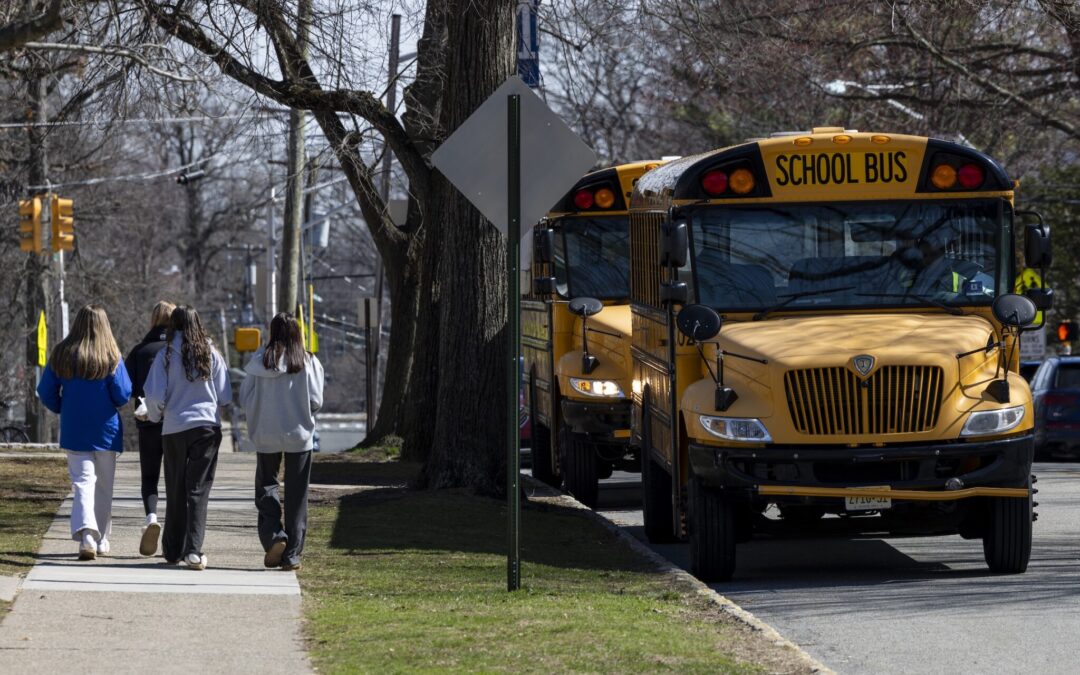
Photo by Anne-Marie Caruso/New Jersey Monitor