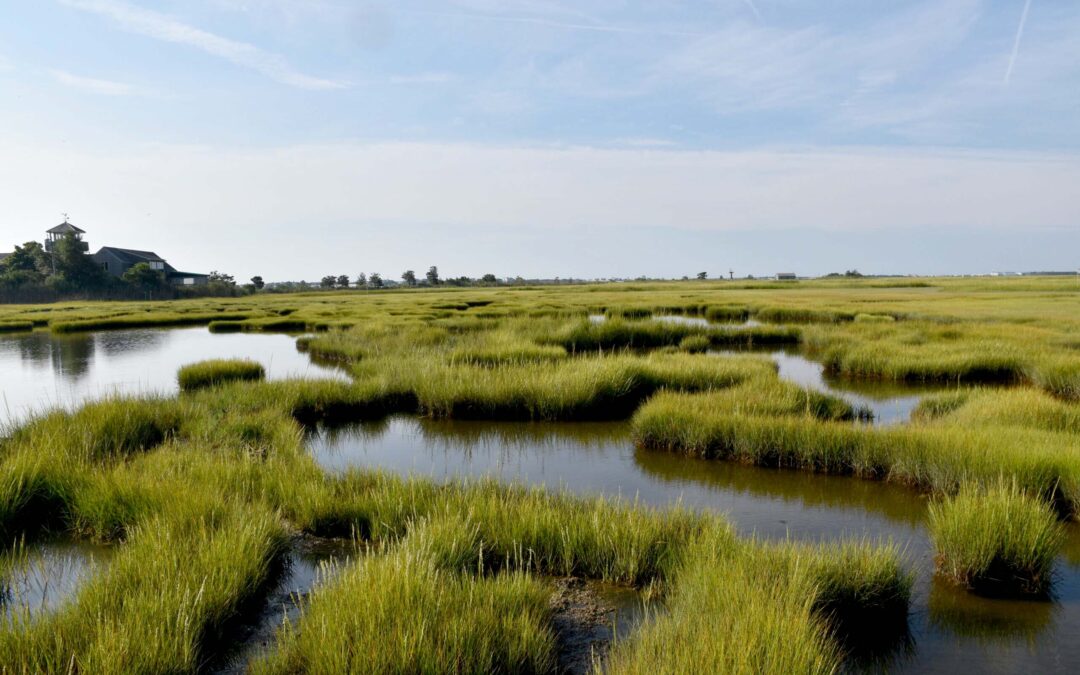
To many visitors, the vast expanse of salt marsh stretching toward the back bays is simply part of the scenery. But beneath the grasses lies one of South Jersey’s greatest defenses against coastal flooding, storm surge and erosion — and one of its most threatened ecosystems.
As sea levels continue to rise, New Jersey’s salt marshes are disappearing faster than they can naturally rebuild themselves. Scientists estimate the marshes surrounding The Wetlands Institute alone have lost more than 30 percent of their acreage since the 1950s, and without intervention, another 30% could disappear by the middle of the century.
That is why researchers are looking beyond traditional shoreline protection and investing in nature-based solutions that strengthen the coast from the ground up.
One of the most promising examples is Scotch Bonnet Island, a small tidal marsh located in the back bays west of Stone Harbor near The Wetlands Institute. Although relatively small in size, the marsh has become an important testing ground for restoration techniques that could help preserve wetlands throughout South Jersey and beyond.
One year after completing the first phase of restoration there, scientists say they are already seeing encouraging signs that the marsh is recovering.
More than just open space
Salt marshes are among the hardest-working ecosystems along the Jersey Shore.
Their dense grasses slow incoming water during storms, absorb wave energy and help reduce flooding in nearby communities. Their roots stabilize sediment, helping shorelines withstand erosion, while also filtering pollutants from coastal waters.
Marshes are more than environmental assets — they are natural infrastructure that quietly protects homes, businesses and local economies every day.
Yet these ecosystems face increasing pressure from sea-level rise.
As tides rise higher and remain on the marsh longer, grasses begin to die. Without vegetation to trap sediment and build elevation, marshes gradually sink below the water’s surface, eventually becoming open bays.
Without healthy marshes, coastal communities become increasingly vulnerable to flooding while losing habitat that supports wildlife, recreation and commercial fisheries.
A nursery for coastal wildlife
At first glance, New Jersey’s salt marshes may appear quiet—a landscape of waving grasses, winding tidal creeks and shallow pools stretching toward the horizon. In reality, they are among the most productive ecosystems on the East Coast, supporting an extraordinary diversity of life both above and below the water.
The dominant marsh grasses, including smooth cordgrass and saltmeadow hay, provide shelter and food for countless species while helping stabilize the marsh’s muddy soils. Twice each day, the tides flood the marsh with nutrient-rich water, creating ideal conditions for fish, shellfish and invertebrates to thrive.
Many of the fish that populate New Jersey’s bays and coastal waters begin their lives in these protected wetlands. Juvenile summer flounder, striped bass, bluefish, Atlantic menhaden and killifish use the marsh creeks as nurseries, where dense vegetation and shallow water offer protection from larger predators. Blue crabs forage among the grasses, while fiddler crabs and ribbed mussels help aerate the soil and improve water quality.
The marshes are equally important for birds. Great blue herons, great egrets, snowy egrets and glossy ibises stalk the tidal pools in search of fish and crustaceans. Ospreys soar overhead, while clapper rails, willets and seaside sparrows depend almost entirely on healthy salt marsh habitat for nesting and raising their young.
Each spring, migrating shorebirds—including the federally threatened red knot—stop along New Jersey’s coast to rest and refuel before continuing thousands of miles to Arctic breeding grounds. Many rely on the rich feeding grounds found in and around marshes, making these wetlands an essential link in one of the world’s great wildlife migrations.
The marshes also provide critical habitat for diamondback terrapins, the only turtle species in North America that lives exclusively in brackish coastal waters. Females emerge from the marshes each summer to lay their eggs on nearby sandy uplands before returning to the tidal creeks.
Beyond supporting wildlife, healthy marshes improve water quality by filtering excess nutrients and trapping sediment. They also store significant amounts of carbon in their soils, making them an important natural ally in addressing climate change while protecting nearby communities from flooding and storm surge.
“When people look across the marsh, they often see open space,” conservationists say. “In reality, it’s a living, breathing ecosystem that supports the entire health of our coastal environment.”
A living laboratory
Recognizing the urgency of the problem, The Wetlands Institute partnered with the U.S. Army Corps of Engineers and the New Jersey Department of Environmental Protection to launch the Seven Mile Island Innovation Lab, an initiative focused on developing practical, science-based solutions for marsh restoration.
Completed in fall 2024, the Scotch Bonnet Marsh Enhancement Project restored approximately 5.5 acres of low-lying marsh by placing beneficially reused dredged sediment across the marsh surface. The additional material raised portions of the marsh by as much as 2 feet — enough to restore elevations that allow native marsh grasses to survive and thrive once again.
Rather than relying on seawalls or hard infrastructure, the project works with natural tidal processes, allowing vegetation to reclaim the marsh over time. Researchers say the results after one year have been encouraging.
Monitoring shows the restored marsh has stabilized at the elevations scientists intended, while native marsh grasses have already begun naturally recolonizing the area. Based on similar restoration projects completed elsewhere in southern New Jersey, researchers expect the marsh to become fully vegetated within about three years.
“One year after construction, we are again seeing indications that restoring marsh elevation can help reverse the trajectory of marsh loss,” said Dr. Lenore Tedesco, executive director of The Wetlands Institute. “This project demonstrates how working with natural processes can reverse marsh loss, rebuild marsh function, support wildlife and strengthen the resilience of threatened coastal systems.”
Looking ahead
The Wetlands Institute plans to continue monitoring Scotch Bonnet Island while expanding restoration efforts throughout the surrounding marsh complex.
A recently awarded $3.075 million grant through New Jersey’s Regional Greenhouse Gas Initiative Natural Climate Solutions Program will fund the Salt Marsh Trail Revitalization Project, restoring additional marsh habitat, improving conditions for at-risk wildlife and elevating portions of the Institute’s popular Salt Marsh Trail.
For more than 50 years, The Wetlands Institute has combined scientific research, conservation and environmental education to protect New Jersey’s coastal ecosystems. Through research, habitat restoration and public outreach, the nonprofit works to ensure that future generations inherit healthy wetlands capable of protecting both wildlife and the communities that call the Jersey Shore home.
As restoration efforts continue at Scotch Bonnet Island and other marshes, Institute leaders say community support remains essential. Donations help fund scientific research, habitat restoration projects, wildlife conservation and educational programming that inspires the next generation of environmental stewards.
Those interested in supporting the Institute can become members, make a one-time or recurring donation, volunteer, or participate in one of the organization’s many public programs throughout the year. More information is available at wetlandsinstitute.org.