
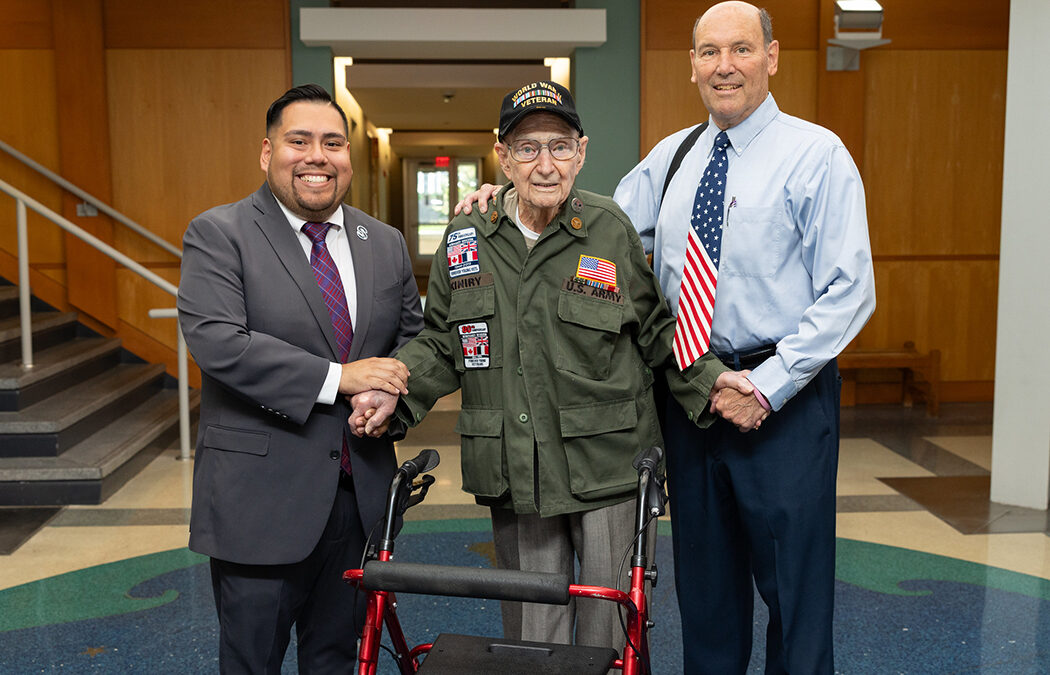
Sgt. Andrew “Tim” Kiniry landed on Omaha Beach on June 16, 1944, 10 days after D-Day, and later that year participated in the Battle of the Bulge, Germany’s last major offensive of World War II.
But nothing prepared the 45th Evacuation Hospital Combat Medic for what he would witness on April 28, 1945.
“We were put in the back of trucks and not told anything, which was the Army’s deal – you never knew where you were going,” Kiniry said on April 16 during a talk at Stockton University. “I didn’t know the first thing (about Buchenwald concentration camp). We pulled inside the gates and we came across an odor of which I can never describe. It was terrible.”
The 104-year-old from Minotola addressed a group of more than 100 students and community members during a talk moderated by Stockton adjunct professor Doug Cervi and sponsored by Stockton’s Sara and Sam Schoffer Holocaust Resource Center (HRC), the Jewish Federation of Atlantic and Cape May Counties and the Board of Jewish Education of Atlantic and Cape May Counties.
His testimony was recorded as part of the center’s mission to share the history of the Holocaust and life stories of Holocaust survivors of southern New Jersey. Fewer than 45,000 of the 16.4 million Americans who served in World War II are still living, according to the National WWII Museum.
“Tim’s courage helped shape the world we inherited, and his presence reminds us that history is not distant, it is sitting right here,” said Irvin Moreno-Rodriguez, the director of the HRC in introducing Kiniry. “We stand here today because heroes like you sir stood firm when the world needed you the most.”
Kiniry, who was presented with an honorary Doctor of Public Service degree last year by Stockton, spoke about the two weeks he spent treating the approximately 21,000 survivors at Buchenwald in Germany shortly after U.S. forces liberated the camp from the Nazis on April 11.
“We saw the people standing there and I thought, ‘Are they real? Are their clothes real?’ Because a lot of their clothes were tattered,” he said.
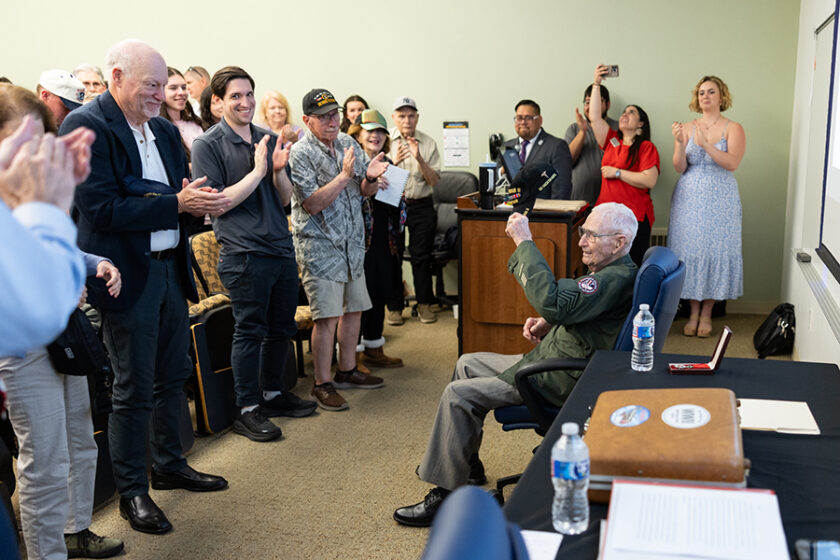
Kiniry said the first thing they tried to do was clean up the survivors by setting up showers in tents.
“But we had a problem getting them to go in these tents. They were afraid of being gassed,” he said referring to how Jews in concentration camps were told the gas chambers were “showers.”
After the survivors showered and dried off, Kiniry said they were sprayed with DDT because they were covered in lice.
“Some of them had to be washed by hand, but you had to be careful because without much trouble you could push their bones through their skin. They were just skin and bones. It was terrible,” he said.
Kiniry also spoke about how deliberate they had to be when feeding the survivors.
“Some of them got a hold of some food and they ate it, but it killed them. They just took too much, too quick and their stomachs couldn’t handle it,” he said. “We had to give them chocolate milk, eggnog and candy bars to build them up, which did help.”
After his testimony, Moreno-Rodriguez told the audience that remembering what Kiniry did and the survivors he helped isn’t enough.
“It is now our obligation, our responsibility, to ensure that the courage of those who came before us continues to illuminate a path forward,” he said. “May we honor Tim’s service and the service of other American service members. Let us honor them not only with our words, but with the choices we make and the responsibilities we now, all in this room, choose to accept.”
Stockton junior Kylie Fitzpatrick said she was moved by hearing Kiniry’s testimony in person. The Historical Studies major, who contributes to social media for the HRC, felt it was especially important to record Kiniry’s story for others who could be at the event.
“I really appreciate that he came and took the time to talk to us, and I feel like he didn’t want to stop, which was a good thing,” said the Forked River resident. “I was just excited to hear the next thing that he was going to talk about. Now, it’s our responsibility to share it.”
Té Sammons ’25, a graduate assistant for the HRC, was also thankful Kiniry’s testimony will be preserved for future generations.
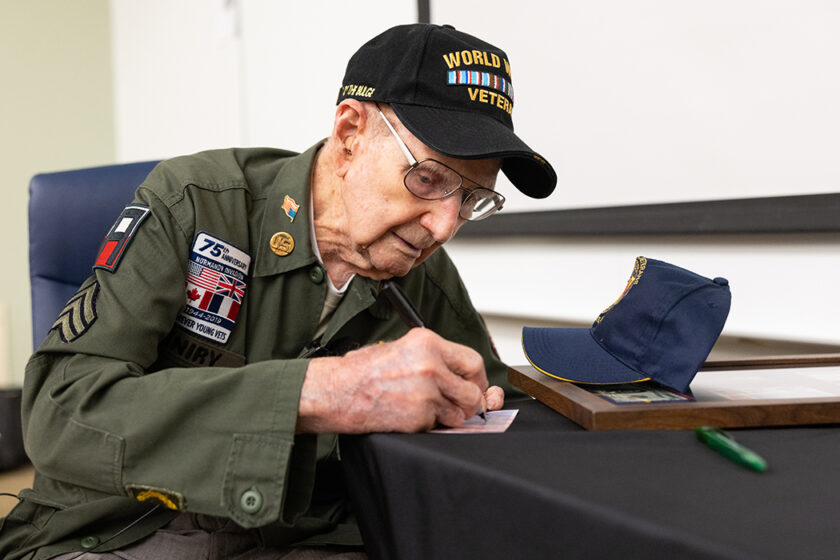
“We have people that are from this era that are unfortunately passing and their stories will pass with them if we aren’t able to hear them,” said the Master of Business Administration student from Minotola. “Events like this are super important and especially timely. We are at a point, especially in our political environment, that we in the younger generation would say history looks like it’s repeating in many ways.”
Kiniry took questions from the audience, including one from Leah Lederman, of Vineland, whose father, Herschel, was in Buchenwald during the war.
“The importance is that (the Holocaust) isn’t forgotten. It should be told. It should be taught. It should be understood,” she said. “Stockton is playing a crucial, crucial part of history now for the future, documenting the history of survivors.”
After the presentation, Kiniry was also made an honorary Jewish war veteran by the Jewish War Veterans Garr-Greenstein-Friedenberg Post 39 in Margate.
Photos Credit: Susan Allen/Stockton University