
I was going to write this column anyway, but with the 2016 Challenge spreading throughout the internet, this came at a perfect time.
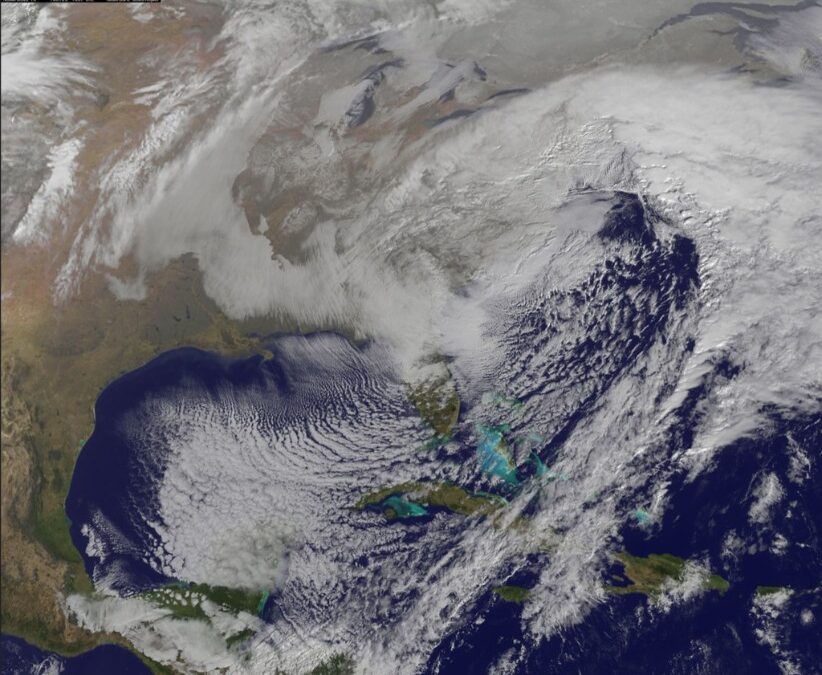
The Blizzard of 2016 happened Jan. 22 to 24 of that year. The Weather Channel named it Winter Storm Jonas, which is how many of us know it today.
It came with high winds, rounds of significant coastal flooding, extreme cold and, of course, snow. This nor’easter had it all, enough to make this the fifth most impactful northeast winter storm since records began in 1956, according to the National Oceanic and Atmospheric Administration (NOAA). For context, that’s between the slightly weaker Presidents Day II Blizzard of 2003 and the much stronger Blizzard of 1996.
Sadly, at least eight people died, according to NJ.com, and over 100,000 homes and businesses were without power. Moody’s Analytics estimated $4 billion in damage on the East Coast, in December 2025 dollars.
Jonas is a good reason why my weather dad, Jim Eberwine, always says that we have a 12-month hurricane season here at the shore. Nor’easters around here are feared more for their flooding and wind than the snow itself.
Flooding rivaling Sandy
For those south of Brigantine, where Superstorm Sandy made landfall four years earlier in 2012, the Blizzard of 2016 brought even more significant flooding.
Two rounds of flooding affected the Jersey Shore the mornings of Jan. 23 and 24. The combination of powerful, onshore winds, and the near-full moon drove feet of saltwater into beach towns in some locations.
In Cape May Harbor, the NOAA tide gauge reached a record 9.36 feet above mean lower low water. That was more than a half foot higher than Sandy. Below are others that had a higher crest than Sandy.
Delaware Bay (Cape May):
- 8.98 feet in Jonas
- 8.89 feet in Sandy
- North Wildwood:
- 9.44 feet in Jonas
- 8.9 feet in Sandy
Nearly every tide gauge, from Cape May to Tuckerton, was in major flood stage on Jan. 23. That made travel nearly impossible around the high tide (snow and ice aside) and brought water into homes and businesses that rarely see it.
Farther north through Sandy Hook saw moderate flooding, similar to the flooding we had during the October 2025 nor’easter. Generally the flood level was 3 to 4 feet above normally high ground along the South Jersey shoreline.
There were concerns about saltwater freezing on the roads on the nights of Jan. 23 and 24, as temperatures fell into the 20s. However, that mostly did not occur.
Whipping winds
Power outages were a problem for many at the Jersey Shore. Onshore winds were fierce and drove tidal flooding.
Strathmere had the highest gusts at the South Jersey Shore, topping out at 64 mph at 6:28 a.m. on Jan. 23, according to the National Weather Service. Several places gusted at or over 60 mph, including Ocean City, Cape May and Pleasantville.
However, the strongest winds were in Ocean County. Good Luck Point in Bayville took the top mark statewide at 72 mph. Good luck standing in that. Other Ocean County gusts on Jan. 23 included:
- Tuckerton: 68 mph
- Harvey Cedars: 64 mph
- Beach Haven: 62 mph
- Lakewood: 61 mph
- Seaside Heights: 61 mph
- Holgate: 61 mph
- Beach Haven: 60 mph
Beyond that, many beach towns, from Sea Bright to Cape May, gusted to at least 50 mph once.
A decent amount of snow
The fierce winds blew and snow drifted feet high. However, snow was more of a concern for inland folks rather than people in shore and beach towns.
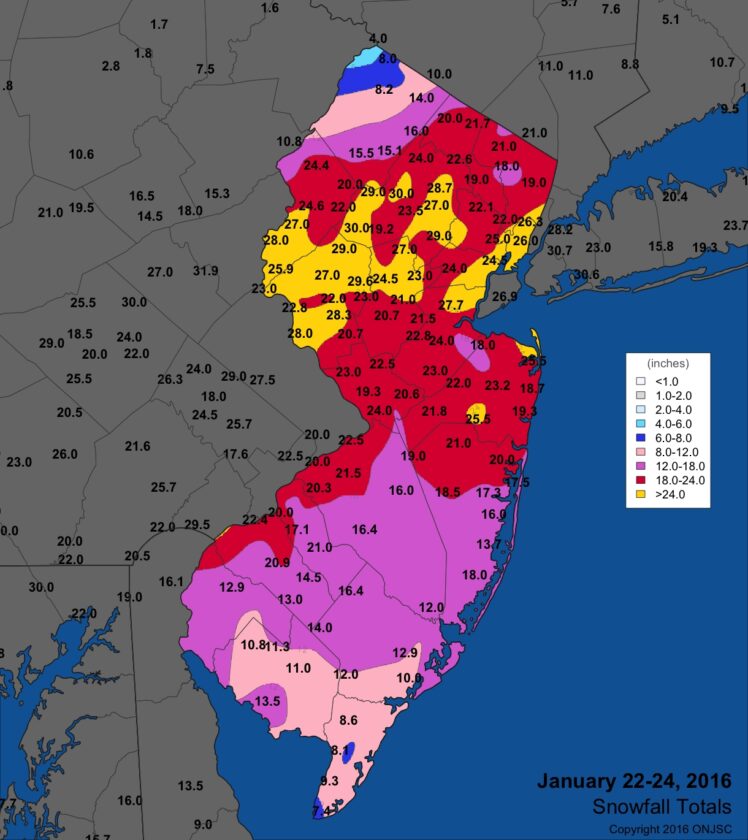
The highest snowfall totals reported in Atlantic and Cape May counties were 17.5 inches in Buena Vista Township. Closer to the coast, Atlantic City International Airport picked up 12.9 inches. Wildwood Crest had 11.3 inches and Woodbine had 8.6 inches, according to data gathered by the Office of the New Jersey State Climatologist.
In typical Jersey Shore fashion, we had a smorgasbord of precipitation types.
“Snow began falling in the south during the early evening of the 22nd, moving steadily northward,” said Dave Robinson, the New Jersey state climatologist at the time.
“The intensity of the storm grew overnight, with heavy snow falling by the morning of the 23rd, winds howling and ocean waters pouring into coastal communities at times of high tide… Early snow turned over into a mix of snow, sleet and rain in… coastal areas, before turning back to snow toward the storm’s end.”
Farther north, it was a high-end snowstorm. Ocean County picked up 12 to 21 inches of snow. Monmouth County’s lower snowfall total was just 16.5 inches in Colts Neck. Rumson picked up 25.5 inches while on the beach, Long Branch saw up to 21 inches. NOAA’s fifth-place ranking aside, the Jersey Shore hasn’t had a winter storm bring quite the combination of snow, wind and tidal flooding since.
The Blizzard of January 2022 saw 12 to 21 inches up and down the Jersey Shore. Drifts of snow were all around. Thankfully, there was no tidal flooding.
Just a few weeks before that, there was significant flooding and wind in the snowy nor’easter of Jan. 3, 2022 (I was freezing in my rain boots in a foot of water off the White Horse Pike in Atlantic City). Snowfall totals of 9 to 15 inches buried South Jersey in snow. Once you got to Exit 88 on the Garden State Parkway, barely an inch fell.
Is a big snow expected this winter?
I don’t believe so. As mentioned in our winter outlook column, this looks more like the season for medium-sized snows without major tidal flooding. The prevailing storm track doesn’t favor the types of low-pressure systems that form off the Florida or Georgia Coast, and increase in strength as they move north.
That being said, another bitterly cold outbreak is expected late in January through the first half of February. This may be a case of it being too dry to snow much. We’ll keep you updated.
Joe Martucci, a Certified Broadcast Meteorologist and Digital Meteorologist, is the President and Director of Meteorology for Cup A Joe Weather and Drone. You can connect with him at cupajoe.live.