Long before the girl singing groups of the 1960s came along and dominated the record business, there were two female singing groups that not only sold millions of records, but also had long and stellar careers on stage, radio, television and in the movies, beginning in the early 1940s and running through the 1980s.
Their celebrity was unprecedented and both groups were frequent visitors to Atlantic City through the decades.
The Andrews Sisters – Maxene, LaVerne and Patty – experienced their greatest popularity in the 1940s on radio, records, stage and in the movies. Their first hit record, made in 1937, was “Bei Mir Bist Du Schön.” Many hits, including “Boogie Woogie Bugle Boy,” “Don’t Sit Under the Apple Tree” and “Rum and Coca Cola,” sold in the millions.
The sisters were not beauty queens like the McGuire Sisters, but by way of their hit records, radio programs and personal appearances entertaining the troops, stateside and overseas, they parlayed their success into film appearances, albeit of the “B” variety.
The Andrews Sisters appeared in 17 feature films, including several with the comedy team of Abbott and Costello, and one real oddity – a low-budget picture called “How’s About It” that featured of all people, Buddy Rich and his Orchestra, who was contractually obligated at the time to play drums for bandleader Tommy Dorsey.
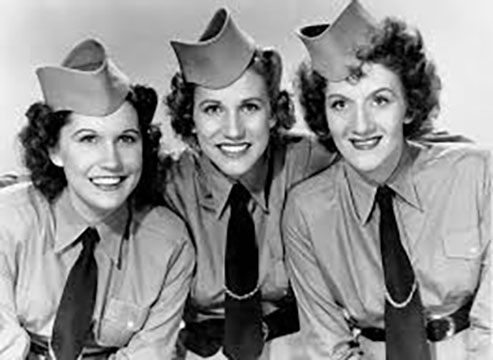
When not busy making films, records or entertaining the troops, The Andrews Sisters found time to visit Atlantic City.
The sisters’ first appearance on the Boardwalk was Sept. 5-6, 1942, on Million Dollar Pier. Their popularity grew to such an extent that they headlined at the Steel Pier the following summer. They didn’t visit the Steel Pier again until 1958.
Sadly, despite massive success, the group was beset by personal and professional problems through the years.
In 1951, Patty left the group to become a solo act. Maxene and LaVerne worked as a duo for several years until Maxene attempted suicide in 1954. In 1956, they reunited, but by then their style, firmly rooted in the swing era, was becoming passé. The group still recorded and toured with great success as a nostalgia act.
The unexpected success of Bette Midler’s “Boogie Woogie Bugle Boy” in 1973 led to a resurgence in interest in The Andrews Sisters, and the group continued to work – with Janie Sell in place of LaVerne, who died in 1967 – notably in a Broadway revue called “Over Here!” which ran successfully at the Shubert Theatre in New York City for a year. The show was supposed to go on the road, but the producers had money problems. The Shubert Theatre shows of 1974 marked the last time the sisters would sing together as a trio.
“The McGuire Sisters were fine once they stopped imitating The Andrews Sisters,” Maxene Andrews told radio host Joe Franklin in the 1970s. Though the McGuires were certainly influenced by the Andrews, the groups were quite different if only because the McGuires were from a different era.
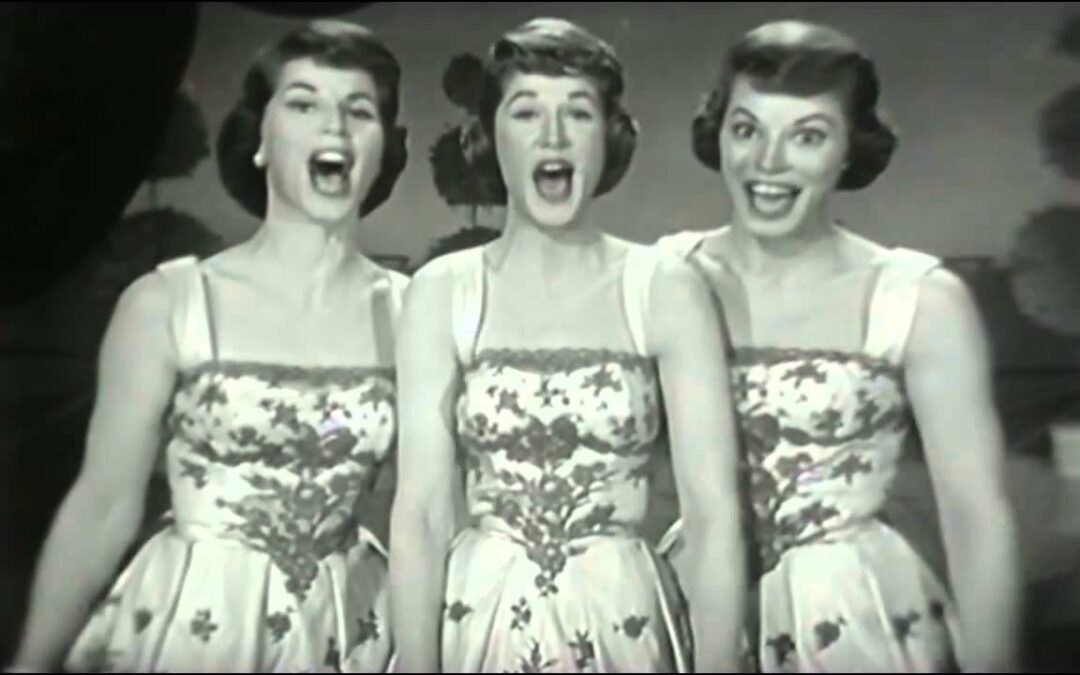
The McGuires’ first real professional shows were in 1949. During their heyday, Phyllis, Dorothy and Christine McGuire were marketed as glamorous beauty queens. Stylistically, their vocal harmonies were richer and hipper, and the material that was written exclusively for them reflected the optimism of the 1950s.
While The Andrews Sisters were working at the Steel Pier and singing “Don’t Fence Me In” and “I’ll Be with You in Apple Blossom Time,” The McGuire Sisters were hobnobbing with Frank Sinatra and appearing at Atlantic City’s 500 Club, in addition to the Steel Pier, where they worked in 1961.
They moved, and sometimes danced when they sang, and, on television at least, the group was a central part in some pretty fancy production numbers. The McGuire Sisters were hip. Until they weren’t.
Their records, like “Sincerely,” “Sugartime” and “Something’s Got to Give,” sold in the millions, and they performed as guests on just about every variety program on television. Things changed in the mid-1960s for most middle-of-the-road acts like The McGuire Sisters. Their final appearance was on an Ed Sullivan program of 1968.
Almost 20 years later, The McGuire Sisters decided to reunite, and one of the first stops on their new tour was Atlantic City.
“I’ve got nothing but fond memories of Atlantic City,” Phyllis McGuire said at the time. Six months after The McGuire Sisters sold out the Showboat, Phyllis McGuire made a rare, solo appearance in Atlantic City.
According to Bruce Chadwick of the New York Daily News, “One of the usually inseparable trio of sisters has taken the lead in ‘Applause.’ Phyllis McGuire saw Lauren Bacall in ‘Applause’ on Broadway three times. She fell in love with the show. She wanted to star in the show. Now, 18 years later, McGuire’s dream is coming true. On Wednesday, Phyllis opened in ‘Applause’ at the Claridge Hotel.
“Not only has it been 18 years since she saw ‘Applause,’ but it’s been more than two decades since McGuire has been onstage in a play or musical. Is she nervous? ‘You better believe I am,’ says the ‘middle one’ of the fabled McGuire Sisters, who were reunited as a group in 1986 in Atlantic City and still perform together frequently. But McGuire isn’t panicky or nervous. ‘I feel very, very comfortable in this play and the reason is it’s a play written for someone just like me, someone just like Bacall. Besides, I’m all alone this summer because my two sisters decided they didn’t want to work and are off on vacation.’”
The McGuires’ last public appearance was in 2004, when the sisters got together again to perform in a Public Broadcasting fundraiser. John Sforza, biographer of The Andrews Sisters, watched The McGuires in that telecast and commented, “The sisters’ command of their vocal cords and harmonious blend, perhaps the most impressive of any trio before or since, had not significantly diminished.”
Wisely, they went out on top.