
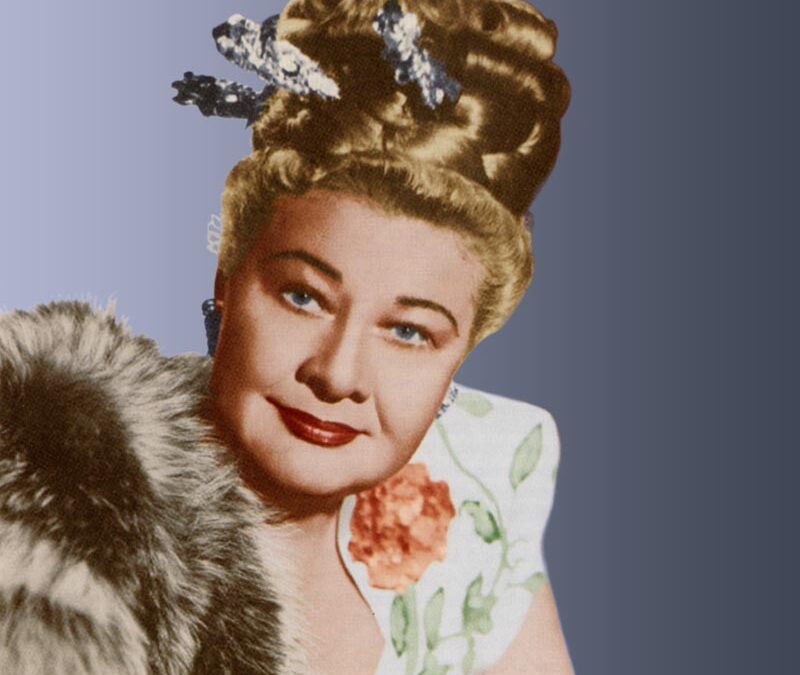
Sofia Kalish was born on Jan. 13, 1887, in Tulchyn – part of the Russian Empire. Kalish and her family immigrated to the United States the following year and settled in Boston before moving to Hartford, Connecticut, where her father opened a restaurant.
Young Sofia began singing for the customers, and they loved it. She thought she might be headed to a career in show business, but that dream was temporarily sidetracked.
At age 17 she eloped with a beer cart driver named Louis Tuck, and in 1905, they had a son. The couple separated not long after. Kalish left the child with her family and took off for New York City to try her hand at performing. Around 1907, she made her first appearance on stage as Sophie Tucker.
Tucker, who performed frequently in Atlantic City until her passing in 1966, was a remarkable entertainer. Though she was no raving beauty, her show and her songs were on the bawdy side for the time – “Nobody Loves a Fat Girl, But Oh How a Fat Girl Can Love” is one example – but her showmanship, good humor and risqué stage attitude combined to make her a certifiable hit.
Her debut visit to Atlantic City came in 1909 while she was performing with the prestigious Ziegfeld Follies. According to writer John Kenrick’s profile of Flo Ziegfeld, written for the Musicals101.com website, the star of the show was a singer named Nora Bayes.
“After singing one of her big numbers, ‘By the Light of the Silvery Moon,’ Bayes threw a series of tantrums when newcomer Sophie Tucker won cheers during her Atlantic City tryout,” Kenrick wrote. “Ziegfeld tried to appease Bayes by cutting Tucker down to one song, but Bayes left in a huff a few weeks after the New York opening. Ziegfeld brought in vaudeville star Eve Tanguay, who took over Tucker’s number. But it was Tucker who went on to lasting stardom, refusing to ever work for Ziegfeld again.”
In all probability, the show was presented at Nixon’s Apollo Theatre, on New York Avenue in Atlantic City.
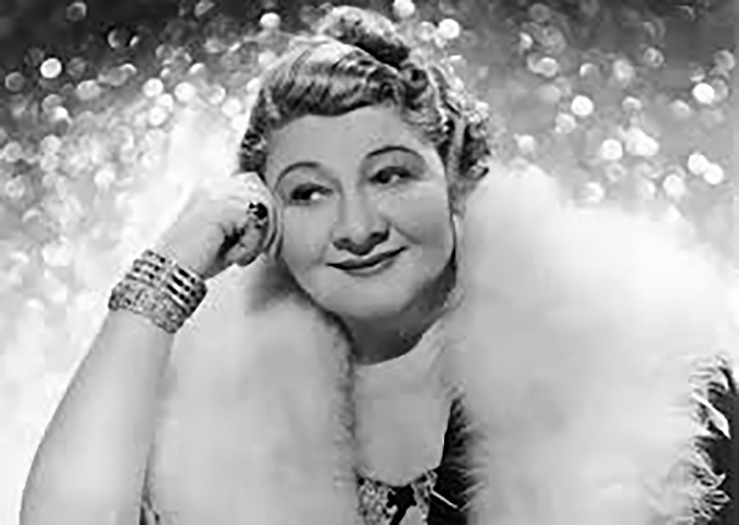
Tucker lost no time securing other work after she was bounced from the Follies. Given that she was deemed the show’s star, she ended up headlining at Atlantic City’s Criterion Theatre, opposite Steel Pier. This was her first appearance as a real headliner.
From the opening of the city’s Garden Pier in July of 1913 through 1934, the pier housed B.F. Keith’s Theatre, which presented a number of first-run plays. Some time in the 1920s, Tucker appeared with silent film matinee idol Douglas Fairbanks at Garden Pier.
Her career began to really take off. Billing herself as “The Last of the Red Hot Mamas,” Tucker’s hit recordings, including her theme, “Some of These Days” and “My Yiddishe Momme,” helped cement her fame, which had already spread to Europe.
In the mid-1920s, she toured Europe, performed for King George V, and re-released “Some of These Days,” which sold 1 million copies by 1926. By 1929, Hollywood was beckoning, and Tucker made her first film appearance that year in a movie called “Honky Tonk.”
Her show changed little for five decades. In his biography of pianist Irving Fields, Tony Sachs wrote that Tucker’s “sexual appetite was a frequent subject of her songs, unusual for female performers of the day after the decline of vaudeville. Tucker’s comic and singing styles are credited with influencing later female entertainers, including Mae West, Carol Channing, Totie Fields, Joan Rivers, Roseanne Barr, Ethel Merman, Cass Elliot of the Mamas & the Papas, and Bette Midler, whose stage character ‘Soph’ is a tribute to Tucker.”
While Tucker often publicly credited Atlantic City with being the place that helped make her a star, what really cemented her association with the city took place in 1946.
By that point, she had transitioned into radio, which included stints as a guest star and host of her own program, “The Roi-Tan Program with Sophie Tucker” (Roi-Tan was a popular cigar of the time). Further, she continued playing the nation’s top night spots; in the mid-1940s, one of the nation’s top night spots was Atlantic City’s legendary 500 Club.
The story of the meeting of comics Dean Martin and Jerry Lewis at the 500 Club has been told countless times, but Tucker’s role in helping them become overnight sensations has not been detailed often.
Tucker was a semi-regular at Paul “Skinny” D’Amato’s popular nightspot since the club began booking name talent.
Jonathan Van Meter, in his landmark book, “The Last Good Time,” the story of the 500 Club and Skinny D’Amato, wrote about what happened.
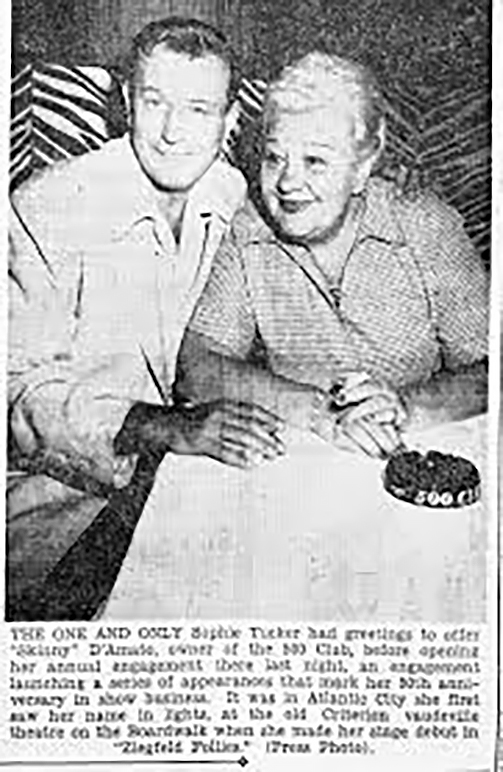
“On July 26, 1946, Skinny and his partner Irvin Wolf booked the 62-year-old legend Sophie Tucker into the back room, where the gambling took place,” Van Meter wrote. “Tucker began appearing in Atlantic City as early as 1909, during the resort’s vaudeville heyday. Skinny quickly realized that she brought in gamblers. She would become a mainstay at the nightclub and one of Skinny’s dearest friends, appearing there many times until her death some 20 years later.”
Tucker wandered into the showroom where Martin and Lewis were making their debut that night, and as the story goes, D’Amato was in the process of deciding whether or not to keep the smooth crooner and the manic young comic.
Tucker watched the act, called Skinny over and reportedly said, “Skinny, do yourself a favor. Keep these guys and let them do what they’re doing tonight.” Thus, two stars were born, thanks to “The Last of the Red Hot Mamas.”
D’Amato often named Tucker and Frank Sinatra as among his closest friends, and in fact, when Sinatra made the 1957 film “The Joker Is Wild,” a fictionalized account of the story of comic Joe E. Lewis, Tucker made a cameo appearance.
Tucker went where the work was, and by the 1950s, she was appearing on television variety shows like “The Tonight Show” and “The Ed Sullivan Show.”
Her last television performance was on “The Ed Sullivan Show” in 1963. Tucker sang “Give My Regards to Broadway,” “Louise,” and naturally, “Some of These Days.” In January of 1966, she appeared at New York City’s Latin Quarter. Several weeks later, on Feb. 9, she died.
In that she was “The Last of the Red Hot Mamas,” there was, indeed, no one to replace her.
Bruce Klauber is the author of four books, an award-winning music journalist, concert and record producer and publicist, producer of the Warner Brothers and Hudson Music “Jazz Legends” film series, and performs both as a drummer and vocalist.