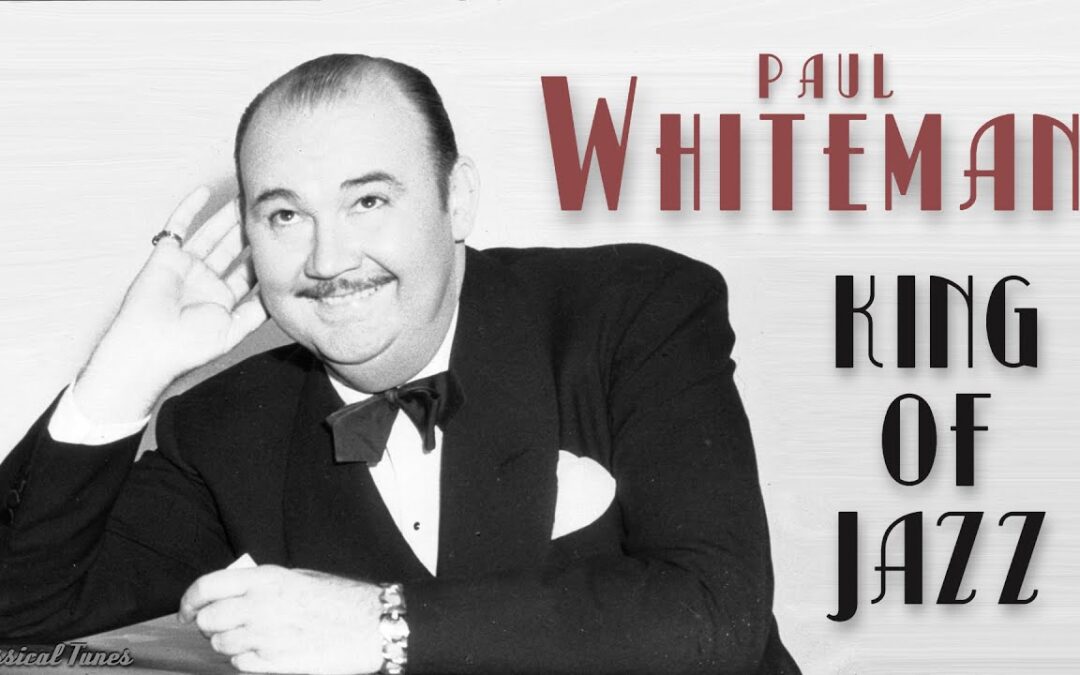
Ground-breaking bandleader Paul Whiteman may have been many things, but “The King of Jazz,” a moniker foisted on him in 1923 by a publicist during a photo shoot for a musical instrument manufacturer, was not one of them.
For the historically minded, what Whiteman did during the time he led his most famous ensemble – roughly 1920 through the early 1930s – was to orchestrate small-group jazz and introduce symphonic elements to hot music. Indeed, he commissioned “Rhapsody in Blue,” premiered by the Whiteman band with composer George Gershwin himself at the piano, and an orchestration by the iconic Ferde Grofé.
Furthermore, Whiteman introduced a number of future jazz legends to the general public, including trumpeters Bix Beiderbecke and Bunny Berigan, trombonist Jack Teagarden, and a young singer named Bing Crosby, who fronted the band’s singing group, The Rhythm Boys.
Whiteman was a frequent visitor to Atlantic City as well. He performed often, with Crosby in tow, at the Ritz Carlton’s Terrace Nightclub from the time of its opening in 1921, and he was an early and popular headliner at the Steel Pier. More than 100 years later, it’s difficult to put Whiteman’s enormous popularity into perspective. According to a jazz history timeline commissioned by the All About Jazz website:
“Whiteman became the most popular band director of the 1920s. In a time when most dance bands consisted of six to 10 men, Whiteman directed a more imposing group that numbered as many as 35 musicians. By 1922, Whiteman was earning over $1 million a year.” That would be about $19.3 million in 2026 dollars.
As a result of his popularity, in person and on record, and because he was quite the personality and the showman, he was able to successfully branch out into radio and motion pictures.
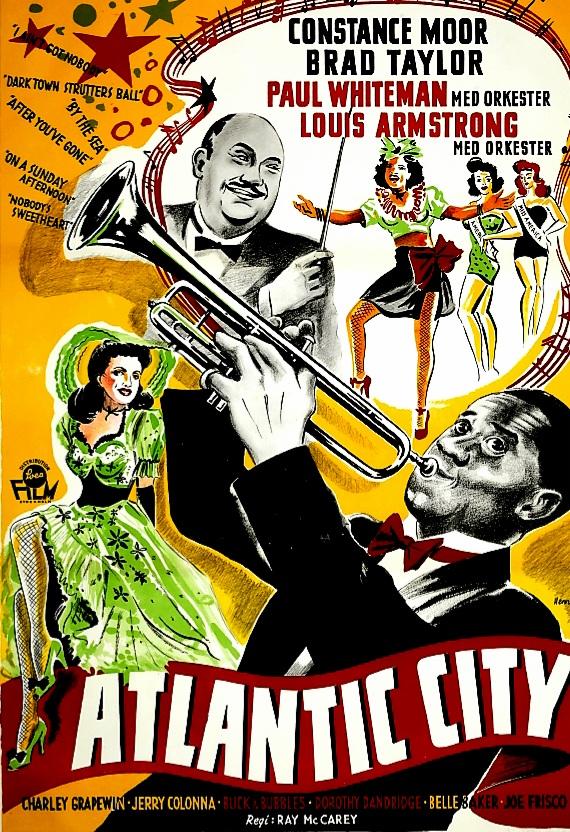
He began on radio in 1929 and had a program on the airwaves on and off until 1954. In the 1950s, he became music director for the ABC Radio Network, and also appeared in several films playing himself, including the 1944 film, “Atlantic City.” It was only a matter of time before he would sink his teeth into television.
Perhaps because the big band era was over by the time television became popular, big bands – no matter how charismatic the leader – just didn’t make it on the tube. Trumpeter Ray Anthony had a short-lived show sponsored by Chesterfield Cigarettes. Sweet bandleader Guy Lombardo starred in a syndicated show that aired briefly. Progressive jazz’s Stan Kenton tried his hand at something called “Music 55,” and the Dorsey Brothers starred in “Stage Show” for two seasons. None of them were highly rated.
On television, Whiteman was more successful than all of them. His first foray into television came in 1949 with a show called “The Paul Whiteman Goodyear Revue,” a variety show that lasted until 1952. This was followed by “Paul Whiteman’s TV Teen Club,” broadcast on ABC television from 1949 through 1954.
Iconic TV dance show host Dick Clark first hit the airwaves on Whiteman’s show doing commercials for Tootsie Roll. According to author John Jackson, author and Dick Clark historian, Whiteman’s show proved to be an inspiration for “American Bandstand,” WFIL-TV’s afternoon dance show hosted by Clark.
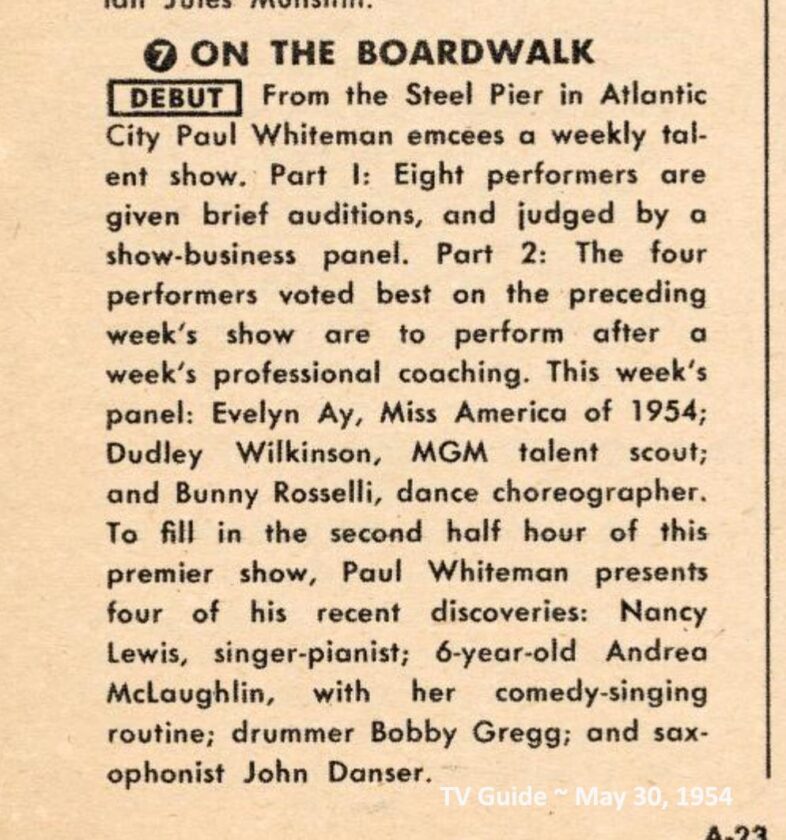
Whiteman then moved his television operation to the Steel Pier in Atlantic City. “On the Boardwalk with Paul Whiteman,” which aired on ABC on Sunday nights from May 30, to Aug. 1, 1954, may have been the first live television show ever broadcast from Atlantic City.
Taking a cue from Arthur Godfrey’s top-rated “Arthur Godfrey’s Talent Scouts,” each episode of Whiteman’s show featured eight young performers during the first half hour who were rated by a panel of four show business people. The top four performers returned the following week to perform again after having a week of professional coaching.
Among the program’s stars were second-line television personalities that included Olympic athlete Bob Mathias, golf pro Ben Hogan and singers Mindy Carson and Earl Wrightson. A press release issued in conjunction with the program’s premiere explained the features of the show:
“‘On the Boardwalk with Paul Whiteman’ centered on an amateur talent contest set against the vibrant backdrop of Atlantic City’s boardwalk, capturing the essence of a seaside vacation atmosphere through lively music, variety acts, and the summer resort vibe of the Jersey Shore. Broadcast directly from the Steel Pier in Atlantic City, New Jersey, the show aimed to showcase undiscovered performers while promoting the city’s attractions during its centennial celebrations.
“The format featured an amateur talent contest in the first 30 minutes, where six performers competed weekly in short acts, judged by a panel, with the top (four) advancing to the following episode for expanded performances. This competitive structure highlighted youthful talents aged 10 to 19, emphasizing quick, engaging routines to maintain viewer interest amid the boardwalk’s festive setting. The second half of the hour-long program shifted to professional entertainment, including musical numbers, comedy sketches, and appearances by established artists from Whiteman’s prior productions.”
Though the show was a low-budget, summer replacement series, ABC and Whiteman were serious about its production. According to the show’s notes.
“The program originated as an ABC initiative to provide summer replacement programming in 1954, capitalizing on the network’s need for affordable live content during the off-season.
“Whiteman was selected as host due to his established star power, extensive experience in live broadcasts, and ongoing role as ABC’s vice president and music director since 1948. The Steel Pier was selected as the show’s primary location to evoke a boardwalk atmosphere.”
Production wasn’t always easy back then, especially with a program emanating from the Steel Pier.
“Weather dependencies were notable,” read the show’s notes. “High temperatures during early broadcasts contributed to participant discomfort – host Paul Whiteman appeared in a dark blue suit while the audience was described as ‘limp’ from the heat – though no major disruptions were reported.
“Audience integration was facilitated through community involvement, as local merchants and hoteliers contributed $25,000 alongside the city’s $25,000 investment to cover costs and promote Atlantic City as a convention destination, effectively turning the production into a civic event that drew on summer tourists for energy and promotion.”
Whiteman’s final decade – he passed in 1967 – was spent in semi-retirement in his New Hope, Pa., home, though he made a number of appearances in the late 1950s and 1960s as a guest conductor, and played Las Vegas from time to time until 1962.
Today, if Paul Whiteman is remembered for anything, it’s likely for his “discovery” of Bing Crosby and for featuring trumpeter Beiderbecke, who would later be known as one of the most influential soloists in the history of jazz. Not a bad legacy for the man known as “The King of Jazz.”