
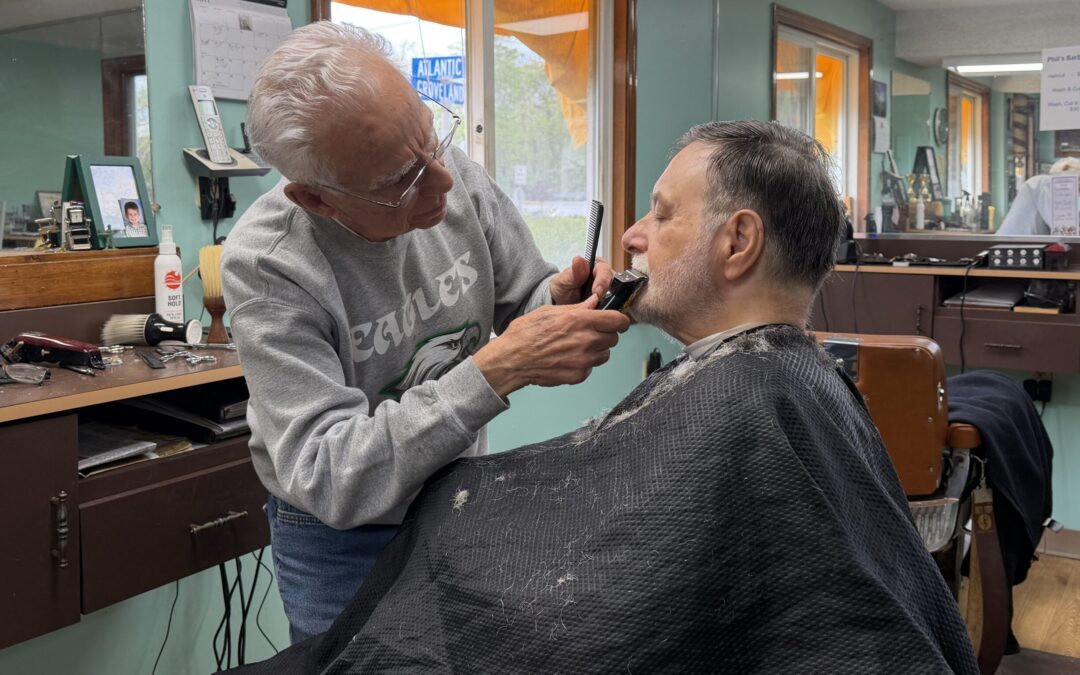
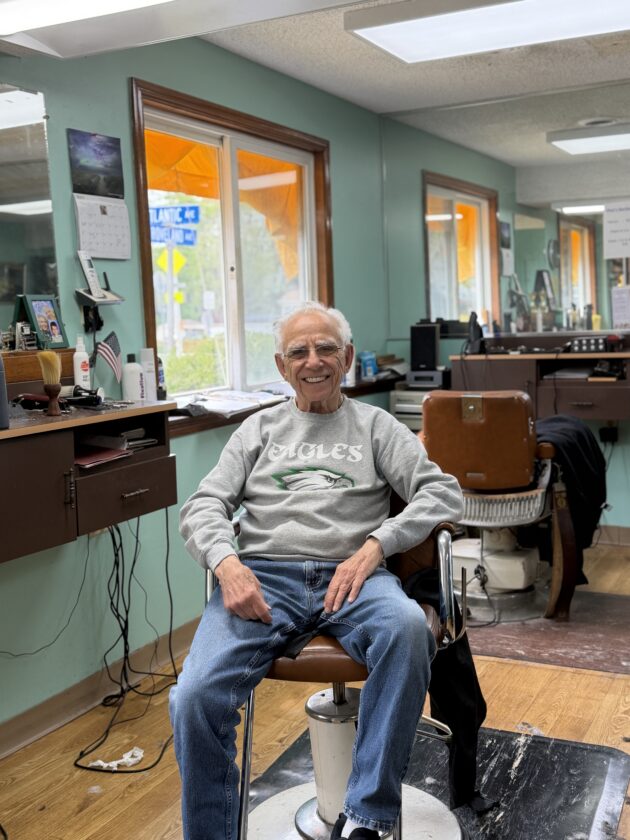
When Phil Huber learned that he’d been nominated as an inductee for the National Barber Museum Hall of Fame, he said he cried.
Huber, owner of Phil’s Barbershop & Hair Replacement on the corner of W. Groveland and Atlantic avenues, has become a mainstay in the South Jersey community and is being recognized for a career spanning nearly seven decades.
“To be recognized by your peers, is probably one of the highest honors you can receive,” he said with a soft smile.
Huber was nominated by John Phillips, a former counselor, consultant and graduate school instructor who has been a client of his for over 50 years.
According to its website, the museum honors those who have distinguished themselves by an outstanding contribution in the furtherance of the barbering profession.
“It is our firm belief that a great number of persons have contributed to the advancement of the barber profession and should be recognized. In this way we pay tribute to those persons who have endeavored to enhance the image of, and the working conditions for the barber,” said Mike Ippoliti, the museum’s curator and director, in his letter to Huber.
The induction ceremony will be at the museum’s 99th National Barber Board of America Conference in Charlotte, North Carolina.
Huber grew up in Ocean City and graduated from Ocean City High School in 1956 after playing on a state championship basketball team. He originally planned to attend Wesley College in Delaware on a basketball scholarship, but his father said he was too immature.
“He said If I went to college, I’d be home at Christmas for good,” Huber said.
Instead, he enlisted in the Army for two years. After returning home, he revisited the idea of college and reached out to his former basketball coach, Dixie Howell.
Howell told Huber that he could get him into Wesley College with all expenses paid.
But three weeks before freshman orientation, Huber’s life took a different turn.
The local barber, Ray Spurlock, who Huber had played basketball with, asked him if he’d like to become a barber. Huber weighed his options.
“I figured four years of college or nine months of barber school,” he said. “So I became a barber.”
At the time, barbering had not necessarily been his dream career. He said he originally wanted to become a high school basketball coach and history teacher. Still, his friendship with Berg and the promise of stable work helped shape his future.
“He said he’d send me to barber school,” Huber recalled. “And I told him, I can afford to go to school, just make sure I have a job when I get out. And that’s how I became a barber.”
Huber began working with Spurlock in 1958 and stayed there until 1984, when Spurlock moved to Florida. Huber purchased his current building in 1983 and officially opened Phil’s Barbershop the following year.
Over the years, Huber served in leadership roles within barber associations and developed close relationships throughout the industry. He said his favorite aspect of his career is the people he has met throughout the years — both away and in the community.
He frequently attended barber shows and conventions around the country, bringing information and resources back to local barbers in New Jersey.
“I could help a lot of people,” Huber said. “When I went to shows in other states, I would bring back the information.”
He also became heavily involved in advocating for barbers at the state level, working directly with officials in New Jersey’s Division of Consumer Affairs and helping fellow shop owners navigate licensing and regulatory issues.
“We worked well together,” Huber said. “And they passed a law in barbering.”
Huber said one of the profession’s biggest shifts came during the rise of the Beatles in the 1960s, when men’s hairstyles dramatically changed.
He said when he first started cutting hair, he learned how to perform regular men’s haircuts with flat tops. But when the Beatles rose in popularity, he had to learn how to cut and style long hair.
“They made me a better barber,” he said with a laugh.
Even after decades in the profession, Huber said he continues learning new techniques every day. Recently, he has focused on mastering modern skin fades.
Technology has also transformed how barbers learn, he said.
“Now we can go on YouTube and see them,” Huber said. “So it’s a lot easier today.”
At 87, Huber still cuts hair five days a week — sometimes six — while living right next door to the shop.
But eventually, Huber said he’ll pass the shop on to his grandson, Chris Scheibein, who recently returned to barber school. After graduating and gaining experience over the summer, Scheibein will apprentice at Phil’s, with Huber overseeing.